
Mining
Feeding run-of-mine ore from dump hoppers to primary crushers under heavy impact loads.
- Large, heavy, sharp material
- Reinforced cast steel pans
- High-manganese pan option

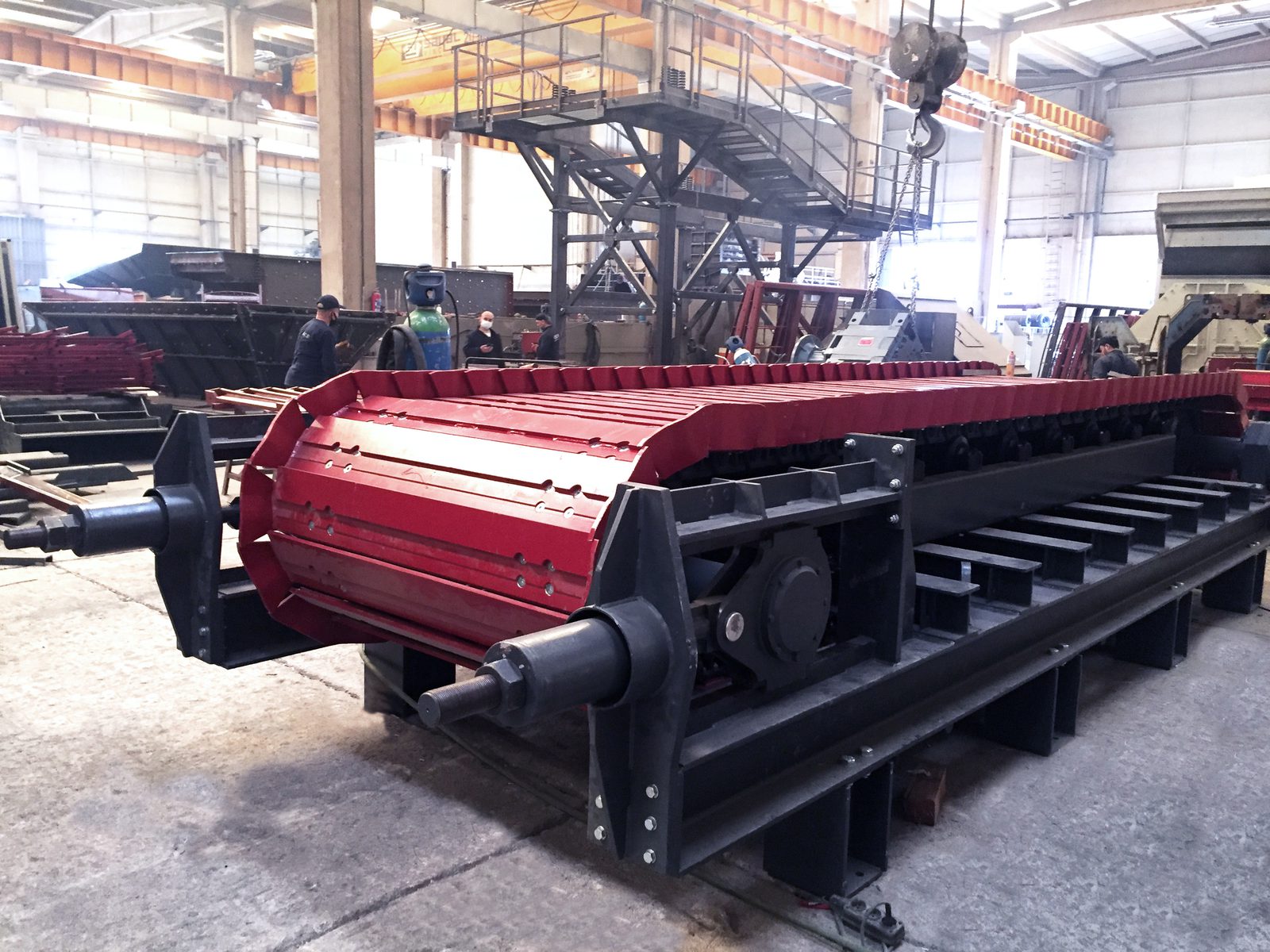
GELEN AF apron feeders are built for the toughest feeding duty: large, heavy and sharp run-of-mine material dumped straight from trucks. Overlapping cast steel pans on a heavy chain carry the load from hoppers or stockpiles to the primary crusher at a controlled, variable speed, with hydraulic chain tensioning and reinforced pans made for mining and aggregate operations. GELEN manufactures its apron feeders in Ankara, and has done since 1981.
Pans built for impact: reinforced cast steel pans with center packers run close to full-length impact rails, which prevents distortion under dumped rock.
Hydraulic chain tensioning: a hydraulic tail-end tensioning system with take-up screws keeps the chain at the right tension and makes adjustment simple.
Variable speed: the feed rate follows the crusher, from slow run-of-mine feeding to faster rates on smaller material.
Options for abrasive ore: high-manganese steel pans are available for particularly abrasive applications and extend service life.
AF series apron feeders are available in various widths and lengths to meet specific process needs. They ensure controlled feeding of run-of-mine material from hoppers or stockpiles to downstream equipment, delivering consistent flow and high efficiency. The overlapping pans move the material positively, so the feed rate follows the chain speed and the crusher is never flooded.
The robust construction features high-grade steel components: hot-rolled steel head shafts, reinforced cast steel pans with center packers running close to full-length impact rails, and a hydraulic tail-end tensioning system with take-up screws. A bolted sprocket design allows easy replacement, replaceable wear liners protect critical areas, and high-manganese steel pans are available as an option for particularly abrasive material.

| Widthmm | Lengthmm | PowerkW | Theoretical Capacityt/h | |
|---|---|---|---|---|
| AF2000 | 2,000 | 10,000 | 45 | 610–1840 |
| AF1800 | 1,800 | 8,000 | 37 | 500–1490 |
| AF1500 | 1,500 | 6,000 | 30 | 350–1040 |
Theoretical capacity is calculated for material with a bulk density of 1.6 t/m³, a bed depth of half the pan width and pan speeds of 4–12 m/min. Actual capacity depends on the material, lump size, skirt height and chain speed.
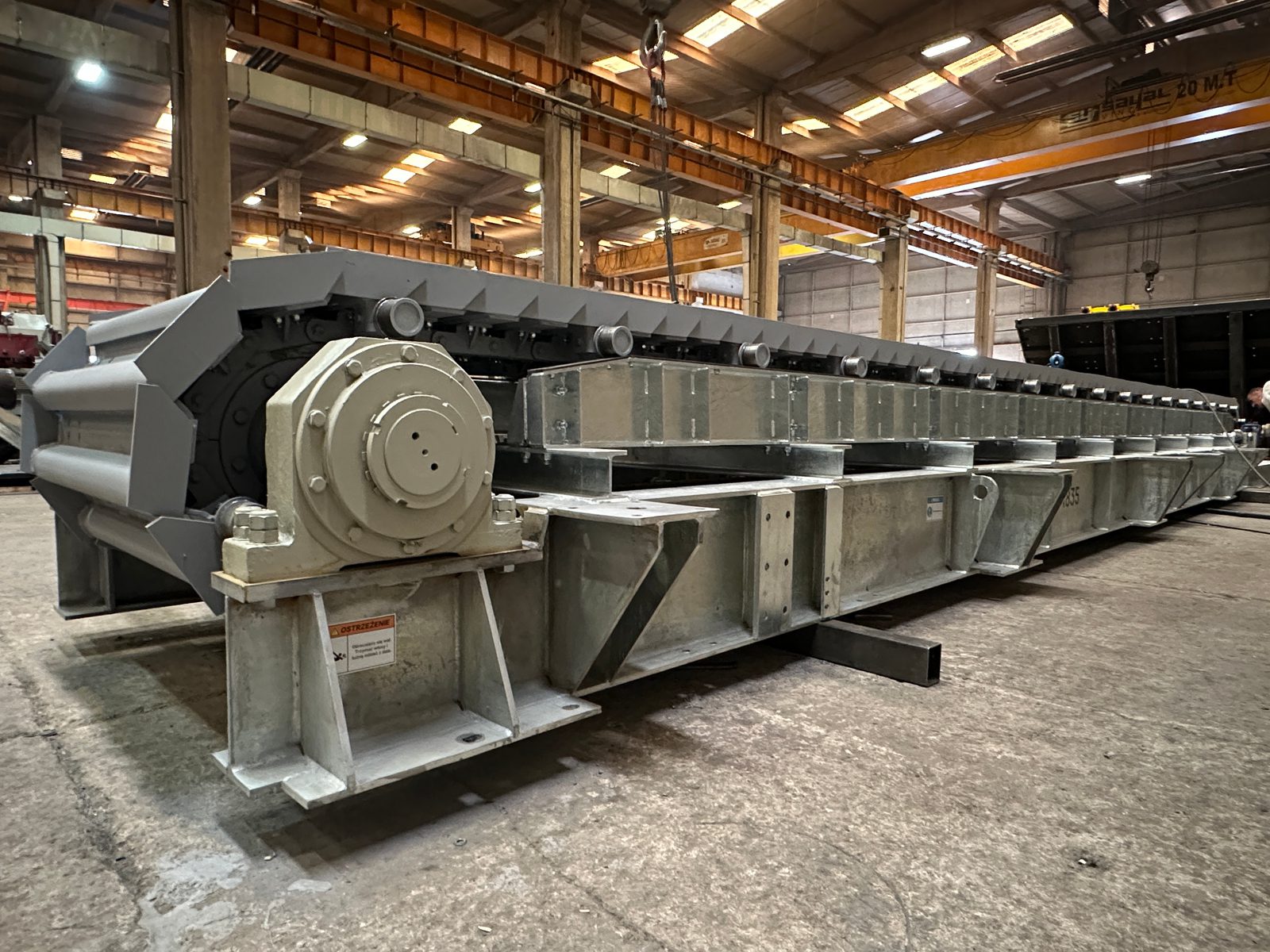
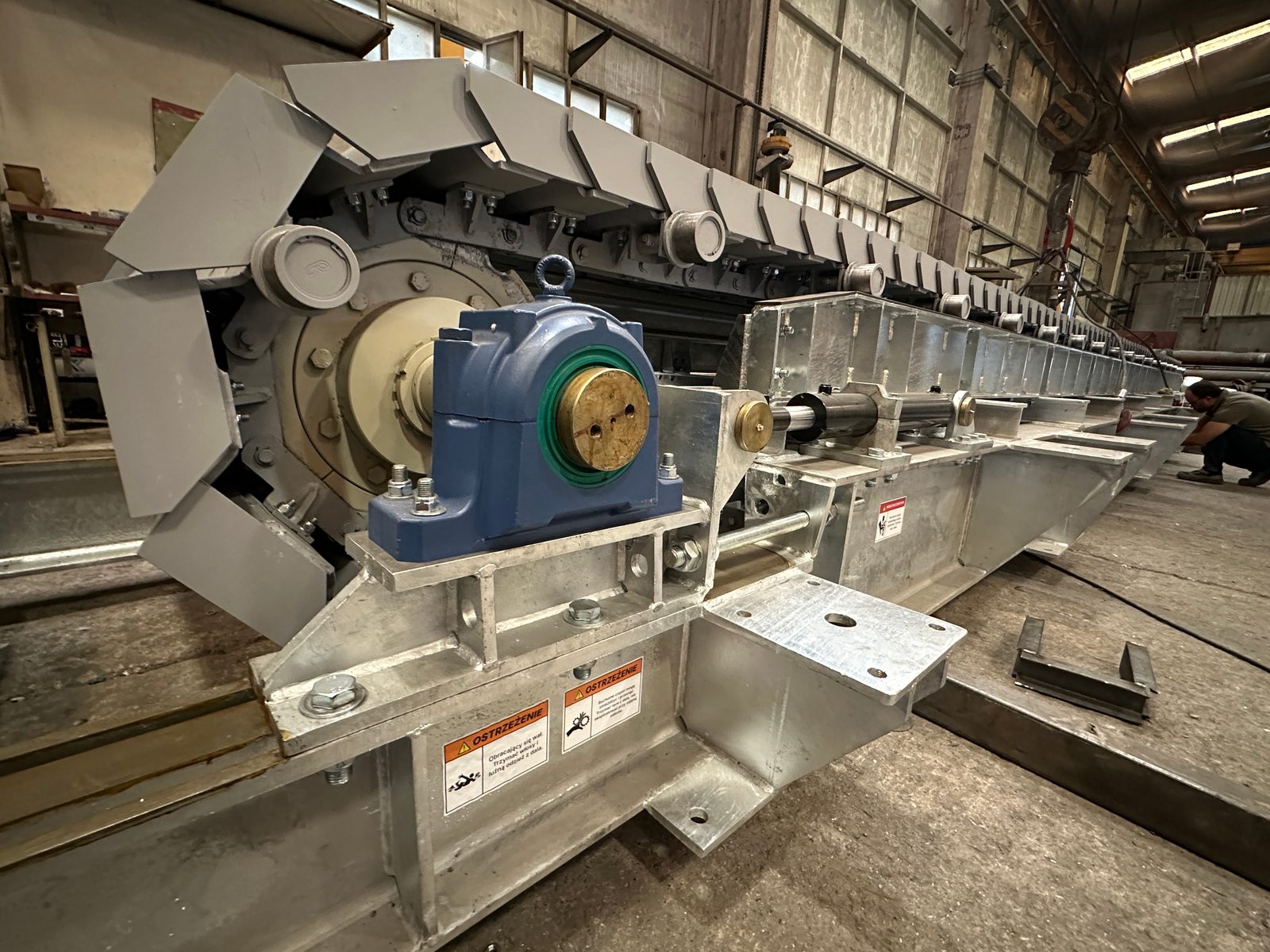
An AF apron feeder on the shop floor, before the skirts go on. Five things worth naming.
Each pan laps over the next, so fines cannot fall through onto the chain below. That overlap is why an apron feeder can sit under a dump hopper and take direct tipping.
The driven end. The sprockets set the pan pitch, and everything the drive does reaches the material through these teeth.
The pans run close to full-length impact rails, which is what stops them distorting under rock dropped straight from a truck. The rails carry the blow; the pans only carry the material.
Takes the impact of run-of-mine rock dropped straight from a truck. It is sized for the shock load, not for the running load.
Chain stretches as the links bed in. The take-up here is what keeps tension right without shortening the strand.
AF apron feeders are built as AF1500 (1,500 × 6,000 mm, 30 kW), AF1800 (1,800 × 8,000 mm, 37 kW) and AF2000 (2,000 × 10,000 mm, 45 kW), with other widths and lengths available to suit the process. Tell us the material, the largest lump size, the hopper arrangement and the tonnage, and GELEN engineering will size the feeder, drive and pans.
Every apron feeder is built to its duty. Send those numbers and an engineer comes back with a size, a drive and what it will do in your circuit.
Size one for meAn apron feeder is a very heavy conveyor made of steel pans, built to take impact and move large rock at low speed.
Trucks or loaders dump run-of-mine material into the hopper, onto a bed of material resting on the pans.
Overlapping cast steel pans on a heavy chain carry the load forward at a variable speed.
The chain speed sets the feed rate, so the crusher receives exactly as much as it can take.
At the head end the material drops into the primary crusher or onto a conveyor.
GELEN apron feeders handle the heaviest feed in mining, aggregate and recycling plants.
Feeding run-of-mine ore from dump hoppers to primary crushers under heavy impact loads.

Metering blasted rock to jaw and gyratory crushers at a controlled rate.

Drawing material from hoppers and stockpiles to downstream conveyors and equipment.

Feeding large demolition concrete and mixed debris that would damage lighter feeders.
What the AF series brings to heavy-duty feeding.
Pans with center packers run close to full-length impact rails, resisting distortion under dumped rock.
A hydraulic tail-end tensioning system with take-up screws keeps chain tension consistent and simplifies adjustment.
The feed rate is matched to downstream processing, from slow run-of-mine feeding to higher rates.
High-grade steel components carry the heavy loads of primary feeding.
A bolted sprocket design and replaceable wear liners make the most common service tasks quick.
High-manganese steel pans are available for particularly abrasive material, extending service life.
The apron feeder is the first machine under the dump hopper at heavy-duty primary stations.
Every circuit is different. Send us yours and we will say where an apron feeder fits and what it changes downstream.
Check my circuitBoth feed primary crushers. The size and weight of the material decide.
| Apron Feeder (AF) | Vibrating Feeder (TB / BE) | |
|---|---|---|
| Best for | Large, heavy, sharp run-of-mine material | Hard, free-flowing rock |
| Motion | Overlapping pans on a chain | Linear vibration |
| Impact loads | Very high, directly under dump trucks | High, with a material bed on the pan |
| Scalping | No | Yes, with a BE grizzly feed screen |
| Theoretical capacity | 350–1,840 t/h | 90–820 t/h |
See vibrating feeders and reciprocating feeders.
Not sure which one? Send us the duty and an engineer will say which, and what you would give up by choosing the other.
Which one fits?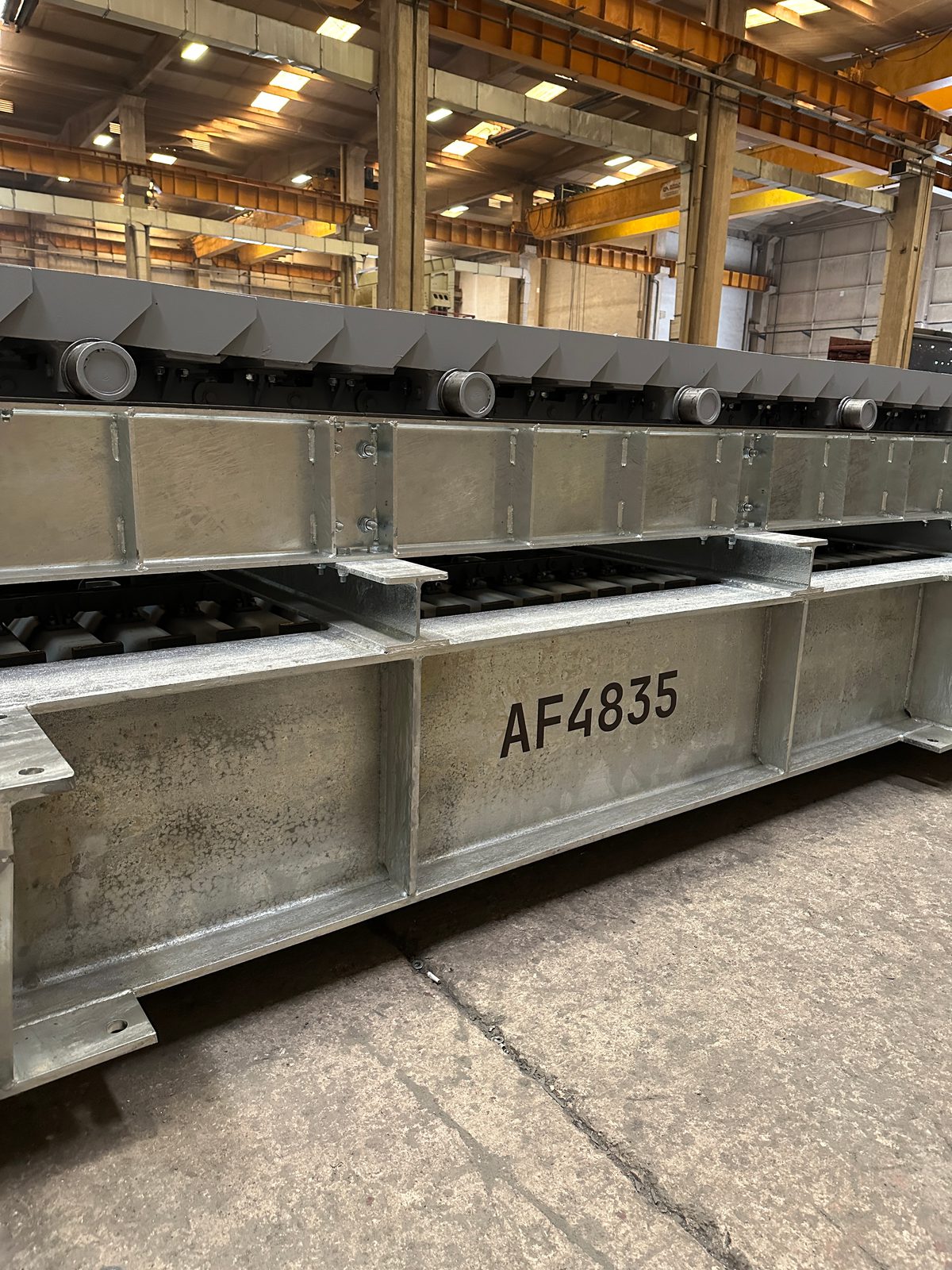
Technical guides and industry organisations for mining and crushing plant operators.
An apron feeder is a heavy-duty feeder made of overlapping steel pans mounted on a chain. It receives large, heavy material — typically run-of-mine ore or blasted rock dumped from trucks — and carries it to the primary crusher or a conveyor at a controlled speed. GELEN builds apron feeders as the AF series.
The AF series uses high-grade steel components throughout: hot-rolled steel head shafts, reinforced cast steel pans with center packers and close to full-length impact rails that prevent distortion. A hydraulic tail-end tensioning system with take-up screws keeps the chain tension consistent.
For particularly abrasive applications GELEN offers optional high-manganese steel pans, which significantly extend service life. The standard cast steel pans are reinforced with center packers and supported by impact rails, and replaceable wear liners protect critical areas.
Yes. Variable speed drives let operators set the chain speed to match downstream processing. Because the overlapping pans move material positively, the feed rate follows the speed closely and the crusher is not flooded.
Calculated for material with a bulk density of 1.6 t/m³, a bed depth of half the pan width and pan speeds of 4–12 m/min, the AF1500 handles about 350–1,040 t/h, the AF1800 about 500–1,490 t/h and the AF2000 about 610–1,840 t/h. Actual capacity depends on lump size, skirt height and speed, so GELEN confirms the size and drive for each application.
Choose an apron feeder for very large, heavy and sharp run-of-mine material dumped directly from trucks, where impact loads are extreme. Choose a vibrating feeder or grizzly feed screen for hard, free-flowing rock, especially when fines should be scalped before the crusher.
Inspect chain wear, sprocket condition and pan integrity regularly, and keep all moving parts lubricated as specified. The hydraulic tensioning system simplifies chain adjustment, and the bolted sprocket design allows easy replacement. Keeping the area under the feeder clear of spillage protects the return strand.
Send your material, your capacity and the product sizes you need. An engineer answers, not a form.