
Concrete & Asphalt Sand
Producing clean, low-moisture sand from quarry fines and natural sand for concrete and asphalt specifications.
- Removes clay and silt in the cyclones
- Low-moisture product
- 100–300 t/h models

GELEN GSP sand washing plants recover saleable sand from slurry and deliver it with low moisture. A rubber-lined slurry pump feeds hydrocyclones that separate clay, silt and slime; the sand drops onto a high-frequency dewatering screen and leaves ready to stockpile. Four models cover 100 to 300 t/h in one compact, factory-built unit.
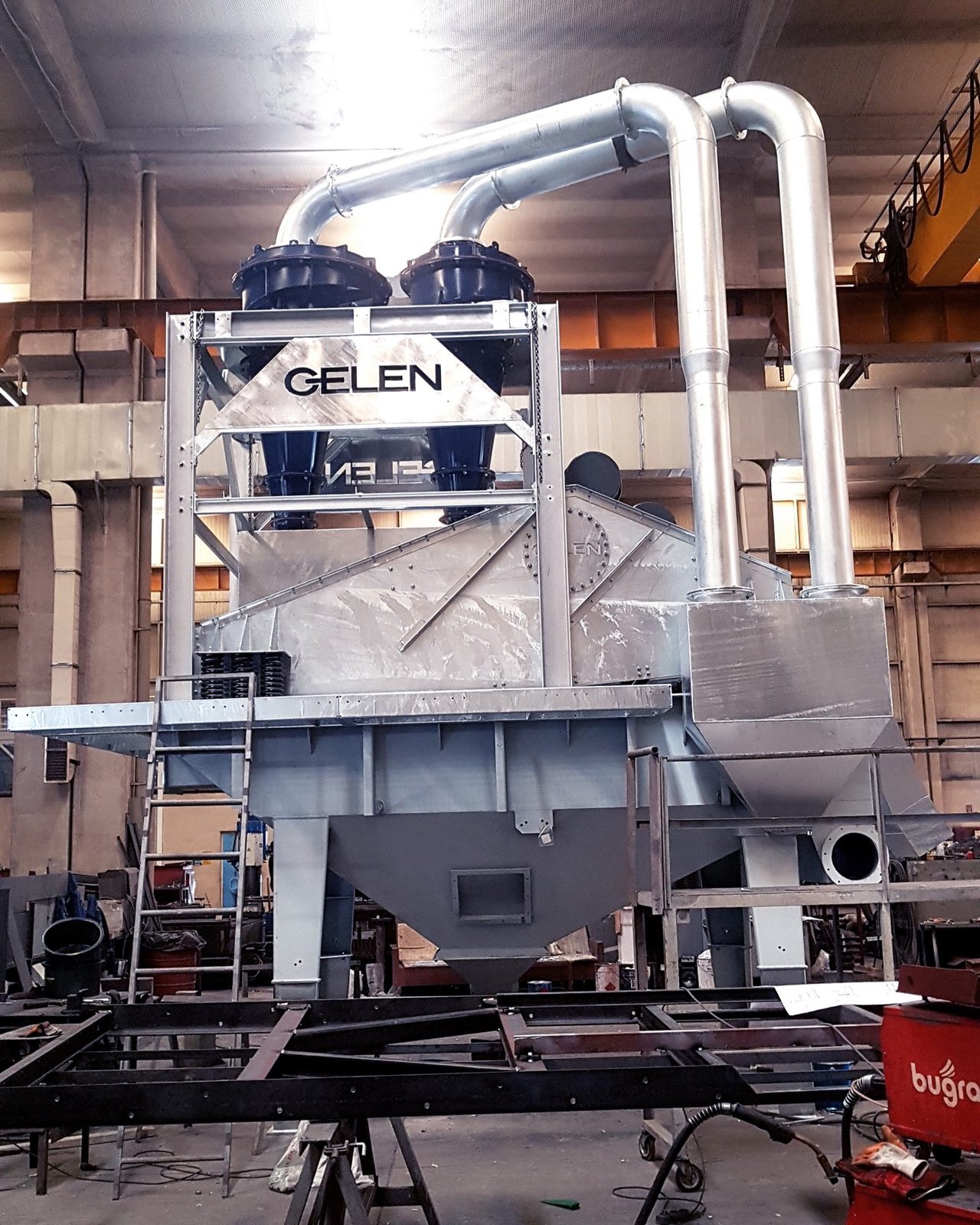
Fine sand stays in the product: hydrocyclones separate at a finer cut than gravity settling, so saleable fine sand that a classifier would lose over its weir is recovered.
Drier sand, sooner: the high-frequency dewatering screen drains the cyclone underflow on polyurethane decks, so the sand can be stockpiled and sold without long drainage times.
One compact structure: pump, sump, cyclones and screen are built as a single factory-assembled unit, which shortens installation and keeps the footprint small.
Wear parts where they matter: pumps and cyclones are rubber-lined against abrasive slurry, extending service life and cutting maintenance.
A GSP plant combines the three machines a fine sand circuit needs. Slurry from a wet screen, a screw classifier overflow or a sand pit collects in the sump and is pumped to the hydrocyclones. Centrifugal force in the cyclones sends clay, silt and slime out through the overflow, while the sand leaves through the underflow at the cyclone apex.
The underflow falls onto a GDW high-frequency dewatering screen. Its linear motion and modular polyurethane decks drain the water from the sand bed and discharge a low-moisture product, while the water drains back to the sump. Both the pump and the cyclones are rubber-lined to withstand abrasive slurry.
Four models cover 100 to 300 t/h of sand. GSP-1 uses a single 660 cyclone on a 1,800 × 2,400 mm screen; GSP-4 uses two 840 cyclones on a 2,100 × 4,900 mm screen with a 300/250 pump and a 75 kW pump motor.
| Capacityt/h | Dewatering Screen | Screen Sizemm | Screen MotorskW | Hydrocyclone | Pump Sizemm | Pump MotorkW | Feed Volumem³/h | |
|---|---|---|---|---|---|---|---|---|
| GSP-1 | 100 | GDW68 | 1800 x 2400 | 2 x 5.5 | 660 | 250/200 | 37 | 300–350 |
| GSP-2 | 200 | GDW513 | 1500 x 4000 | 2 x 6.1 | 2 x 660 | 250/200 | 55 | 500–550 |
| GSP-3 | 250 | GDW613 | 1800 x 4000 | 2 x 7.5 | 2 x 660 | 250/200 | 75 | 550–600 |
| GSP-4 | 300 | GDW716 | 2100 x 4900 | 2 x 11 | 2 x 840 | 300/250 | 75 | 700–750 |
Capacity is sand output. Feed volume is the slurry flow to the plant. Cyclone and pump sizes are trade designations (a "660" cyclone, a "250/200" pump).
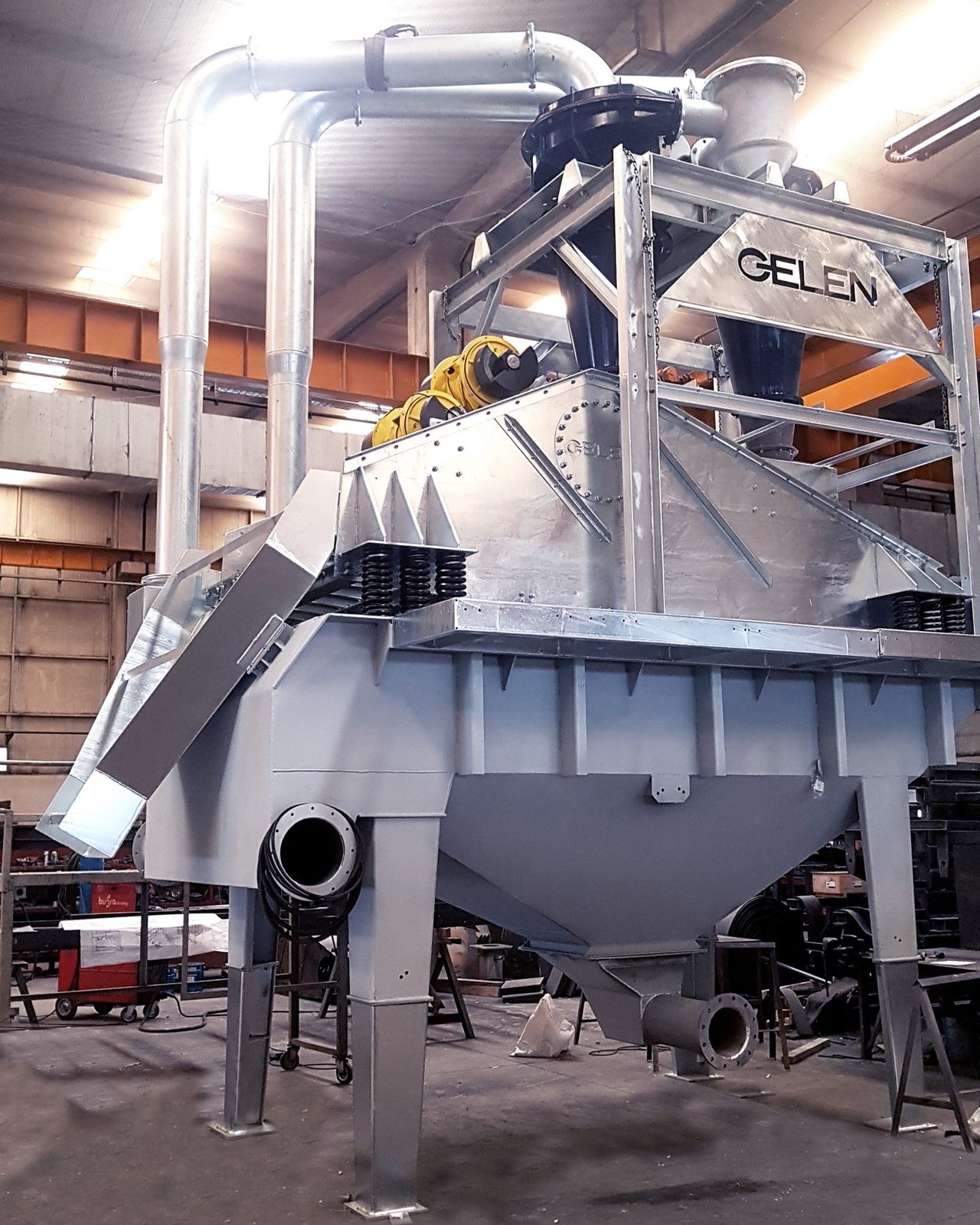
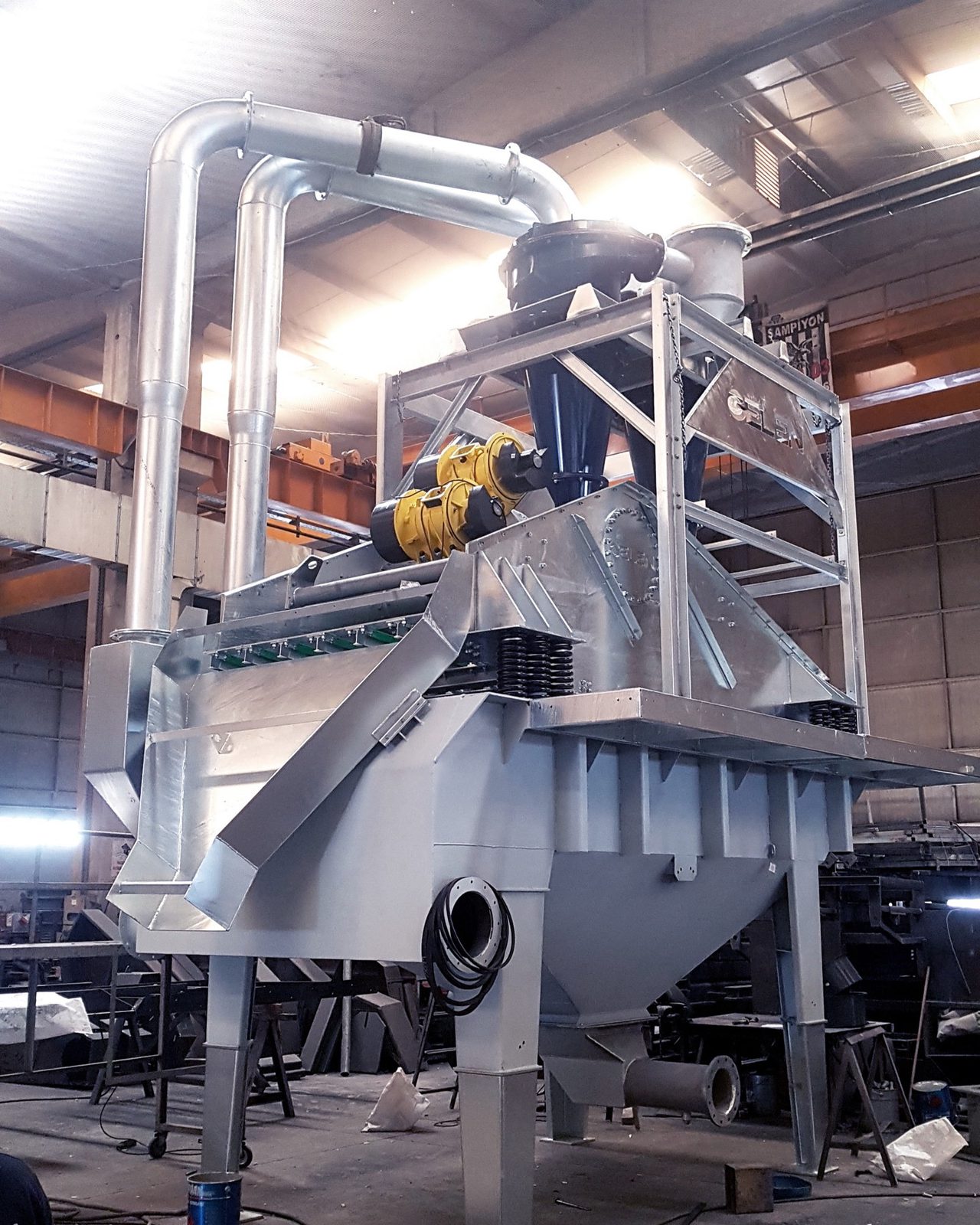
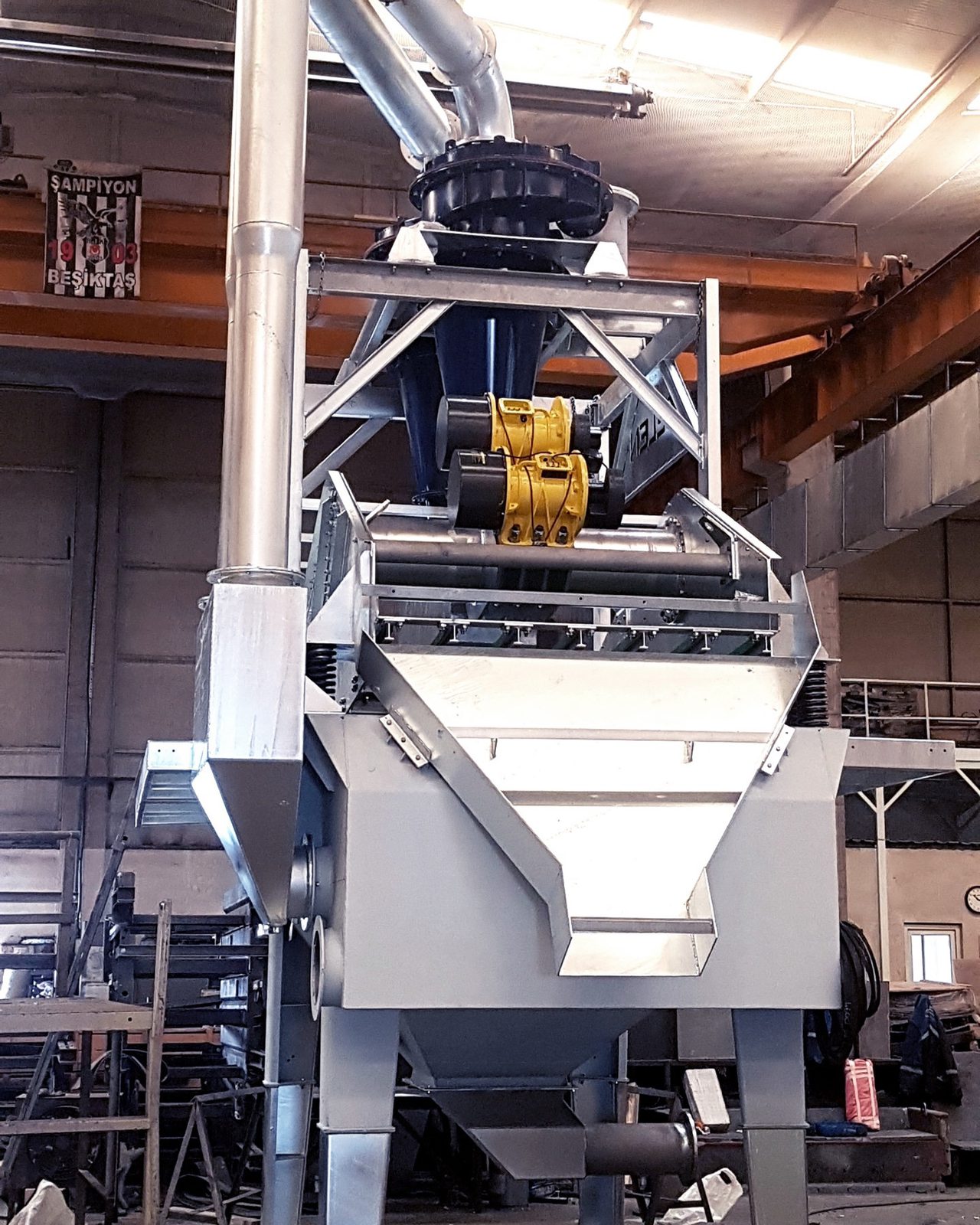
A GSP in the factory before dispatch. Five things worth naming, top to bottom.
Slurry enters tangentially and spins. Coarse sand is thrown to the wall and spirals down to the underflow; silt and water leave over the top. The cut point is set by pressure, not by a screen aperture.
The cyclone underflow lands here. A high-frequency linear throw on polyurethane panels takes the moisture down to something that can be stockpiled and sold the same day.
Holds the slurry and feeds the pump at a steady head. Level control here is what keeps the cyclones from starving or flooding — which is where the cut point drifts.
The pump sends slurry up these to the cyclone inlets. Inlet pressure is the adjustment that moves the cut.
The screen rides on springs so its throw does not reach the structure or the pipework bolted to it.
GELEN GSP sand washing plants produce 100 to 300 t/h of washed sand from a slurry feed of 300 to 750 m³/h. Each plant pairs one or two hydrocyclones (660 or 840) with a GDW high-frequency dewatering screen from 1,800 × 2,400 mm to 2,100 × 4,900 mm, driven by two vibrator motors, and a rubber-lined slurry pump of 37 to 75 kW. Send us your feed gradation, fines content and water supply, and GELEN engineering will select the model and design the water circuit around it.
Every washing plant is built to its duty. Send those numbers and an engineer comes back with a size, a drive and what it will do in your circuit.
Size one for meThe GSP plant turns a dilute sand slurry into a drained, saleable sand in four steps.
Sand slurry from wet screening, a classifier overflow or a sand pit collects in the sump, and the rubber-lined pump feeds it to the hydrocyclones.
Centrifugal force sends clay, silt and slime out of the overflow; the sand concentrates and leaves through the apex as underflow.
The underflow lands on the high-frequency dewatering screen, where linear vibration drains water through the polyurethane decks.
Low-moisture sand discharges to a stockpile conveyor, and the water returns to the sump or to water treatment.
GSP plants recover and dewater sand in aggregate, mining and recycling operations.
Producing clean, low-moisture sand from quarry fines and natural sand for concrete and asphalt specifications.

Recovering fine sand from the overflow of screw classifiers or wet screens that would otherwise be lost to the settling pond.

Dewatering and deslime of sand fractions in industrial sand and mineral processing plants.

Returning most of the process water to the circuit and sending only the fines-laden overflow to ponds, thickeners or water treatment.
What the GSP series brings to a sand washing circuit.
The whole fine sand circuit is built as one compact, factory-assembled structure, reducing site work and footprint.
Cyclones separate at a finer cut than gravity settling, keeping saleable fine sand in the product and sending clay and silt out.
A linear-motion GDW screen drains the sand on modular polyurethane decks, producing a drier product than a classifier alone.
Slurry pumps and hydrocyclones are rubber-lined to extend service life in abrasive sand slurry.
GSP-1 to GSP-4 cover 100 to 300 t/h with the same layout, so plants can be sized precisely and extended with confidence.
GELEN builds the screens, classifiers, conveyors and crushers around the GSP unit, so feed, water and product flows are designed as one system.
A GSP plant can produce the sand on its own, or recover the fine sand that a screw classifier sends over its weir.
Every circuit is different. Send us yours and we will say where a washing plant fits and what it changes downstream.
Check my circuitBoth machines wash and dewater sand. The right choice depends on how much fine sand you need to keep and how dry the product must be.
| Sand Washing Plant (GSP) | Screw Classifier | |
|---|---|---|
| Separation | Hydrocyclones (centrifugal) | Gravity settling in a pool |
| Fine sand recovery | Recovers fine sand to a finer cut | Fine particles below the cut leave with the overflow |
| Dewatering | High-frequency dewatering screen | Drainage on the spiral incline |
| Product moisture | Lower | Higher |
| Moving parts | Pump, vibrating screen | Slow-turning spiral |
| Typical use | Fine sand recovery, low-moisture sand | Concrete and asphalt sand where some fines loss is acceptable |
Many plants use both. See screw classifiers.
Not sure which one? Send us the duty and an engineer will say which, and what you would give up by choosing the other.
Which one fits?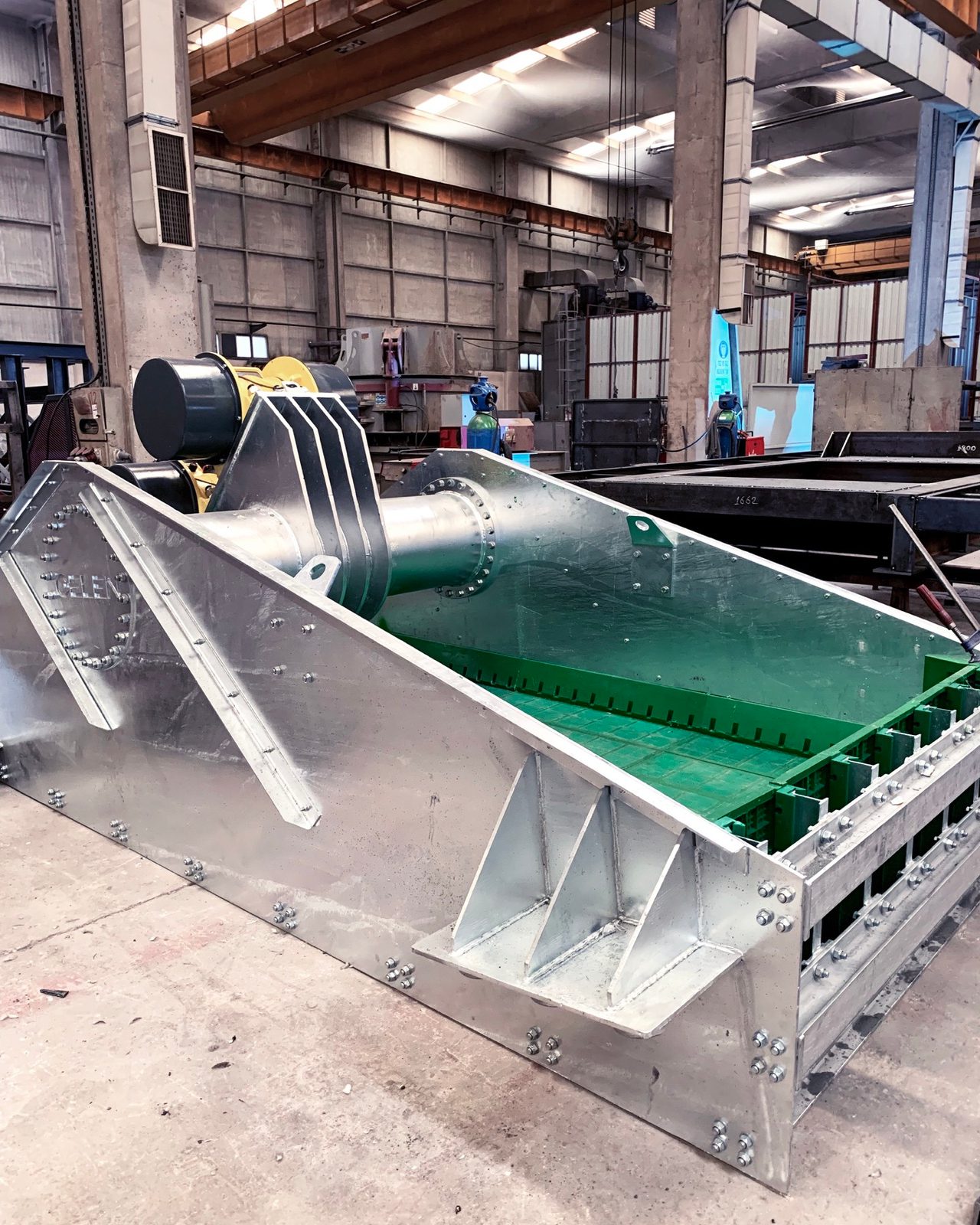
Technical guides and industry organisations for sand and aggregate producers.
A sand washing plant cleans sand of clay, silt and other fines and delivers it as a drained, saleable product. The GELEN GSP series is a compact plant that combines a slurry pump and sump, hydrocyclones and a high-frequency dewatering screen in one structure.
Slurry is pumped to the hydrocyclones, which send the fines out through the overflow and concentrate the sand in the underflow. The dewatering screen then drains the sand, which leaves ready to stockpile.
The hydrocyclone does the separation: centrifugal force sends light clay, silt and slime out through the overflow, while the heavier sand is concentrated and discharged through the apex as a dense underflow.
The dewatering screen does the drying: the underflow falls onto a high-frequency screen whose linear vibration drains water through polyurethane decks. The result is a sand with much lower moisture than a pool-type classifier produces, and the drained water returns to the sump.
Four models cover 100 to 300 t/h of sand: GSP-1 (100 t/h), GSP-2 (200 t/h), GSP-3 (250 t/h) and GSP-4 (300 t/h). They are rated for slurry feed volumes from 300–350 m³/h on GSP-1 to 700–750 m³/h on GSP-4. Actual output depends on feed gradation and fines content.
Choose a hydrocyclone sand washing plant when fine sand is valuable and must not be lost, or when the product must be as dry as possible for sale. Choose a screw classifier when a simple, slow-moving machine is enough and a small loss of the finest particles is acceptable.
Many plants combine them: the screw classifier produces the main sand and a GSP plant recovers fine sand from its overflow.
Yes. The overflow of a screw classifier or a wet screen often carries fine sand that is lost to the settling pond. Pumping that overflow through a GSP plant recovers the fine sand as a separate, dewatered product and reduces the load on the ponds.
A dewatering screen is a vibrating screen designed to remove water from a bed of sand rather than to size it. The GDW screens in GELEN GSP plants use high-frequency linear motion and modular polyurethane decks.
After a hydrocyclone the sand is still wet slurry. The dewatering screen drains it into a product that can be conveyed, stockpiled and sold without long drainage time.
The GSP models are rated for slurry feed volumes of 300–350 m³/h (GSP-1), 500–550 m³/h (GSP-2), 550–600 m³/h (GSP-3) and 700–750 m³/h (GSP-4). Most of this water drains from the dewatering screen back to the sump; only the overflow carrying clay and silt goes to ponds, a thickener or water treatment, where it can be clarified and reused.
The slurry pump, the hydrocyclones and the dewatering screen decks carry the abrasive sand. GELEN fits rubber liners to pumps and cyclones and uses modular polyurethane panels on the screen, so worn sections can be replaced individually. Checking the cyclone apex, pump liners and deck panels on a regular schedule keeps the cut point and product moisture stable.
Send your material, your capacity and the product sizes you need. An engineer answers, not a form.