ITE Series Grizzly Screens for Primary Scalping Ahead of the Crusher
The ITE Series is a heavy-duty grizzly vibrating screen (also called a vibrating grizzly screen) built for primary scalping ahead of jaw and impact crushers in mining, quarry, and construction-and-demolition recycling plants. The bolted high-tensile frame absorbs the impact loads of run-of-mine boulders dropping straight from a feeder, while stepped grizzly bars (or interchangeable perforated wear plates) move oversize across the deck and let undersize fines bypass the crusher entirely.
300+ Grizzly Screens delivered to mines, quarries, and recycling plants worldwide.
Stepped grizzly bar geometry: Tapered bar spacing widens slightly toward the discharge end so material self-clears, dramatically reducing the blinding and pegging that plague flat-bar designs.
Bolted high-tensile frame: Side plates are bolted rather than welded, so the structure resists fatigue cracking under repeated impact loads from run-of-mine feed.
Replaceable bar/plate decks: Stepped grizzly bars and perforated wear plates both bolt into the same frame — switch the top-deck configuration in under 60 minutes to match a new feed material or bar spacing.
1 to 2 deck range: Configurations from ITE1225 to ITE2050 cover primary scalping throughputs from roughly 100 t/h up to 800+ t/h on quarry feed.
ITE Series Grizzly Screens
Grizzly screen confidence
The ITE Series turns the simple grizzly-bar principle into a high-throughput primary scalping machine. Vibration and a steep deck slope move material across the bars while gravity drops undersize fines straight through to the bypass chute.
Self-clearing geometry: Stepped bar spacing means stuck stones work themselves free instead of bridging across the deck.
Bar or plate top deck: Choose grizzly bars for clean rock or perforated wear plates for high-fines / dirty feed — both mount on the same frame.
Heavy-impact-rated frame: Bolted high-tensile side plates resist the cracking that welded designs see when feed comes straight from a primary feeder or hopper.
Anatomy
What You Are Looking At
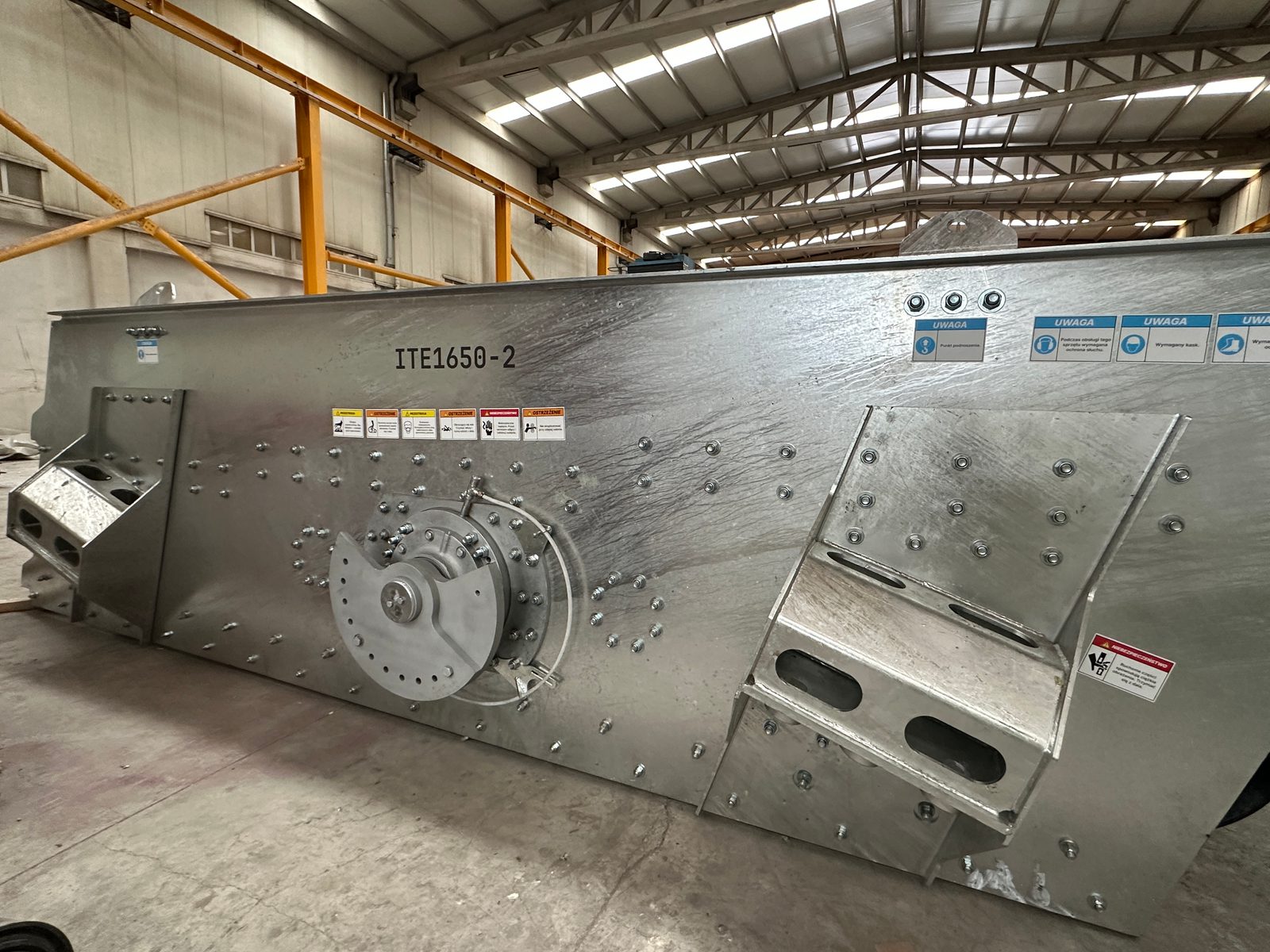
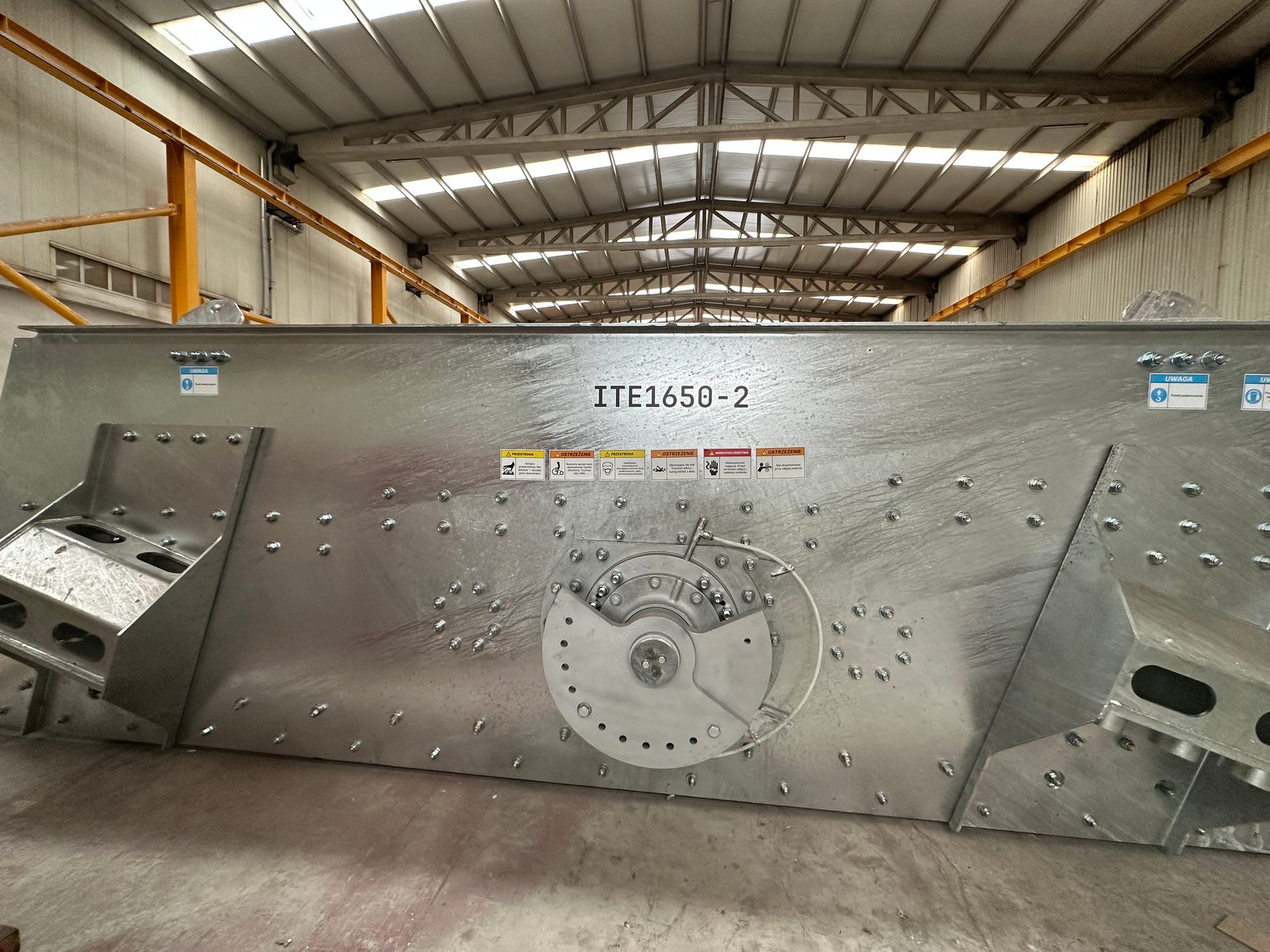
An ITE1650 with two decks, hot-dip galvanised. A scalping screen takes the roughest feed on the plant, so everything here is built heavier than it looks.
1 · Hot-dip galvanised side plate
Zinc through the whole section, inside the bolt holes and under every bracket. A scalping screen lives in wet, dirty feed ahead of the primary, which is where paint gives up first.
2 · Drive shaft and counterweights
One shaft, with the counterweights bolted to it, gives the circular throw. The stroke is set by how much weight is on it — which is how the same body suits a heavy scalp or a lighter cut.
3 · Swaged collar joints
The rows of studs across the plate. Each is swaged rather than torqued, so it holds its clamp load through millions of cycles without being re-checked.
4 · Spring support bracket
Coil springs sit in these, isolating the vibrating body from the structure. On a scalping duty they also take the shock of loader-sized rock arriving.
5 · Feed end
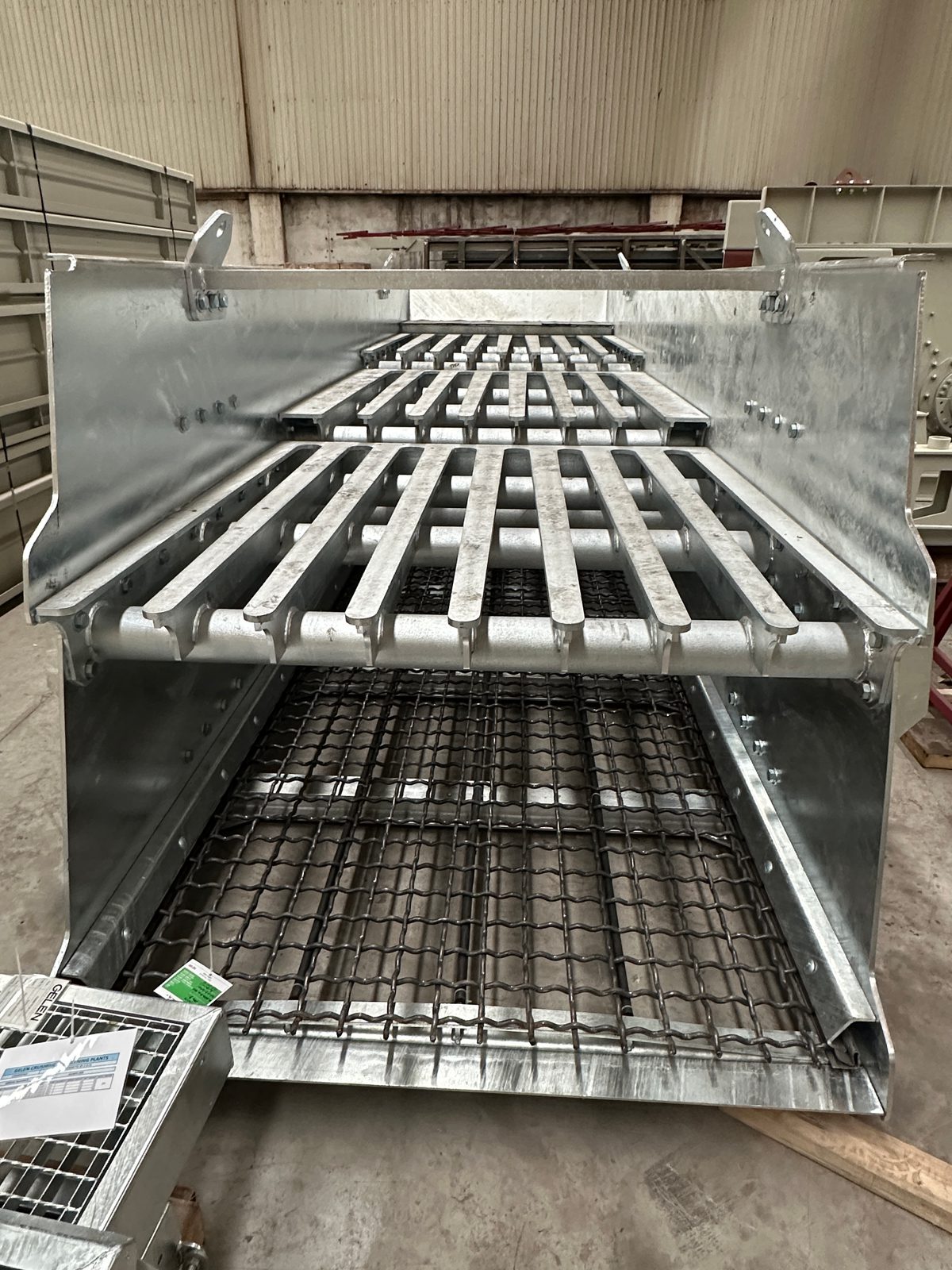
Where the blasted rock lands. The top deck here is grizzly bars or punch plate rather than mesh, because mesh would not survive the impact.
Performance Charts
Performance Charts
Screening Area per Deck by Model
Area of one deck (width × length) from the specification table.
Technical Specifications
Main Dimensions mm
Weight kg
Power kW
Width
Length
2-Deck
3-Deck
4-Deck
ITE2050
2000
5000
9,200
-
-
22
ITE1850
1800
5000
8,500
9,550
-
22
ITE1650
1600
5000
8,100
8,800
-
18.5
ITE1440
1400
4000
4,200
4,700
-
15
ITE1240
1200
4000
2,300
2,850
-
11
ITE1230
1200
3000
1,800
2,000
-
5.5
ITE1225
1200
2500
1,650
1,900
-
5.5
Every grizzly screen is built to its duty. Tell us the feed size, the scalping cut and the tonnage and we will size one.
The ITE Series accepts two top-deck configurations on the same frame, and the right choice depends on your feed material and what you're trying to remove:
Stepped grizzly bars — Parallel steel bars with tapered spacing. Best for clean primary feed where the goal is bypassing fines and dirt while feeding oversize rock to the crusher. Highest open area, lowest blinding risk, easy to rotate and replace individually.
Perforated wear plates — Thick AR-grade steel plates with cut or punched openings. Best for high-fines or wet/sticky feed where bars would clog. Lower open area than bars but much more resistant to plugging on dirty feed.
Hybrid configuration — Bars on one section, plates on another. Used when feed conditions vary across the day or season, or when the operator wants the coarse-cut benefits of bars combined with the anti-plugging benefits of plates.
How It Works
How a Grizzly Screen Works
Technical Specifications
How a Grizzly Screen Works
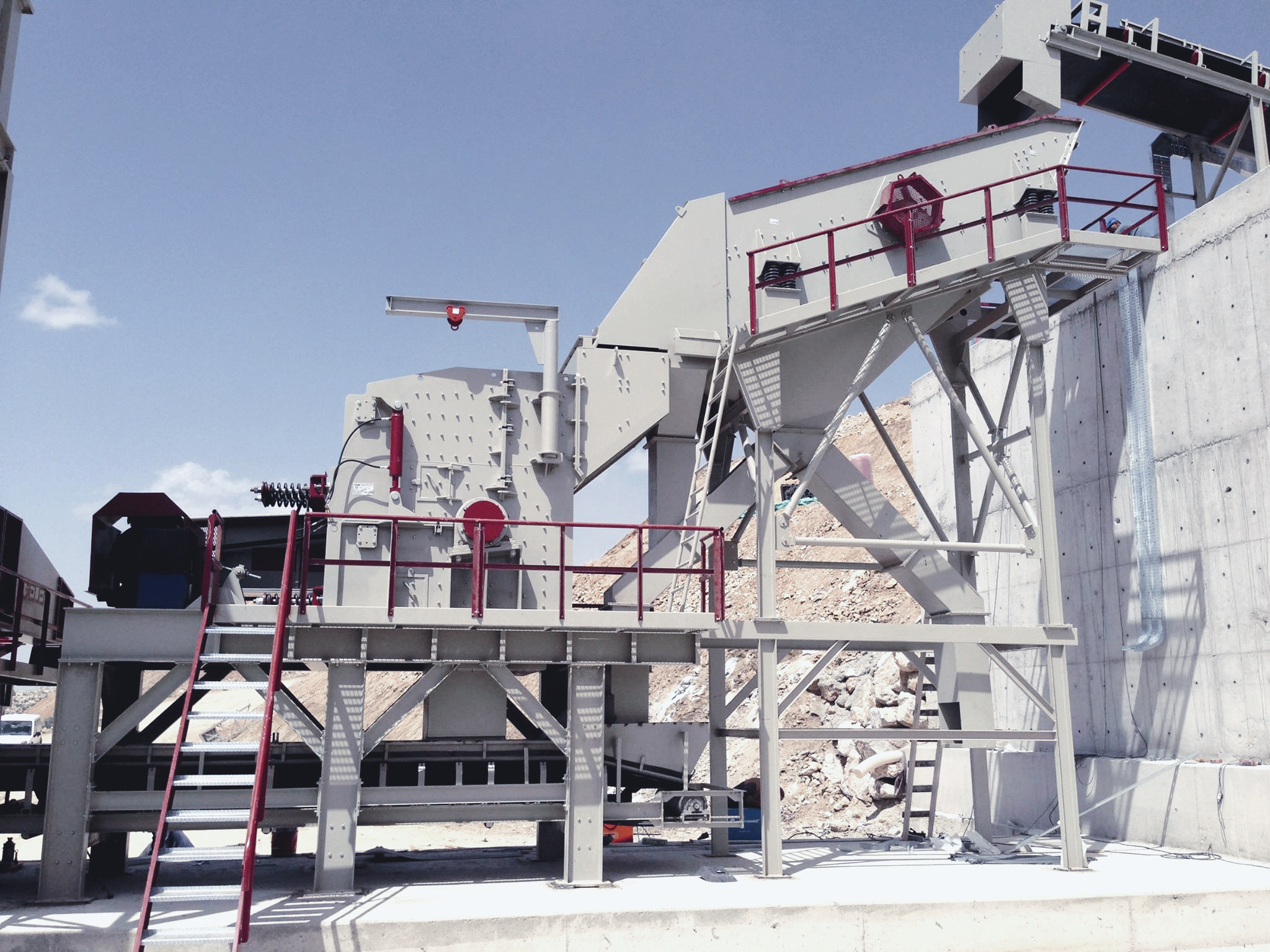
A grizzly vibrating screen is the simplest and oldest type of screening machine in a crushing plant — and one of the most valuable. The principle is straightforward: thick parallel steel bars (or heavy perforated plates) form a sloped deck, the deck vibrates, and material that's smaller than the gap between bars falls through while material that's larger slides across the top. The vibration doesn't just stratify particles the way it does on a sizing screen — it also breaks loose sticky clay, walks stuck stones forward, and prevents the deck from packing up under the weight of run-of-mine feed. In a typical primary station, the grizzly sits between the feeder and the jaw crusher: the feeder presents material to the deck, fines and clay drop through the bar spacing into a bypass chute (skipping the crusher entirely), and oversize rock slides off the discharge end straight into the crusher mouth. The result is a primary crusher that sees only the material that actually needs crushing — saving wear parts, energy, and downtime.
Applications & Performance
Quarry & Aggregate Production
Primary scalping ahead of the jaw crusher in limestone, granite, basalt, and dolomite quarries. Removes loose dirt, soil, and weathered fines from the run-of-mine feed before they reach the crusher chamber, dramatically extending jaw plate life.
Mining & Mineral Processing
Run-of-mine scalping for iron ore, copper, coal, and gold operations. Bypasses the undersize fraction directly to the secondary stage, reducing primary crusher load and energy consumption per ton processed.
C&D Recycling
Concrete and asphalt recycling plants where rebar, dirt, and broken brick must be separated from sound aggregate before crushing. Heavy-duty bars handle the impact of demolition feed without bending or cracking.
Mobile & Modular Plants
Compact ITE models (ITE1225, ITE1230) integrate into mobile primary stations and modular crushing plants where space is tight but scalping is still required to protect the downstream crusher.
Applications & Industries
The ITE Series grizzly vibrating screen sits at the front of GELEN crushing and screening plants — proven in quarries, mines, and recycling operations across more than 50 countries as the first defense against crusher wear.
Quarry & Aggregate Production
Primary scalping ahead of the jaw crusher in limestone, granite, basalt, and dolomite quarries. The grizzly removes loose dirt, soil, and weathered fines from the run-of-mine feed before they reach the crusher chamber, dramatically extending jaw plate life. A typical 500 t/h limestone quarry sees 15–25% of the feed bypass the crusher entirely through a properly-sized grizzly. See the screen applications guide for more sizing examples.
Stepped bar geometry self-clears stuck stones
ITE1225 to ITE2050 — 100 t/h to 800+ t/h
Bypasses dirt and fines from crusher
Mining & Mineral Processing
Run-of-mine scalping for iron ore, copper, coal, and gold operations. The ITE bypasses the undersize fraction directly to the secondary stage, reducing primary crusher load and energy consumption per ton processed. Heavy-duty bolted frame handles 24/7 operation under continuous impact loads from haul-truck-fed hoppers. For maintenance and uptime planning, see the vibrating screen maintenance schedule.
Run-of-mine boulder rated frame
Heavy-impact bolted construction
24/7 continuous operation
C&D Recycling
Concrete and asphalt recycling plants where rebar, dirt, and broken brick must be separated from sound aggregate before crushing. Heavy-duty bars handle the impact of demolition feed without bending or cracking. The ITE pairs with both jaw and impact crushers in stationary and mobile recycling plants. For blinding and pegging troubleshooting on dirty feed, read the prevent screen blinding guide.
Handles rebar and demolition debris
Anti-blinding stepped bar geometry
Stationary and mobile configurations
Why Choose the GELEN ITE Series?
Six specific reasons the ITE Series grizzly screen is GELEN's standard primary scalping machine.
Stepped Grizzly Bar Geometry
Bar spacing tapers from feed end to discharge end, so material that fits at one point but jams further down the deck has a clear path to work itself free. This self-clearing geometry dramatically reduces the blinding and pegging that plague flat-bar grizzly designs — especially on clay-bound, wet, or high-fines feed.
Bolted High-Tensile Frame
Side plates are high-tensile steel, assembled with high-strength bolted connections rather than welded joints. Bolted frames resist the fatigue cracks that plague welded screen bodies after 5,000–10,000 hours of impact loading from primary feed. Individual sections, springs, and bar mounts can all be replaced without cutting and re-welding the structure.
Replaceable Bar/Plate Decks
Both stepped grizzly bars and perforated AR-steel wear plates bolt into the same frame. Switch the top-deck configuration in under 60 minutes when feed conditions change — bars for clean primary rock, plates for high-fines or sticky feed, hybrid setups when conditions vary. No specialized tooling required, just standard impact-wrench work.
Crusher Protection by Design
A grizzly that bypasses 20% of the feed reduces crusher hours by the same 20% — which translates directly into wear part life on jaw plates, impact bars, and concaves. Plants that retrofit a grizzly typically see 3–6 month payback on the screen investment from wear-part savings alone, plus the option to specify a smaller (cheaper, more efficient) primary crusher for the same throughput.
Run-of-Mine Rated Capacity
Configurations from ITE1225 (1200 mm × 2500 mm, 5.5 kW) up to ITE2050 (2000 mm × 5000 mm, 22 kW) cover primary scalping throughputs from roughly 100 t/h up to 800+ t/h on quarry feed. Smaller models integrate into mobile and modular plants; larger models handle stationary primary stations under haul-truck-direct feed.
Plant-Wide Integration
The ITE Series is designed to drop into a complete GELEN crushing plant alongside the CK Series jaw crusher, the STE Series inclined screen, and vibrating feeders. Standard chute connections, matching frame heights, and consistent spare-parts logistics across the line.
Plant Circuit
ITE in Your Plant Circuit
The ITE Series grizzly screen integrates at one specific point in a crushing and screening plant: the primary scalping stage, between the feeder and the primary crusher.
The ITE grizzly and STE inclined screen do different jobs in the same plant. Use the ITE for primary scalping ahead of the crusher; use the STE Series inclined screen after the crusher for product sizing.
FEATURE
ITE GRIZZLY
STE INCLINED
Primary role
Primary scalping ahead of crusher
Product sizing after crusher
Top deck
Stepped grizzly bars or perforated plates
Wire mesh / PU / rubber panels
Cut size range
Coarse (40 mm and up)
Fine to coarse (1 mm and up)
Number of decks
1 to 2
2 to 4
Feed source
Direct from feeder / hopper (run-of-mine)
Conveyor from crusher discharge
Frame construction
Heavy-duty bolted impact-rated
Bolted, fatigue-resistant
Wears removed by
Bypassing fines from crusher chamber
N/A — sizing screen, not protection
Not sure which one? Send us the duty and an engineer will say which, and what you would give up by choosing the other.
Hot-dip galvanised GELEN ITE1650 grizzly screen body at the factory
6 / 7
Hot-dip galvanised GELEN ITE grizzly screen at the factory
7 / 7
Galvanised grizzly bars over the wire mesh lower deck of a GELEN ITE screen
Documents
Downloads
PDFThe GELEN product catalogue carries the screening range with the crushing and feeding equipment it works with. Bar spacing and deck build are set against your feed, so the per-model data sheet is issued with the quotation.Download Catalogue
Industry Resources
Expand your knowledge with these technical guides and connect with the global aggregate and screening community.
A grizzly vibrating screen is a heavy-duty primary screening machine that sits between the feeder and the primary crusher in a crushing plant. Its top deck is built from a row of parallel grizzly bars (or thick perforated wear plates) instead of conventional wire mesh. As run-of-mine feed lands on the deck, the vibratory motion conveys it down the slope while undersize particles fall between the bars and bypass the crusher entirely. Oversize material slides across the bars and feeds into the primary crusher.
The result: less material going through the crusher, less fines clogging the chamber, and lower wear on jaw plates or impact bars. A grizzly is the simplest, oldest screen type in a crushing plant — and one of the most valuable for protecting downstream equipment.
Three things separate a grizzly screen from a standard vibrating screen. First, the screening surface — a grizzly uses thick parallel bars (or heavy perforated steel plates) sized to handle run-of-mine boulders, while a standard vibrating screen uses thinner wire mesh, polyurethane, or rubber panels designed for smaller, pre-crushed material. Second, the duty role — the grizzly always sits at the front of the plant for primary scalping, while a standard inclined vibrating screen sits after one or more crushing stages for product sizing. Third, the structural rating — grizzly frames are built much heavier to absorb the impact loads of large rocks dropping directly from a feeder or hopper.
The ITE Series is engineered for that primary scalping role, while the STE Series handles downstream product sizing on the same plant.
The GELEN ITE Series is built around three engineering choices that matter for primary scalping. First, the bolted high-tensile frame — side plates are bolted, not welded, so the structure resists fatigue cracking under repeated impact loads and individual sections can be replaced without cutting and re-welding the screen body. Second, stepped grizzly bar geometry — bar spacing is tapered so material self-clears as it travels down the deck, dramatically reducing the blinding and pegging that typically plague flat-bar grizzly designs.
Third, replaceable bar/plate decks — both grizzly bar sets and perforated wear plates bolt into the same frame, so you can switch the top-deck configuration in under an hour to match a new feed material or bar spacing.
Bar spacing should match the closed-side setting (CSS) of your downstream primary crusher. A common rule is to set the grizzly spacing equal to or slightly smaller than your jaw crusher CSS — that way any material small enough to pass through the jaw also passes through the grizzly without taking up crusher capacity. For a typical 100 mm CSS jaw, set the grizzly to 80–100 mm spacing.
For dirty quarry feed with significant fines, use a smaller spacing of 50–80 mm to bypass more dirt and reduce crusher wear. For very clean primary feed where you want everything to go through the crusher, use 100–150 mm spacing. The ITE Series accepts custom bar sets so the spacing can be specified at order or changed in the field.
Yes — and this is one of the strongest reasons to specify a grizzly ahead of any primary crusher when feed conditions are difficult. Sticky and clay-bound material is exactly what plugs the chamber of a jaw or impact crusher, so removing as much of it as possible upstream saves the crusher from forced shutdowns.
The ITE Series handles wet and sticky feed in three ways: stepped bars give the material a positive forward push so it doesn't pack between bars, high-G vibration breaks up loose clay agglomerates on the deck, and an optional spray bar set can be added at the feed end to wash sticky material clear of the bars. For very sticky clay slurries, talk to GELEN engineering about a heated bar set or wider spacing.
The ITE Series spans seven models from the compact ITE1225 (1200 mm × 2500 mm, 5.5 kW) up to the large ITE2050 (2000 mm × 5000 mm, 22 kW). On typical quarry feed with a moderate fines fraction, throughput ranges from roughly 100 t/h on the smallest model to 800+ t/h on the largest.
Actual capacity depends heavily on feed PSD, bar spacing, and the percentage of fines you're trying to bypass — a high-fines feed and tight spacing will cut capacity by half compared to a clean coarse feed and wide spacing. GELEN can provide a sizing recommendation based on your feed analysis and target throughput.
A grizzly screen ahead of a primary crusher cuts operating cost in four measurable ways. 1. Less tonnage through the crusher — a grizzly that bypasses 20% of the feed reduces crusher hours by the same 20%, which translates directly to wear part life. 2. Less abrasive fines in the chamber — fine particles are the worst thing for jaw plate wear because they grind without breaking, and a grizzly removes most of that fine fraction before it reaches the crusher.
3. Smaller crusher selection — by removing fines upstream, you can specify a primary crusher one size smaller for the same plant throughput, which cuts CAPEX and energy consumption by 15–25%. 4. Fewer forced shutdowns — clay and dirt that plugs a crusher costs hours of downtime per incident, and a grizzly with the right bar spacing keeps that material out of the chamber. Plants that retrofit a grizzly typically see 3–6 month payback on the screen investment from wear part savings alone.
Routine grizzly screen maintenance focuses on six items. Daily: visual inspection of grizzly bars for cracks or excessive wear, and a quick check that no oversized boulders are stuck between bars. Weekly: grease the vibrator bearings on the OEM schedule (typically every 40–80 operating hours), inspect bolt torque on the side plates and bar mounts, and check spring suspension for fatigue. Monthly: measure the deck stroke and confirm it's within the spec range, check motor current draw against the baseline, and inspect the drive belts. Quarterly: pull and rotate the grizzly bars to even out wear (most bars are symmetric and can be rotated 180° to double their service life), inspect the bearings for play or noise, and confirm the frame is free of fatigue cracks at the high-stress corners.
The ITE Series bolted frame design makes most of these maintenance tasks accessible without specialized tooling, and individual grizzly bars or wear plates can be replaced in under 60 minutes. Follow the broader vibrating screen maintenance schedule for the rest of your screening line.
1981
Manufacturing since
1,000+
Screens delivered
6
Continents served
1,000 t/h
Largest plant
Talk to a GELEN Engineer
Send your material, your capacity and the product sizes you need. An engineer answers, not a form.