
Introduction: Jaw crushers are often the first crushing stage in quarry and mining circuits. This handbook blends theory with on-site practices so you can choose the right model, reduce installation and maintenance mistakes, and cut energy costs.
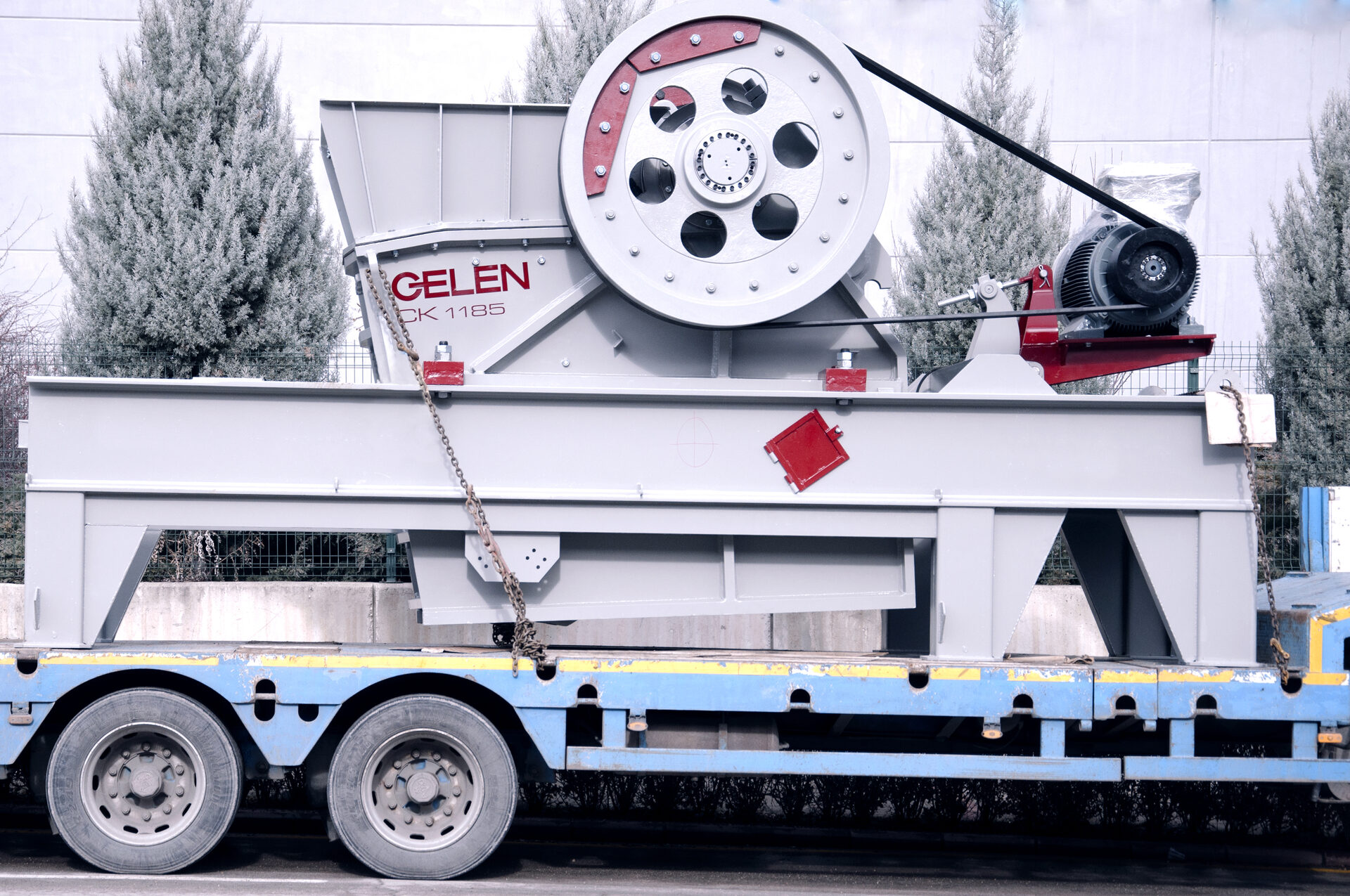
What Is a Jaw Crusher and How Does It Work?
Basic Working Principle
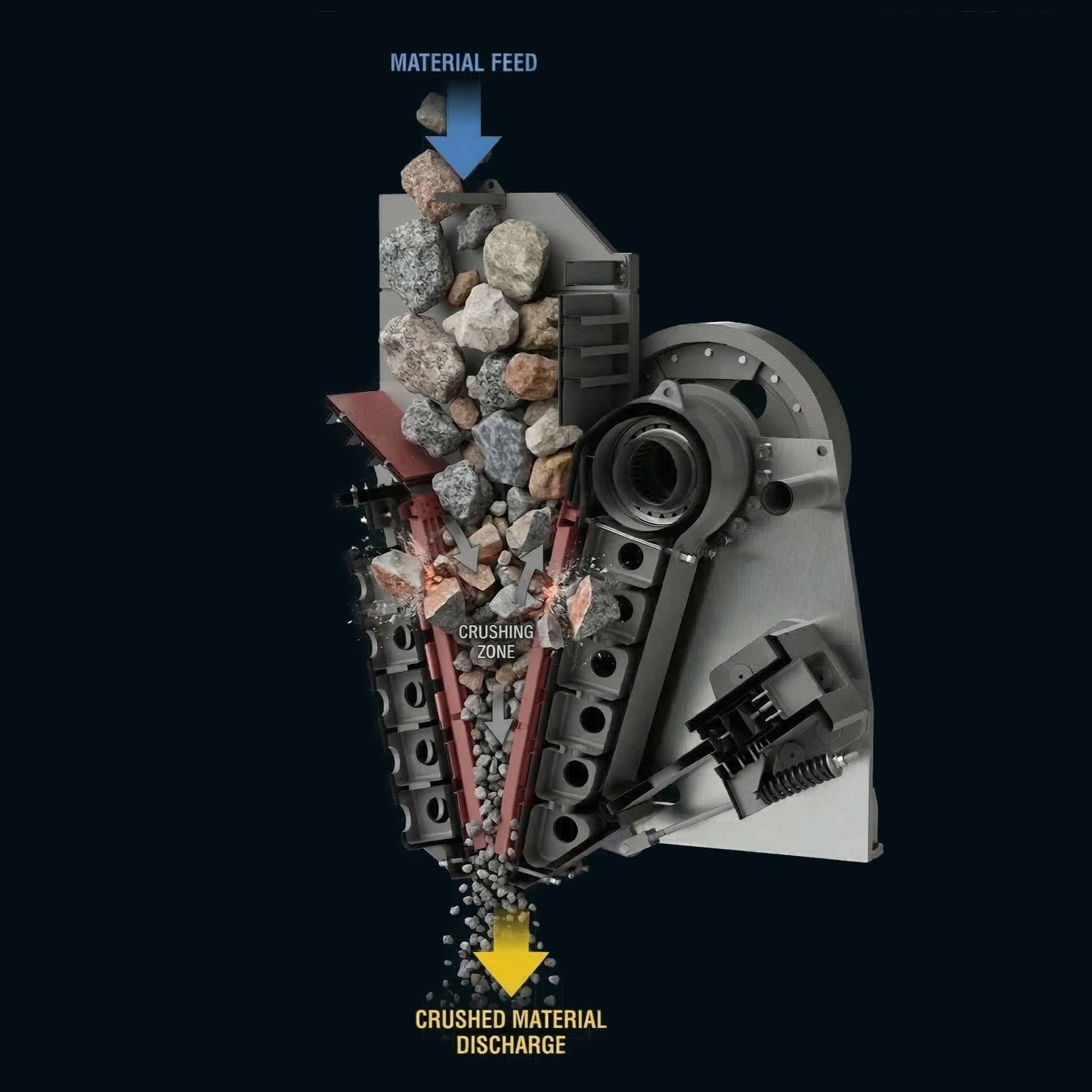
- Fixed jaw / moving jaw: Material enters the V-shaped chamber; the moving jaw drives an elliptical motion via the eccentric shaft to compress against the fixed jaw.
- Eccentric shaft & elliptical motion: RPM and eccentricity set stroke frequency and capacity. Wrong speed increases wear and power draw.
- Step-by-step flow: (1) Feed hopper → (2) Falls into V → (3) Compression and breakage → (4) Discharge once small enough. Cycle repeats until product exits.
How to Calculate Reduction Ratio?
Formula: Reduction ratio = F80 / P80. F80 is the size that 80% of the feed passes; P80 is the size that 80% of the product passes.
Example: Reducing an 800 mm granite block to 100 mm gives a theoretical ratio of 800 / 100 = 8:1. Safe single-stage ratios are typically ~6:1, so plan two stages (primary + secondary).
Tip: Oversized top-size pieces skew the ratio. When selecting a jaw crusher, consider maximum feed size, not just F80.
Caution: Trying 8:1 in one step accelerates jaw plate wear and overloads the motor; for ratios above ~6:1 plan a second stage or combine with a cone/impact crusher.
Jaw Crusher Types — Which One Fits Your Job?
Primary vs. Secondary Jaw Crusher
Primary models offer wide feed openings (e.g., 800–1200 mm). Secondary models need tighter CSS control and plan for recirculating load.
| Feature | Primary | Secondary |
|---|---|---|
| Feed size | 600–1200 mm | 150–400 mm |
| Recirculating load | Low | High; must be managed |
| Use case | First break, high capacity | Further reduction before shaping |
| Setting | Wider CSS | Tight CSS, close control |
Mobile vs. Stationary: 5-Year TCO
Mobile units provide speed and flexibility; stationary units deliver the lowest $/ton over long horizons.
| Line Item | Mobile Jaw Crusher | Stationary Jaw Crusher |
|---|---|---|
| Purchase | Higher (chassis, hydraulics) | Lower |
| Transport / install | Low; 1–3 days | Concrete foundation, 2–4 weeks |
| Operational efficiency | Rapid site changes | Lowest kWh/t |
| Service access | Easy but tighter space | Wide service space |
| 5-year TCO | Best for flexible projects | Lowest for fixed quarries |
Decision: Choose mobile for short-term sites, contract crushing, or permitting uncertainty; choose stationary for long-life quarries.
Laboratory Jaw Crushers
Used for sample prep and R&D; low capacity (50–500 kg/h), tight CSS, high repeatability. Ideal for understanding material behavior before scaling up.
How to Choose the Right Jaw Crusher — Step-by-Step
Step 1 — Define Material Properties
- Hardness: For Mohs 6+ use heavy-duty jaws and higher Mn plates. If Bond Work Index is high, upsize motor power.
- Moisture: Above 5% increases sticking; add pre-screen or grizzly feeder.
- Abrasiveness: With high SiO2, upgrade jaw plate alloy and plan for side liners.
- Stickiness / elasticity: High clay demands slower feed and closer CSS control to prevent jams.
Step 2 — Capacity Calculation
Target tons/hour sets feed opening and motor size. Rule of thumb: Primary feed width (mm) ≈ 0.8 × max lump size.
Example: 500 t/day aggregate at 10 h/day → 50 t/h. For 50–150 mm feed, a 900×600 mm jaw crusher class fits.
| t/h | Suggested opening (mm) | Motor power (kW) |
|---|---|---|
| 50–120 | 900 × 600 | 55–90 |
| 120–250 | 1100 × 800 | 90–132 |
| 250–400 | 1300 × 1000 | 132–200 |
Step 3 — Choose CSS by Target Product
CSS (Closed Side Setting): Narrowest opening, controls top size. OSS (Open Side Setting): Widest opening, impacts capacity. Rule of thumb: Product dmax ≈ 1.6 × CSS.
| Target product | Recommended CSS | Note |
|---|---|---|
| 0–100 mm | 60–70 mm | Primary output |
| 0–63 mm | 40–45 mm | Secondary jaw |
| 0–32 mm | 20–25 mm | Lab / special |
Key parameters: Flywheel mass (inertia), bearing type (SRB/CRB), jaw plate alloy (Mn13, Mn18, Cr-add) directly affect performance. Ask suppliers for these specs.
How to Adjust Jaw CSS — Practical Guide
Hydraulic Setting
- Safe stop: Halt feed, shut motor, lock-out main power.
- Hydraulic panel: Check pressure; stay within OEM limits.
- Adjust: Command cylinder to move the swing block; set CSS to target.
- Verify: Measure with test stone or lead wire at 2–3 points.
- Fine-tune: If product drifts, check OSS/CSS gap and feed curve.
Shim Setting (Legacy Systems)
- Shut down and isolate energy.
- Access shim pack; record total thickness.
- Add shims (tighten CSS) or remove (open CSS). Typical 1 × 5 mm shim ≈ 5–7 mm CSS change.
- Distribute evenly to keep parallelism.
- Re-tighten, run briefly no-load, check vibration.
Post-Adjustment Checklist
- Verify top size with a test sample.
- Check flywheel bolts and swing block torque.
- Monitor lube pressure and temperature trend.
- Keep grizzly and hopper flow stable.
- Inspect jaw plate wear if product drifts.
Jaw Plate Maintenance & Replacement
When to Replace Jaw Plates?
- Wear indicators: Teeth height down to ~30%; hooks and valleys disappear.
- Weight loss: At ~30% loss, schedule change.
- Performance: If product coarsens or capacity drops ~10%, flip or replace.
Flipping Jaw Plates — When & How
- Lock-out/tag-out; stop feed fully.
- Rig safely; remove plate without scraping the frame.
- Clean seating surfaces.
- Flip, seat, and tighten wedges/bolts to spec torque.
- Run 2–4 hours and re-check product; adjust CSS if needed.
Installing New Jaw Plates
- Remove old plate; inspect wedges/bolts, replace if damaged.
- Clean the seating area thoroughly.
- Seat new plate; confirm alignment.
- Tighten in star pattern to OEM torque (e.g., 450–650 N·m typical range).
- Run 15–20 minutes no-load, then light feed. Re-torque within 2 hours.
Common Failures & Troubleshooting
What to Do in a Jam (Jamming)
- Emergency stop: Stop feeder and crusher motor.
- Isolate power (LOTO).
- Use crane or loader to remove oversize; gas test and safety check before entry.
- Root cause: Overfeed, wet material, or tramp metal—adjust grizzly spacing and feed rate.
- Prevention: Add pre-screen, keep bunker level steady, use metal separator.
Why Did Crushing Efficiency Drop? — Diagnostic Table
| Symptom | Likely Cause | Fix |
|---|---|---|
| Product getting coarser | CSS widened | Check/reset CSS |
| Capacity dropped | Jaw plate worn | Flip or replace |
| Motor overloaded | Overfeeding | Reduce feed rate |
| Vibration increased | Flywheel imbalance | Check bearings and flywheel |
Wet / Sticky Material Performance
Above ~8% moisture, material sticks to plates; CSS effectively narrows and jamming risk rises.
- Use pre-drying or a grizzly feeder.
- Temporarily disable spray bars to reduce stickiness.
- Keep feed distribution even; avoid sudden big lumps.
Bearing Overheating
- Normal: ~50–80 °C; >90 °C is alarm.
- Causes: Wrong grease, over/under-lubrication, misalignment, flywheel balance.
- Fix: Use OEM grease (NLGI 2), verify auto-lube interval, check bearing clearance and flywheel balance.
Jaw Crusher Maintenance Plan — Daily, Weekly, Monthly, Annual
Daily Checklist
- Clear trapped material at start/end of shift.
- Check oil level and grease pressure.
- Visually inspect jaw and side liner bolts.
- Track motor and bearing temperature trend.
Weekly Maintenance
- Grease per schedule; confirm nipples are open.
- Check belt tension and alignment.
- Measure side liner and base liner wear.
Monthly & Annual
- Measure eccentric shaft and bearing clearances.
- Check flywheel balance; grind or add weight if needed.
- Weigh jaw plates; replace at ~30% loss.
- Test electrical/automation protection (overcurrent relay, vibration sensor).
Jaw vs. Impact vs. Cone — Which Material Needs What?
Comparison Table
| Criterion | Jaw | Impact | Cone |
|---|---|---|---|
| Material hardness | High | Low–Medium | Medium–High |
| Product shape | Open cubic | Most cubic | Good, fine product |
| Wear cost | Low | High | Medium |
| Energy use | Low | Medium | Low–Medium |
Practical Scenarios
- Scenario 1: Granite quarry, primary break → Jaw crusher.
- Scenario 2: Limestone, cubic aggregate target → Impact crusher (HSI).
- Scenario 3: Hard, abrasive, fine product → Cone crusher.
Optimize Energy Consumption
Factors Impacting Efficiency
- Feed size distribution and uniformity.
- Chamber fill: running too empty or too full raises kWh/t.
- CSS setting and reduction ratio; over-reduction costs energy.
Practical Energy Tips
- Pre-screen fines to unload the crusher.
- Use VFD instead of star-delta for soft start.
- Cut idle time; sync feeder and crusher with automation.
Conclusion & Quick Checklist
A well-selected and well-maintained jaw crusher drives total plant performance and energy efficiency. Share this quick card with your crew:
- Hardness, moisture, abrasiveness verified?
- Capacity (t/h) and CSS set for target top size?
- Grizzly, metal separator, and automation protections active?
- Daily/weekly/monthly maintenance lists followed?
- TCO calculated and mobile vs. stationary decision clear?
For project-specific selection and technical support, contact our team.