
Introduction: The term "jaw crusher" covers a wide range of machines, from large primary units that accept 1,000+ mm feed to compact secondary units that refine product to 20–50 mm. Understanding the differences is essential for plant design. This guide compares primary and secondary jaw crushers head-to-head and explains when to use one or both in your crushing circuit.

What Makes a Jaw Crusher "Primary" or "Secondary"?
The terms refer to the crusher's position in the circuit, not a fundamentally different machine. However, primary and secondary jaw crushers are optimised differently:
| Feature | Primary Jaw Crusher | Secondary Jaw Crusher |
|---|---|---|
| Position in circuit | First stage — receives ROM (run-of-mine) material | Second or third stage — receives pre-crushed material |
| Feed opening (W × D) | Large: 600×400 mm to 1,600×1,200 mm | Smaller: 250×150 mm to 600×400 mm |
| Max feed size | Up to 1,080 mm | Typically <200 mm |
| CSS range | 60–200 mm | 10–50 mm |
| Throughput | 50–1,000 t/h | 10–200 t/h |
| Motor power | 55–400 kW | 15–90 kW |
| Machine weight | 10–120 tonnes | 2–20 tonnes |
| Chamber geometry | Deep stroke, steep nip angle for large lumps | Shallow stroke, finer tooth profile for smaller product |
| Typical products | 0–150 mm, 0–200 mm for further crushing | 0–31.5 mm, 0–50 mm for direct use |
When to Use a Primary Jaw Crusher Only
- Coarse product is the final output — road sub-base (0–100 mm), gabion fill, rip-rap, or mine backfill where tight gradation is not required.
- Feed to a downstream secondary crusher — the jaw reduces ROM to a size the cone crusher or impact crusher can accept.
- Mobile / temporary operations — a single primary jaw on a track-mounted chassis covers demolition, road construction, and quarry start-ups.
When to Use a Secondary Jaw Crusher
- You need finer product from jaw action — in circuits where cone crushers are not available or not suited (e.g., very hard abrasive rock where cone liners wear too fast).
- Space or budget is constrained — a secondary jaw is cheaper and simpler than a cone or HSI, though it may produce a less cubic product.
- Low-volume fine production — small quarries or recycling plants that don't justify the capital cost of a cone crusher.
When to Use Both — Primary + Secondary Jaw Crusher
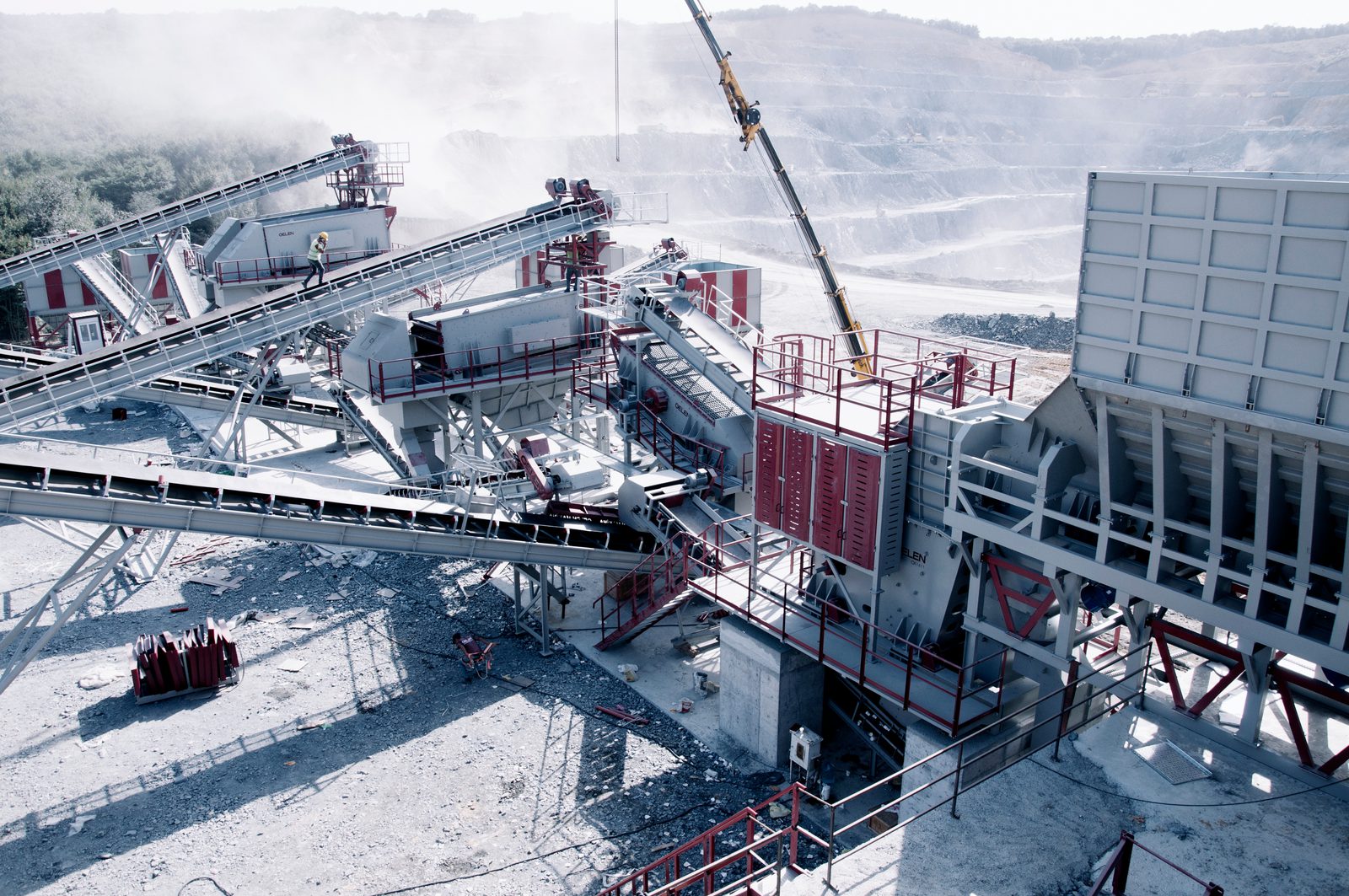
Using two jaw crushers in series (sometimes called a "double jaw" circuit) is common in:
- Mining operations where the ore is extremely hard and abrasive, making cone crusher liner costs prohibitive.
- Remote sites where simplicity is paramount — jaw crushers have fewer moving parts and are easier to maintain in the field than cones.
- Recycling plants needing fine recycled aggregate from reinforced concrete — rebar tolerance in both stages is an advantage.
Typical double-jaw flow: ROM feed → GELEN CK primary jaw (CSS 100 mm) → vibrating screen → GELEN CK secondary jaw (CSS 25 mm) → product stockpiles.
GELEN CK Series — Primary & Secondary Models
The GELEN CK jaw crusher range covers both primary and secondary applications with a single platform design. Key models:
| Model | Role | Feed Opening (mm) | CSS Range (mm) | Capacity (TPH) | Motor (kW) |
|---|---|---|---|---|---|
| CK 0604 | Secondary | 600 × 400 | 20–60 | 25–80 | 30 |
| CK 0806 | Secondary / Small primary | 800 × 600 | 30–80 | 40–150 | 55 |
| CK 1008 | Primary | 1,000 × 800 | 50–120 | 80–300 | 90 |
| CK 1210 | Primary | 1,200 × 1,000 | 80–160 | 150–500 | 160 |
| CK 1612 | Heavy primary | 1,600 × 1,200 | 100–200 | 300–800 | 250 |
All models feature hydraulic CSS adjustment, reversible jaw plates, and heavy-duty eccentric shaft bearings.
Application Scenarios
| Scenario | Recommendation | Why |
|---|---|---|
| Granite quarry, 300 t/h, need 0–31.5 mm | Primary jaw + cone | Cone gives best shape at fine sizes |
| Basalt quarry, 100 t/h, need 0–50 mm, no cone budget | Primary jaw + secondary jaw | Simpler; both handle abrasive basalt |
| Limestone quarry, 200 t/h, need 0–100 mm road base | Primary jaw only | Product spec is coarse enough |
| Concrete recycling, 80 t/h, need 0–31.5 mm RCA | Primary jaw + secondary jaw | Both stages tolerate rebar |
| Gold mine, 500 t/h, feed SAG mill (<150 mm) | Large primary jaw only | CK 1612 reaches 100 mm CSS in one stage |
Conclusion
Primary and secondary jaw crushers serve different but complementary roles. Choose your configuration based on final product size, material hardness, budget, and site complexity. A "double jaw" circuit is a proven, low-maintenance solution for hard materials and remote operations.
GELEN's CK Series covers both roles with models from 600 × 400 to 1,600 × 1,200 mm — all sharing the same hydraulic CSS, reversible plates, and heavy-duty bearing design. Contact us for a plant layout tailored to your requirements.