
Who this is for: plant engineers and operators choosing sand washing equipment, or trying to find out why a washing line loses fine sand or produces wet sand.
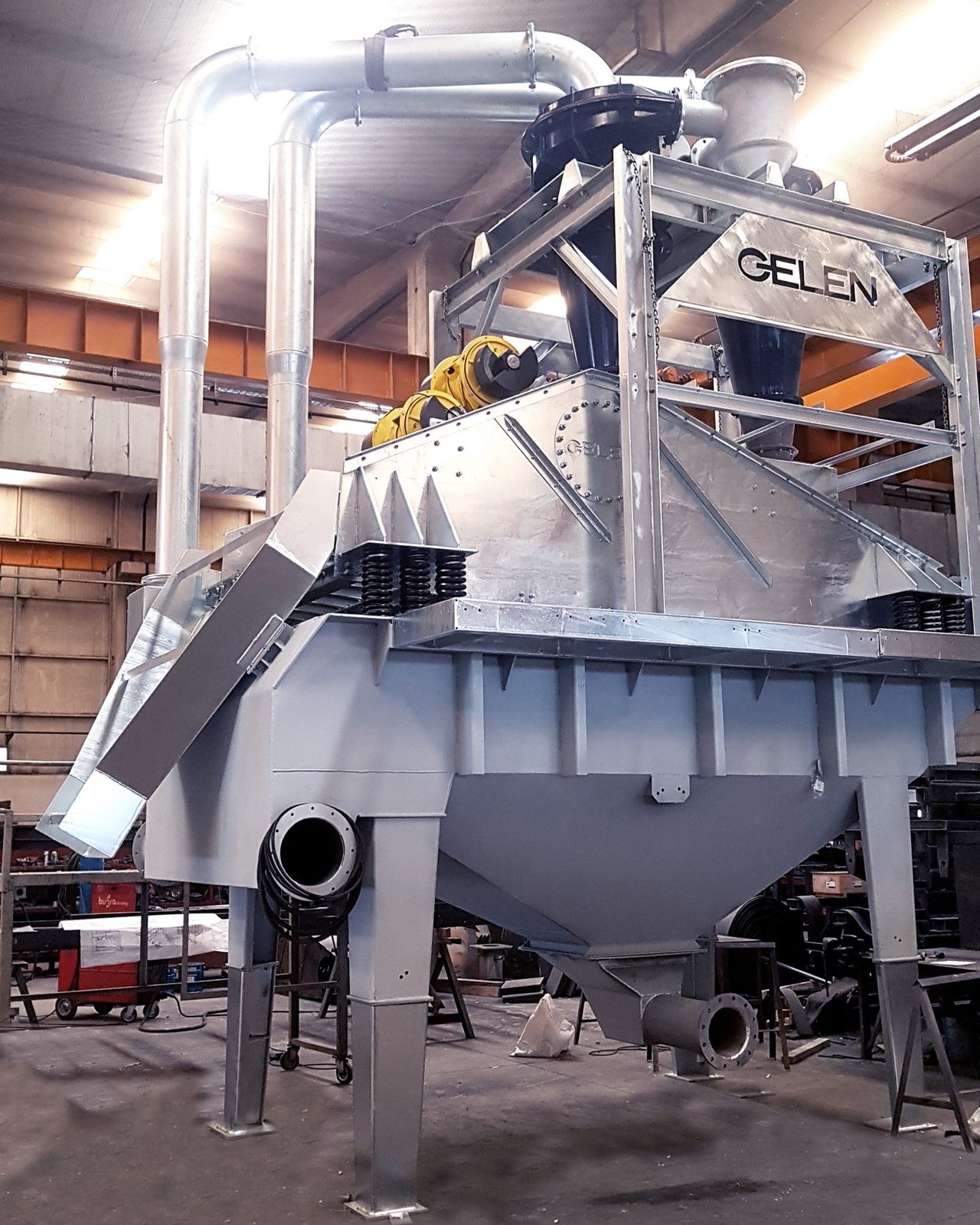
How a Hydrocyclone Works
A hydrocyclone has no moving parts. A pump feeds the sand slurry under pressure into the cylindrical top of the cyclone through a tangential inlet, so the slurry spins down the conical body. The spinning creates a centrifugal force many times gravity.
- Coarse, heavy particles move to the wall, spiral down and leave through the apex at the bottom: the underflow, which is the sand product.
- Water and fine particles stay in the centre, turn upward in an inner vortex and leave through the vortex finder at the top: the overflow, which carries the silt and clay.
The size at which a particle has an equal chance of reporting to either outlet is the cut point (d50). Sand washing cyclones typically cut at about 0.063–0.075 mm. The cut becomes finer with a smaller cyclone diameter, a higher feed pressure and a lower solids content in the feed, and coarser in the opposite direction.
A healthy sand cyclone discharges a spray-shaped underflow. A rope-shaped underflow means the apex is overloaded and fine sand is being pushed into the overflow: reduce the solids load or open the apex.
Because the underflow is still wet, cyclones in a sand plant sit above a high-frequency dewatering screen that drains the sand before it leaves. Together with the slurry pump and sump, this makes the compact sand washing plant.
How a Screw Classifier Works
A screw classifier is an inclined trough with a slowly turning spiral. The sand slurry enters the lower end, where a pool forms behind an overflow weir. Sand settles to the bottom of the pool, the spiral lifts it up the incline out of the water, and it drains as it rises before discharging at the top.
Water with the silt and clay flows over the weir. What settles and what overflows depends on the pool area and the overflow rate: the larger the pool and the slower the water, the finer the sand it keeps. In practice a screw classifier keeps sand coarser than about 0.15 mm (100 mesh).
Screw classifiers are simple and robust: one drive, a slow spiral with wear-resistant flights, no pressure and no pump in the sand line. Twin-spiral machines handle considerably more sand than a single spiral of the same size. See the GELEN HY screw classifiers and GFW fine material washers.
Side by Side
| Hydrocyclone with dewatering screen | Screw classifier | |
|---|---|---|
| Separating force | Centrifugal, from pump pressure | Gravity settling in a pool |
| Typical cut point | About 0.063–0.075 mm | About 0.15 mm |
| Fine sand recovery | High | Lower: fines leave with the overflow |
| Product moisture | Lower, dewatered on a high-frequency screen | Higher, drains on the stockpile |
| Moving parts in the sand line | Slurry pump and screen exciters | Slow spiral only |
| Wear points | Pump, cyclone liners, screen panels | Spiral flights and trough liners |
| Sensitivity to feed changes | Needs a steady slurry density | Tolerant of changing feed |
| Footprint for the same tonnage | Compact, stacked unit | Long inclined machine |
Which One Should You Use?
Choose a screw classifier when
- The sand is medium to coarse and little of it is finer than 0.15 mm
- Simple operation and low maintenance matter more than recovering every fine grain
- The feed changes a lot during the day
Choose a sand washing plant when
- Fine sand is valuable and is being lost to the ponds
- The market wants a drier sand that can be sold straight from the stockpile
- Water is scarce, and a drier product and tighter water circuit help
Use both when
The screw classifier handles the main tonnage, and its overflow goes to a sand washing plant that recovers the fine sand it would otherwise lose. This is a common upgrade for existing plants: the fines that used to fill the ponds become a saleable product.
Fines Recovery and Water Recycling
Whatever separates the sand, the overflow water still carries silt and clay. Recovering that water is the last step of the washing circuit:
- Settling ponds: the simplest option; the silt settles and clear water is pumped back. They need space and periodic cleaning.
- Thickener: flocculant settles the fines quickly in a tank, returning most of the water within minutes.
- Filter press or belt press: turns the thickened silt into a handleable cake, so no wet ponds are needed.
Recovering the fine sand before this step reduces the solids the water treatment has to handle, which is another reason plants add cyclones to screw classifier overflows.