
Wet Screening & Dewatering
Heavy-moisture feed and dewatering duty, where circular throw keeps moist fines moving and drains the bed on the deck.
- Spray-pipe wet mode
- Moist fines stratified not pegged
- Drainage on a horizontal deck

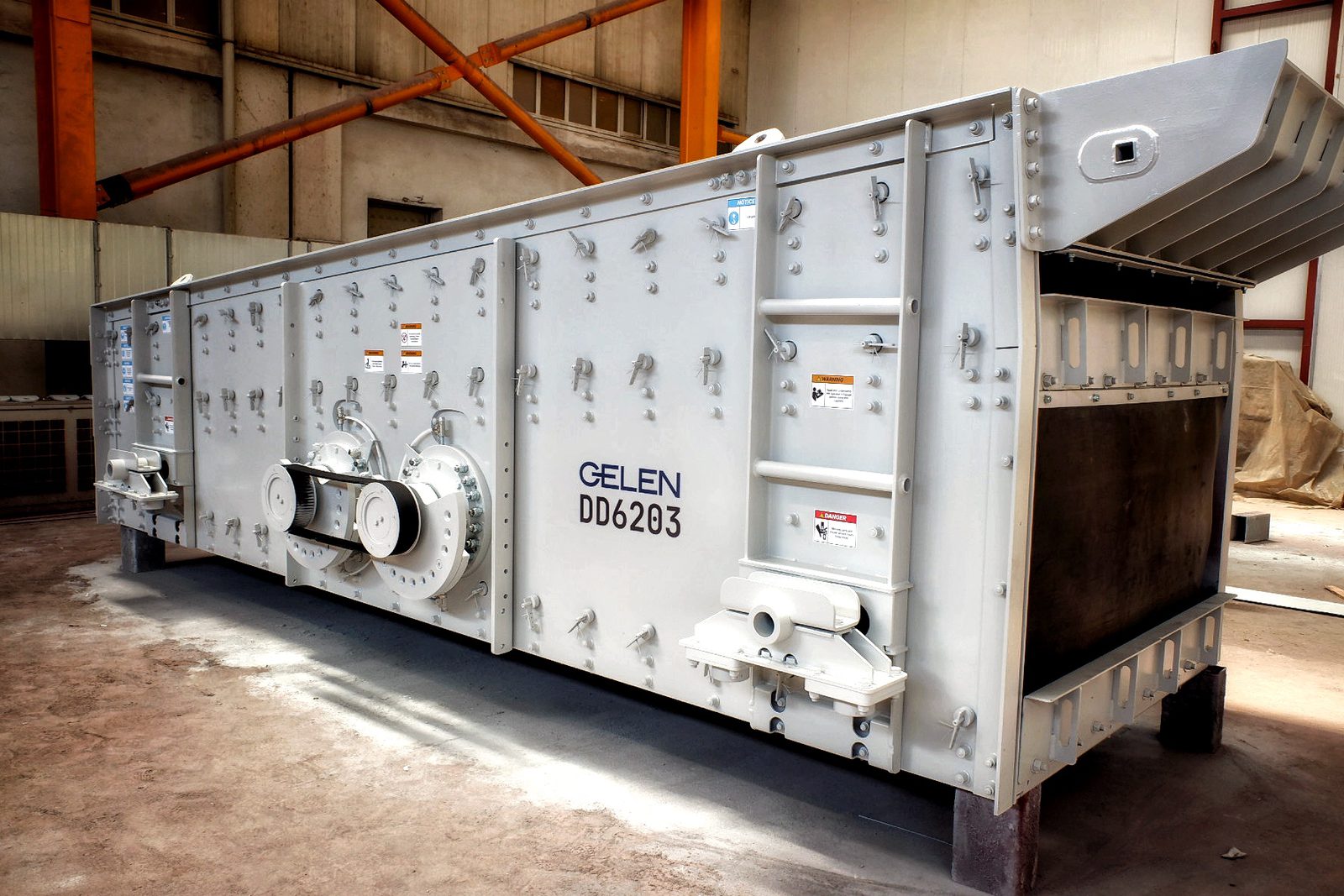
The GELEN DD Series takes its name from its defining feature: two independent motors drive two parallel shafts that turn in the same direction, held in phase by a toothed timing belt. In phase, the two counterweight assemblies add into a single rotating force and the body runs a circular orbit — the same motion family as a single-shaft circular screen, but with the exciter force and the bearing duty split across two shafts. That is what lets a DD carry a far larger unbalance than one eccentric shaft could, on a horizontal, low-headroom deck.
One rotating force from two shafts: the counterweights on both shafts run in phase, so their unbalance adds into one rotating resultant. The machine gets the throw of a much bigger exciter without asking a single eccentric shaft and its bearings to carry it.
Each side can be watched on its own: the two motors are not mechanically coupled — the timing belt locks phase, it does not transmit torque. Bearing temperature, motor current and vibration can be read independently on each side, which makes a fault easy to isolate.
A horizontal deck that still conveys: the frame is bolted down at 0° and the deck stack carries a small slope toward discharge. The bed advances under the circular throw, helped by that slope, so there is no steep incline and no gravity free-fall past a partly blinded aperture.
Built for water: heavy-moisture and dewatering duties are the reason the family exists: the circular throw agitates and stratifies moist fines that would peg a deck on a steeper machine.
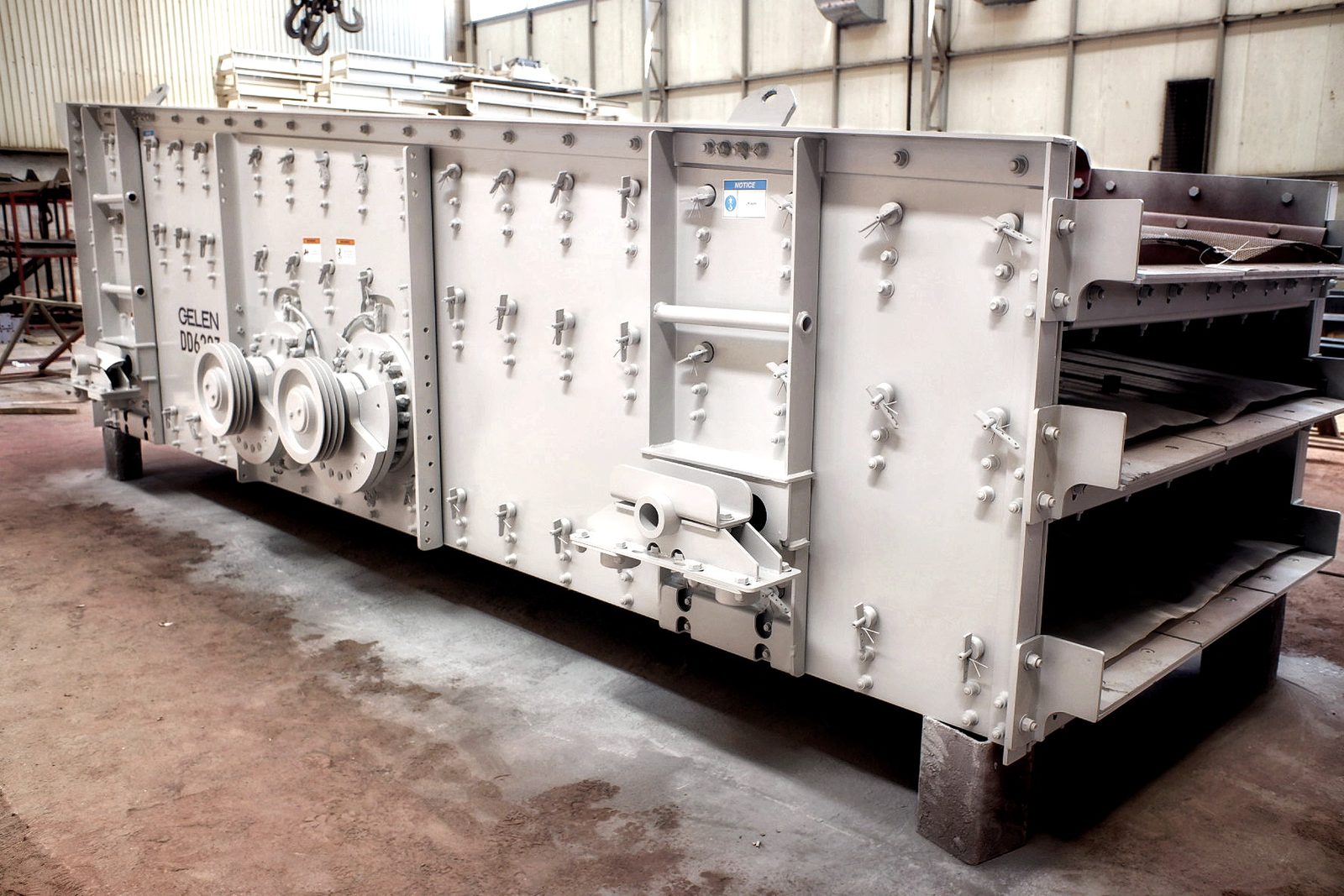
A DD screen is a twin-motor, twin-shaft, circular-motion machine on a horizontal frame. Each shaft has its own motor and V-belt drive; a single toothed timing belt between the shafts holds them in phase. Both shafts run in their own oil bath on spherical roller bearings, and the body hangs on eight helical coil springs, two at each corner, so the operating frequency sits above the natural frequencies in every axis. Decks are PU panels held in bolted cassettes, tensioned by a wedge-bolt system and backed by silicone anti-blinding balls; the structural joints are Huck swaged-collar fasteners, not bolts.
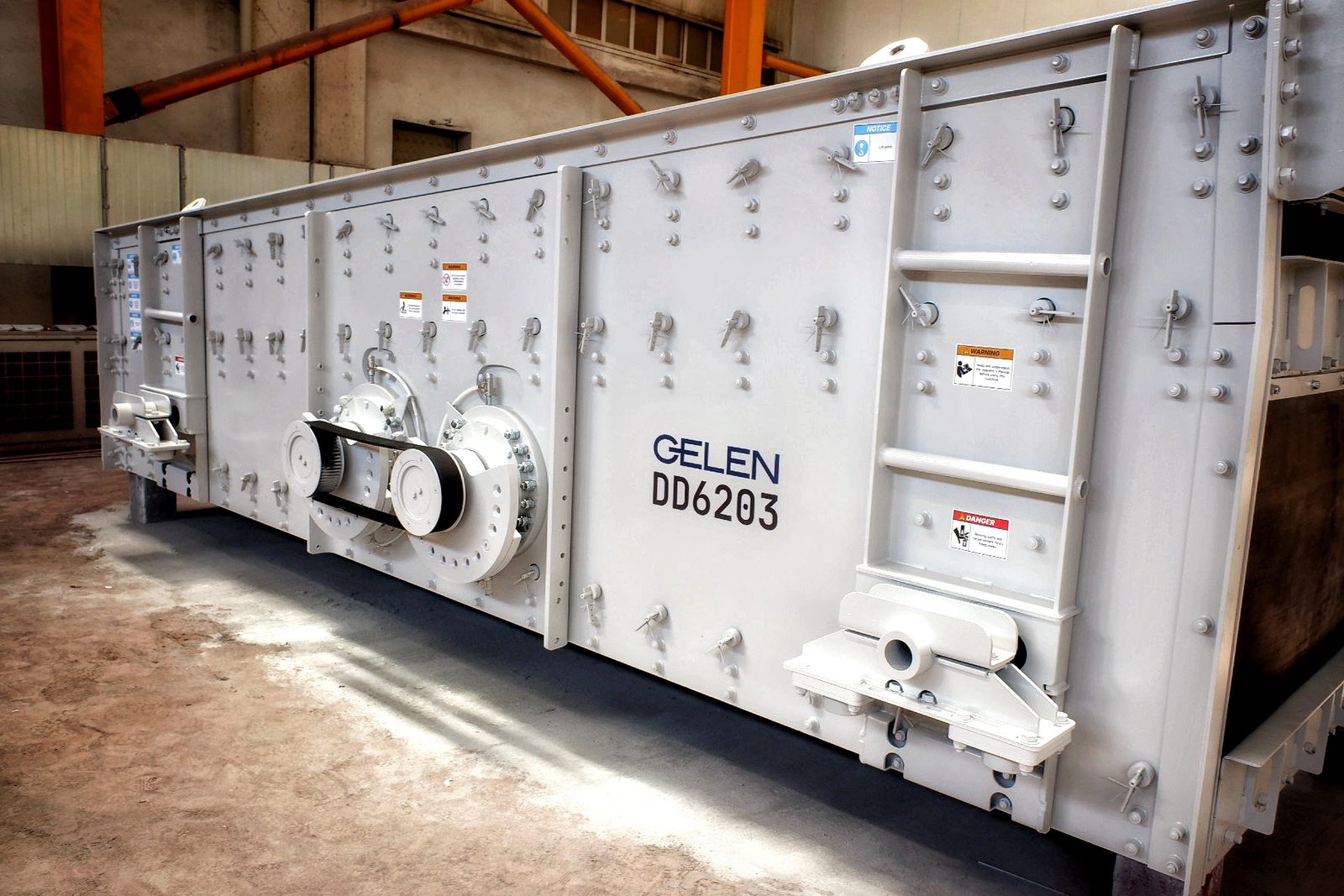
The DD is not a catalogue line with off-the-rack sizes: deck count, deck width and length, aperture set, coating and any wet-mode plumbing are decided for the duty at sales. The machine below is one delivered build — a three-deck DD6203 with two 22 kW motors — given so the scale of the family is clear. Send GELEN application engineering your feed, its moisture, the cuts you need and the tonnage, and the machine is sized from those.
| Decks | Overall Widthmm | Overall Lengthmm | MotorskW | Static Masskg | |
|---|---|---|---|---|---|
| DD6203 | 3 | 3,345 | 6,805 | 2 x 22 | 16,500 |
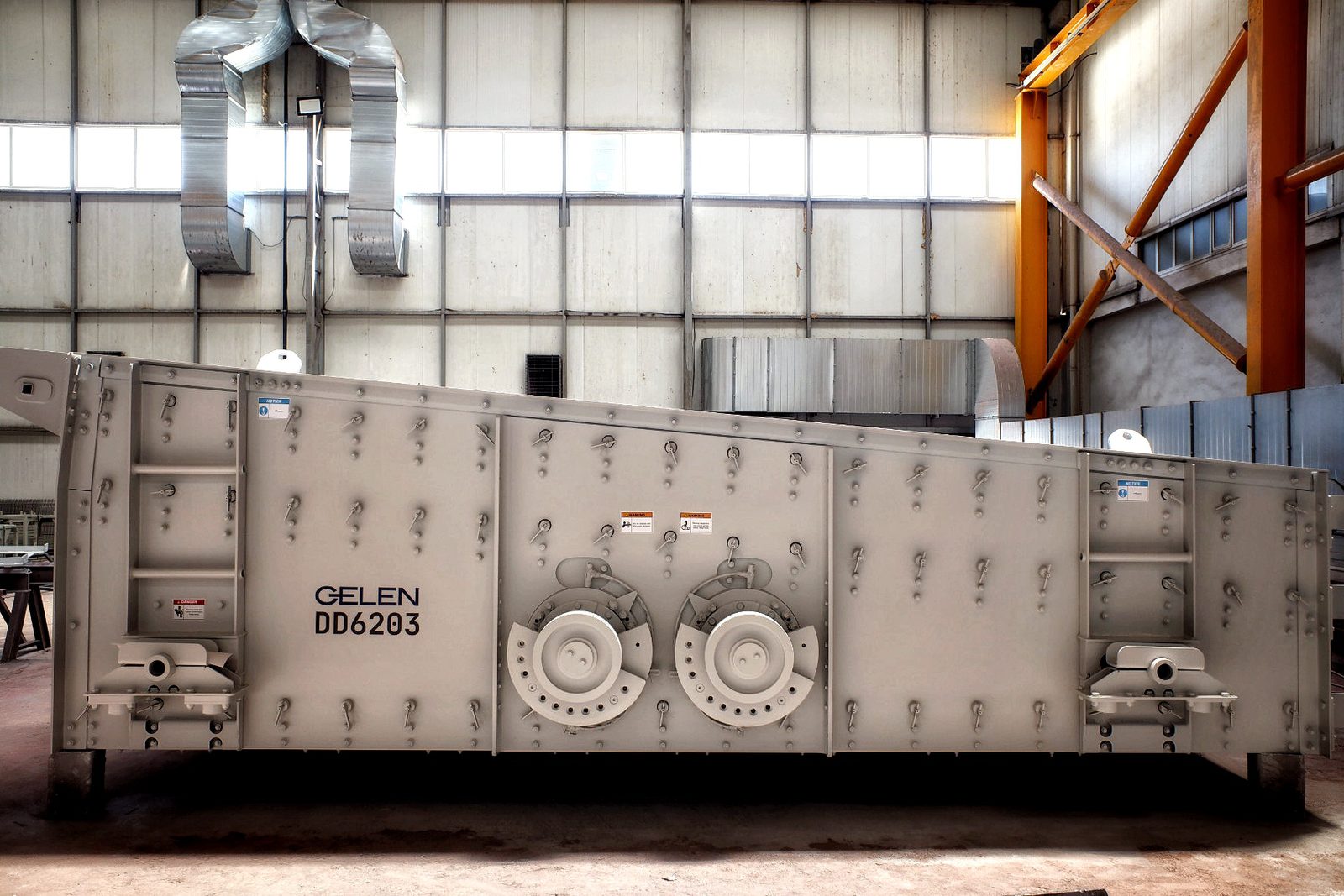
One delivered machine, not a size range: overall dimensions, 0° frame, three decks, two GAMAK 22 kW four-pole motors (44 kW installed) and the bare-machine mass without screen media, from the DD6203 manual. Every DD is configured for its own duty.
The DD6203 from the side: four things worth naming.
One per side. Each carries a shaft in its own oil bath on spherical roller bearings, and the toothed belt between them holds the two counterweights in phase.
The studs across the side plate are swaged collars, not bolts. They are installed once and cannot work loose the way a torqued joint can.
Eight helical coil springs, two at each corner, put the operating frequency above the natural frequency in every axis.
The frame is bolted down at 0 degrees and the deck stack carries a small slope toward this end, so the bed advances under the circular throw.
A DD is specified from the duty, not from a size list. What is fixed is the architecture: two co-rotating shafts in phase on a timing belt, one motor and V-belt drive per shaft, two independent oil baths, spherical roller bearings, eight helical springs at the four corners, PU deck panels in bolted cassettes with anti-blinding balls, and a horizontal frame with lightly sloped decks. Deck count, deck size, apertures, drive rating and coating follow the feed, its moisture, the cut points and the tonnage. Tell GELEN application engineering those four things and the machine is sized around them.
Every dual drive screen is built to its duty. Tell us the cut, the moisture and the tonnage and we will size one.
Size one for meTwo shafts, one motion — and a bed that travels on a horizontal deck.
Each shaft has its own squirrel-cage motor and V-belt drive. Both turn the same way; co-rotation is what produces the circular motion.
A toothed belt between the two shafts keeps their counterweights in step. It locks phase only — it transmits no drive torque.
In phase, the rotating counterweights on both shafts combine into a single rotating resultant, and the body follows a circular orbit.
The circular throw lifts and turns the bed so fines work down to the deck, while the slight deck slope carries the material to discharge.
Undersize passes each deck through its apertures; the oversize leaves at the discharge end as a sized product.
The DD is chosen where the feed is wet, the cut is fine, or the tonnage is high for the headroom available.
Heavy-moisture feed and dewatering duty, where circular throw keeps moist fines moving and drains the bed on the deck.

Classification at fine and ultra-fine apertures, including proppant (frac sand) sizing where the cut has to hold.

Plants that need the tonnage of a big screen but cannot give a steep inclined machine the height it wants.
What the Dual Drive architecture puts into the machine.
Two shafts share the exciter force and the bearing duty, so the machine carries an unbalance a single eccentric shaft of that capacity could not.
A toothed belt between the shafts holds the counterweights in phase. It sets the motion; it carries no drive torque.
Each shaft runs in its own oil bath on spherical roller bearings, with labyrinth seals purged with grease and a V-ring that flings water off.
Eight helical coil springs, two per corner, put the operating frequency above the system's natural frequencies in every axis.
PU deck panels sit in bolted cassettes tensioned by wedge bolts, with silicone balls under the media that dislodge near-aperture particles before they peg.
The primary structural joints are swaged Huck fasteners rather than bolts: installed once, they cannot loosen the way a torqued joint can.
A DD takes the wet, fine or high-tonnage duty in a plant that would otherwise need a much larger inclined machine. It follows crushing or a washing stage, and its undersize goes on to sand recovery or dewatering.
Every circuit is different. Send us yours and we will say where a dual drive screen fits and what it changes downstream.
Check my circuitAll four GELEN screen families size material; the choice is made on the feed, the cut and the duty, not on plant convenience.
| Dual Drive (DD) | Inclined (STE) | Horizontal (ETE) | Grizzly (ITE) | |
|---|---|---|---|---|
| Motion | Circular from two co-rotating shafts | Circular from one eccentric shaft | Elliptical from three geared shafts | Circular with a grizzly top deck |
| Frame | Horizontal, lightly sloped decks | Inclined | Horizontal | Inclined |
| Best for | Heavy moisture, fine and ultra-fine cuts, high capacity | Clean to moderately moist feed at coarse to medium cuts | Sticky, fine-cut or near-blinding feed | Primary scalping ahead of the crusher |
| Headroom | Low | High | Low | High |
| Sizes | Configured per duty | Published size ladder | Published size ladder | Published size ladder |
Not sure which one? Send us the duty and an engineer will say which, and what you would give up by choosing the other.
Which one fits?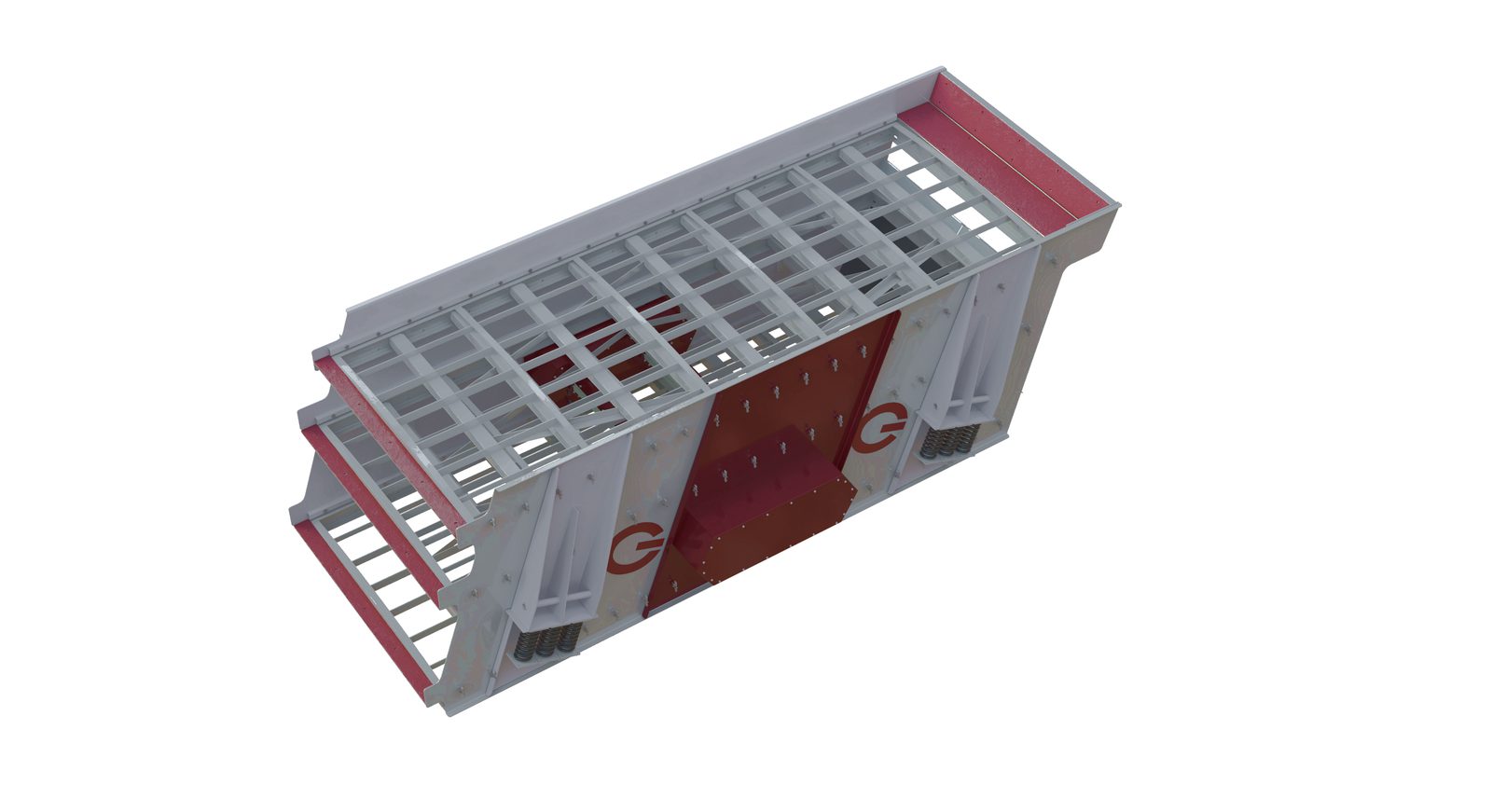
Technical guides and industry organisations for aggregate producers.
A screen driven by two motors turning two parallel shafts in the same direction, held in phase by a toothed timing belt. Because the shafts are in phase, the unbalance of their counterweights adds into one rotating force and the body runs a circular orbit. The point of splitting the exciter across two shafts is capacity: the machine can carry a much larger unbalance than a single eccentric shaft of the same class.
No. The DD is a circular-motion machine and its two shafts co-rotate. An earlier revision of GELEN's documentation described it as linear-motion with counter-rotating shafts; that description is wrong and has been retired. Three things follow from the correction: the motors turn in the same direction, the counterweights set a circular orbit rather than a straight-line throw, and the bed behaves as it does on any circular-motion screen.
Heavy moisture and dewatering duty, fine and ultra-fine cuts, proppant (frac sand) classification, and high capacity where headroom is limited. It complements rather than replaces the inclined STE: the choice between the families is made on the feed material, the cut and the duty.
The frame sits at 0°, but the deck stack carries a small downward slope toward discharge. The bed advances under the circular throw, helped by that slope. Because there is no steep incline, material stays on each deck longer for a given throughput, which is part of why the machine suits difficult, moist feed.
There is no published size ladder. Deck count, deck size, apertures, drive rating and coating are configured for the duty at sales, and the delivered configuration is recorded on the machine's nameplate. As an example of the scale, one delivered build — the DD6203 — is a three-deck machine of about 3,345 × 6,805 mm overall with two 22 kW motors and a bare mass of about 16,500 kg.
The routine of any vibrating screen plus the two things the twin-shaft drive adds: keep both oil baths at level and change the oil to schedule, and keep the timing belt in condition and correctly tensioned, since it is what holds the two shafts in phase. Check the V-belt tension on each drive, the springs, the screen media and the anti-blinding balls, and watch bearing temperature and motor current on each side independently.
Send your material, your capacity and the product sizes you need. An engineer answers, not a form.