

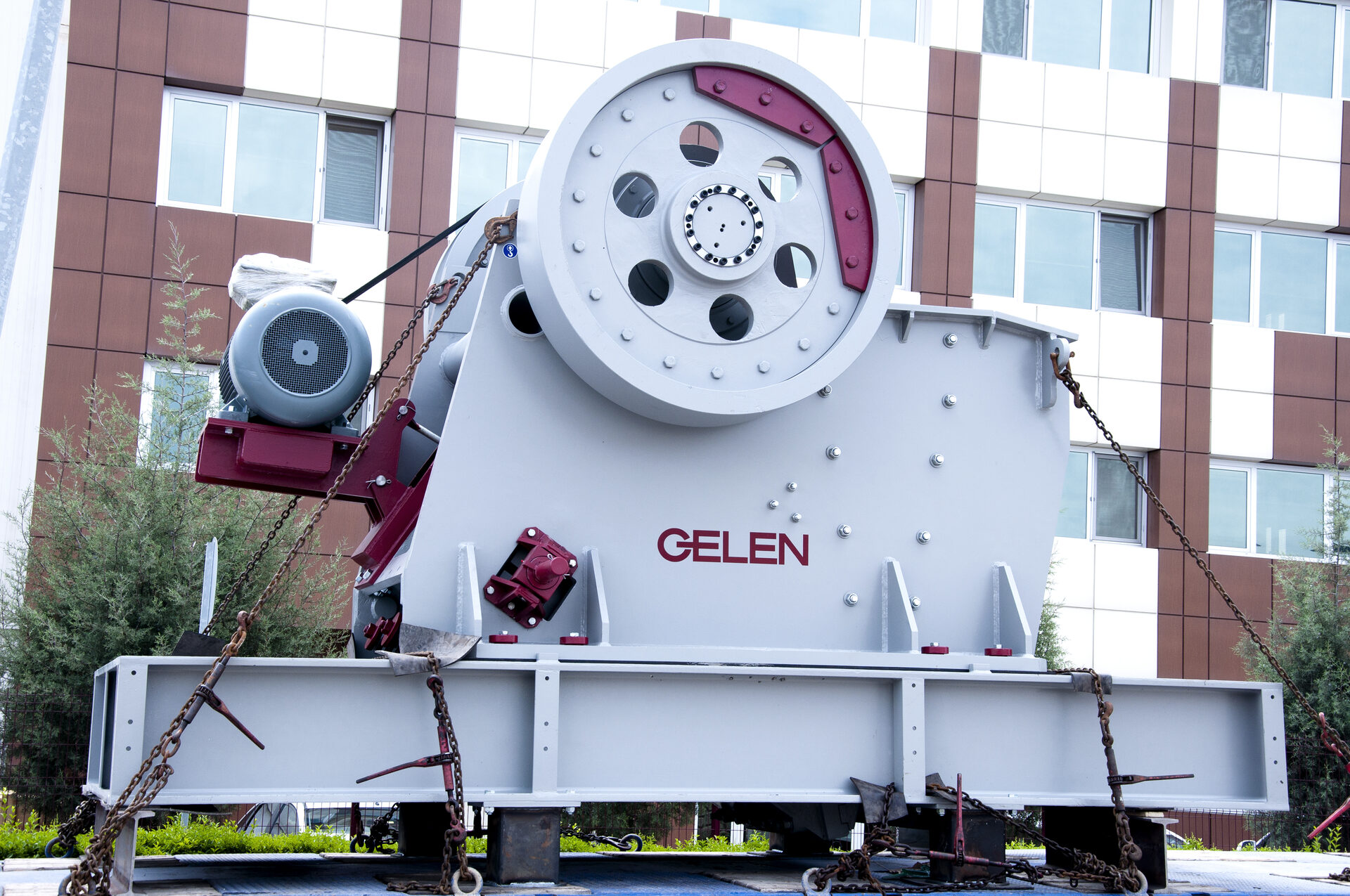
The Complete Guide to Jaw Crushers
What Is a Jaw Crusher?
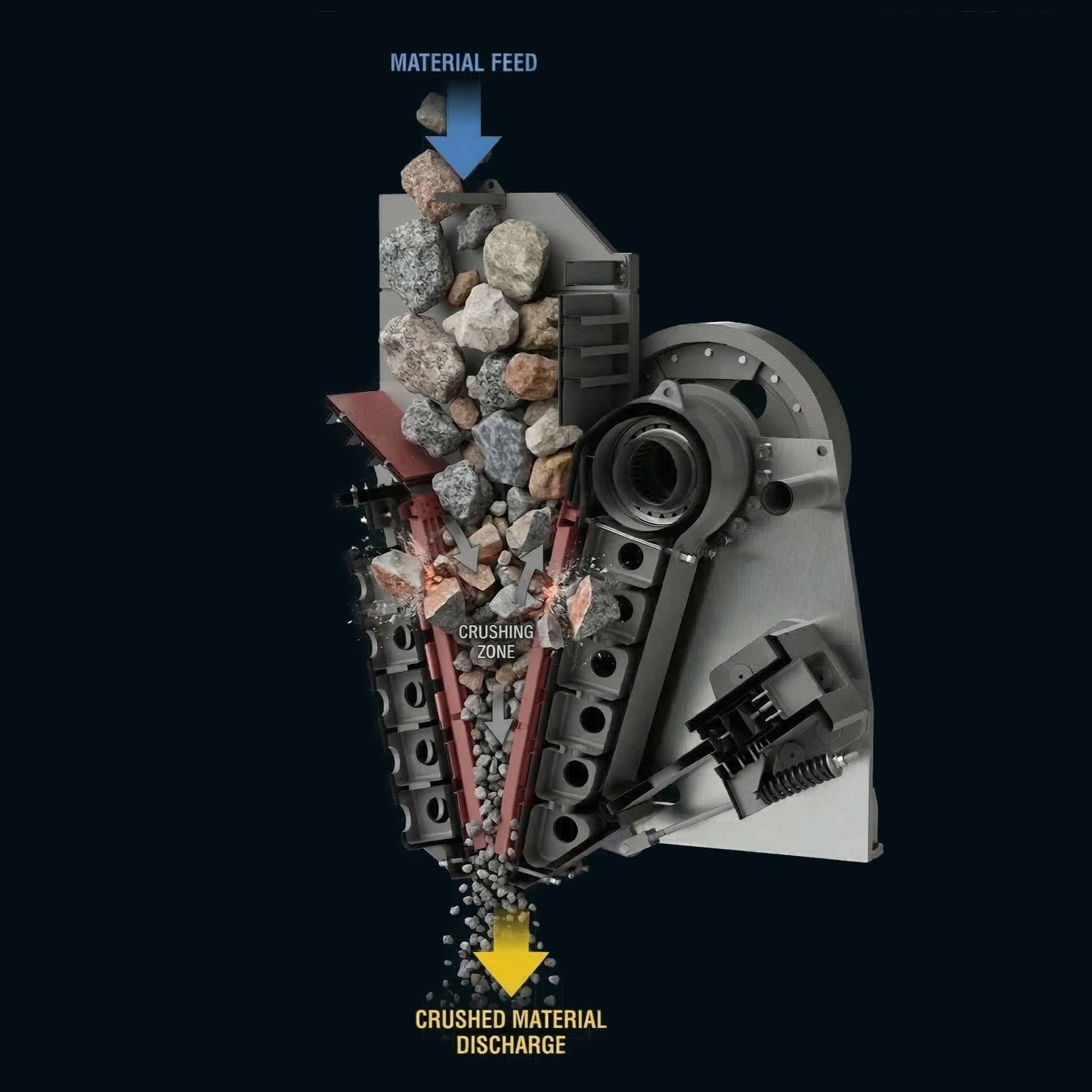
A jaw crusher is a primary crushing machine used across the aggregate, mining and recycling industries. It breaks large stones, ores and demolition rubble into smaller, conveyable pieces by squeezing them between a fixed stationary jaw and a moving swing jaw — pure compressive force, which is why jaw crushers handle hard rock up to around 250 MPa compressive strength that would destroy other crusher types.
In almost every crushing plant, the jaw crusher is the first machine the material meets after the feeder. Everything downstream — cone crushers, screens, washing systems — depends on the jaw doing its job: taking unpredictable, oversized run-of-mine feed and turning it into a consistent product the rest of the plant can process.
GELEN has manufactured jaw crushers since 1981. The CK Series covers twelve models from compact 25 tph machines to primary crushers rated at 1,000 tph, in both primary and secondary configurations.
How a Jaw Crusher Works
The working principle is simple and has barely changed in a century — which is exactly why jaw crushers are so reliable. An electric motor spins a flywheel connected to an eccentric shaft. The eccentric motion makes the swing jaw approach and retreat from the stationary jaw roughly 200–300 times per minute. Material entering the crushing chamber from the top is compressed on each closing stroke, breaks, and drops lower in the chamber as the jaw opens — until it is small enough to fall through the discharge opening at the bottom.
Two settings define what comes out of the machine:
- CSS (closed side setting) — the narrowest gap between the jaws at the bottom of the chamber. This is the main control over product size and is adjusted hydraulically on modern GELEN crushers. See the CSS setting guide for the full procedure.
- Reduction ratio — the ratio between feed size and product size. A jaw crusher typically achieves up to about 6:1, which is why a 600 mm feed leaves the machine at roughly 100 mm.
Because the crushing action is compression rather than impact, wear is concentrated on two replaceable manganese steel jaw plates — one of the lowest wear-cost arrangements of any crusher type.
Jaw Crusher Anatomy: The Components That Matter
When you evaluate or operate a jaw crusher, five components determine performance and operating cost:
- Jaw plates — replaceable manganese steel liners that do the actual crushing. They work-harden in service and are the main consumable; profile and alloy choice depend on your material (see the jaw plate selection guide). GELEN plates are reversible, doubling usable life.
- Toggle plate — the mechanical fuse. If uncrushable material (tramp iron, a digger tooth) enters the chamber, the toggle breaks first, protecting the frame and shaft.
- Eccentric shaft and bearings — convert rotation into the crushing stroke. Bearing temperature is the single most useful health indicator on the machine.
- Flywheels — store energy between crushing strokes, smoothing the load on the motor and reducing peak power draw.
- Frame — GELEN uses stress-relieved welded steel frames sized for continuous primary duty.
Types of Jaw Crushers
Single-Toggle Jaw Crushers
The dominant modern design and the basis of the GELEN CK Series. The swing jaw hangs directly on the eccentric shaft, so it both compresses and pulls material down the chamber in one elliptical motion. The result is higher throughput, simpler construction and easier maintenance than older designs — the right choice for nearly all aggregate, mining and recycling duty.
Double-Toggle Jaw Crushers
An older, heavier design in which the swing jaw moves in pure compression. It survives in a few extremely abrasive niche applications, but for the vast majority of plants its lower throughput and higher cost are no longer justified.
Primary vs Secondary Jaw Crushers
Jaw crushers come in two duty configurations, and confusing them is one of the most common specification mistakes. Primary models have deep chambers and wide inlets (up to 1,600 × 1,200 mm on the CK1612) to swallow blasted rock up to roughly 1,080 mm. Secondary models — CK920, CK1338, CK1465 — have flatter chamber geometry and tighter closed side settings (down to 30 mm) to re-crush material that has already passed a primary. The full comparison is in our primary vs secondary jaw crusher guide.
Mobile Jaw Crushers
Any CK Series crusher can be supplied on a wheeled or track-mounted chassis as part of a mobile crushing plant — the standard answer for contract crushing, temporary sites and in-pit operations where the crusher must follow the face.
Jaw Crusher Sizes and Capacity
Representative models from the GELEN CK Series primary range — the full table with all twelve models is on the jaw crushers product page:
| Model | Inlet opening (mm) | Max feed (mm) | CSS range (mm) | Capacity (tph) |
|---|---|---|---|---|
| CK638 | 600 × 380 | 340 | 40–150 | 25–120 |
| CK965 | 900 × 650 | 580 | 60–170 | 80–260 |
| CK1185 | 1100 × 850 | 760 | 75–200 | 180–460 |
| CK1612 | 1600 × 1200 | 1,080 | 150–300 | 500–1,000 |
Two sizing rules save most buyers from mistakes: the largest feed lump should be no more than about 80% of the inlet opening depth, and the machine should run at 70–85% of its rated capacity for the best liner life. The jaw crusher handbook walks through the full step-by-step selection calculation.
Jaw Crusher vs Cone Crusher vs Impact Crusher
The three main crusher families are not competitors — they are stages. But at the margins the choice matters:
- Jaw crusher — the primary machine. Unbeatable at accepting large, unpredictable, hard feed. Product is coarse and somewhat flaky, which is why a jaw is almost always followed by another stage. Full comparison: jaw vs cone.
- Cone crusher — the secondary/tertiary machine for hard, abrasive rock. Takes the jaw's product and turns it into spec-size aggregate at tight tolerances. See GELEN GHC Series cone crushers.
- Impact crusher (HSI) — trades higher wear cost for a better-shaped, more cubical product; strongest in softer, less abrasive stone and recycling. Full comparison: jaw vs impact.
Applications Across Aggregate, Mining and Recycling
- Quarrying & aggregates — primary reduction of limestone, granite and basalt for construction materials; the highest-volume jaw crusher application worldwide.
- Mining — primary crushing of hard ores ahead of grinding circuits, in both open-pit and underground operations.
- Recycling & demolition — concrete and asphalt recycling, including reinforced concrete: the compression action lets rebar pass through for magnetic separation afterwards. See jaw crushers for concrete recycling.
Wear Parts and Operating Cost
A jaw crusher's operating cost is dominated by three items — jaw plates, electricity, and unplanned downtime — and all three respond to operating discipline:
- Keep the chamber choke-fed: a full chamber crushes rock against rock, spreads wear evenly and improves product shape. Trickle feeding wears the bottom of the plates prematurely.
- Flip or rotate jaw plates before the profile is fully flattened — reversible GELEN plates give a second life at zero parts cost.
- Re-check the CSS regularly: plates wear open, product creeps coarser, and downstream screens start recirculating material.
- Follow a schedule: the jaw crusher maintenance schedule covers daily, weekly and monthly checks, and the troubleshooting guide covers the failures you can diagnose before they stop production.
Choosing the Right Jaw Crusher
Five questions determine the correct model:
- Material characteristics — hardness, abrasiveness and moisture content set the machine class.
- Maximum feed size — determines the minimum inlet opening (feed ≤ ~80% of inlet depth).
- Required capacity — target tons per hour, sized so the crusher runs at 70–85% of rating.
- Product size — sets the CSS, and with it whether one crushing stage is enough or a secondary is required.
- Mobility — stationary plant, wheeled or tracked chassis.
GELEN engineers plants for aggregate, mining and recycling producers in more than 50 countries — send us your material data and we will size the crusher and the circuit around it.
FAQ
What is a jaw crusher used for?
Primary crushing: the first size-reduction stage in aggregate, mining and recycling plants. It converts blasted rock, ore or demolition rubble of up to roughly one metre into a 100–300 mm product that downstream crushers and screens can process.
What reduction ratio can a jaw crusher achieve?
Typically up to about 6:1 in a single pass. Requiring more than that from one stage is the most common cause of poor product shape and accelerated liner wear — add a secondary stage instead.
How big a feed can a jaw crusher take?
The largest GELEN primary model, the CK1612, accepts feed up to 1,080 mm through its 1,600 × 1,200 mm inlet. As a rule the biggest lump should not exceed about 80% of the inlet depth.
Single toggle or double toggle?
Single toggle, in almost every case: higher throughput, lighter, cheaper to maintain. Double toggle survives only in a handful of extremely abrasive special applications.
When should I choose a cone or impact crusher instead?
You usually don't choose instead — you choose after. The jaw takes the primary stage; a cone (hard, abrasive rock) or an HSI (softer stone, better cubical shape) takes the secondary. Only in small recycling setups does a single impact crusher sometimes replace the jaw entirely.
Further Reading
- Jaw Crusher Handbook — in-depth guide from selection to optimization.
- Jaw Crusher Maintenance Schedule — printable PM checklists.
- Jaw Crusher Troubleshooting Guide — diagnose and fix common problems.
- CSS Setting Guide — step-by-step CSS adjustment.
- Jaw Plate Selection Guide — choose the right alloy.
- Jaw Crusher vs Impact Crusher
- Jaw Crusher vs Cone Crusher
- Primary vs Secondary Jaw Crusher
- Jaw Crusher for Concrete Recycling
Experience the GELEN Difference
GELEN jaw crushers combine advanced engineering with robust construction to deliver:
- Superior crushing performance
- Extended component life
- Low operating costs
- Easy maintenance
Our wide range of jaw crusher sizes ensures we have the perfect solution for your primary crushing needs, from compact units to large-scale rock crusher installations.