
Who this is for: plant designers, quarry and mine managers and contractors choosing the feeder for a primary crushing station, a surge bin or a reclaim tunnel.
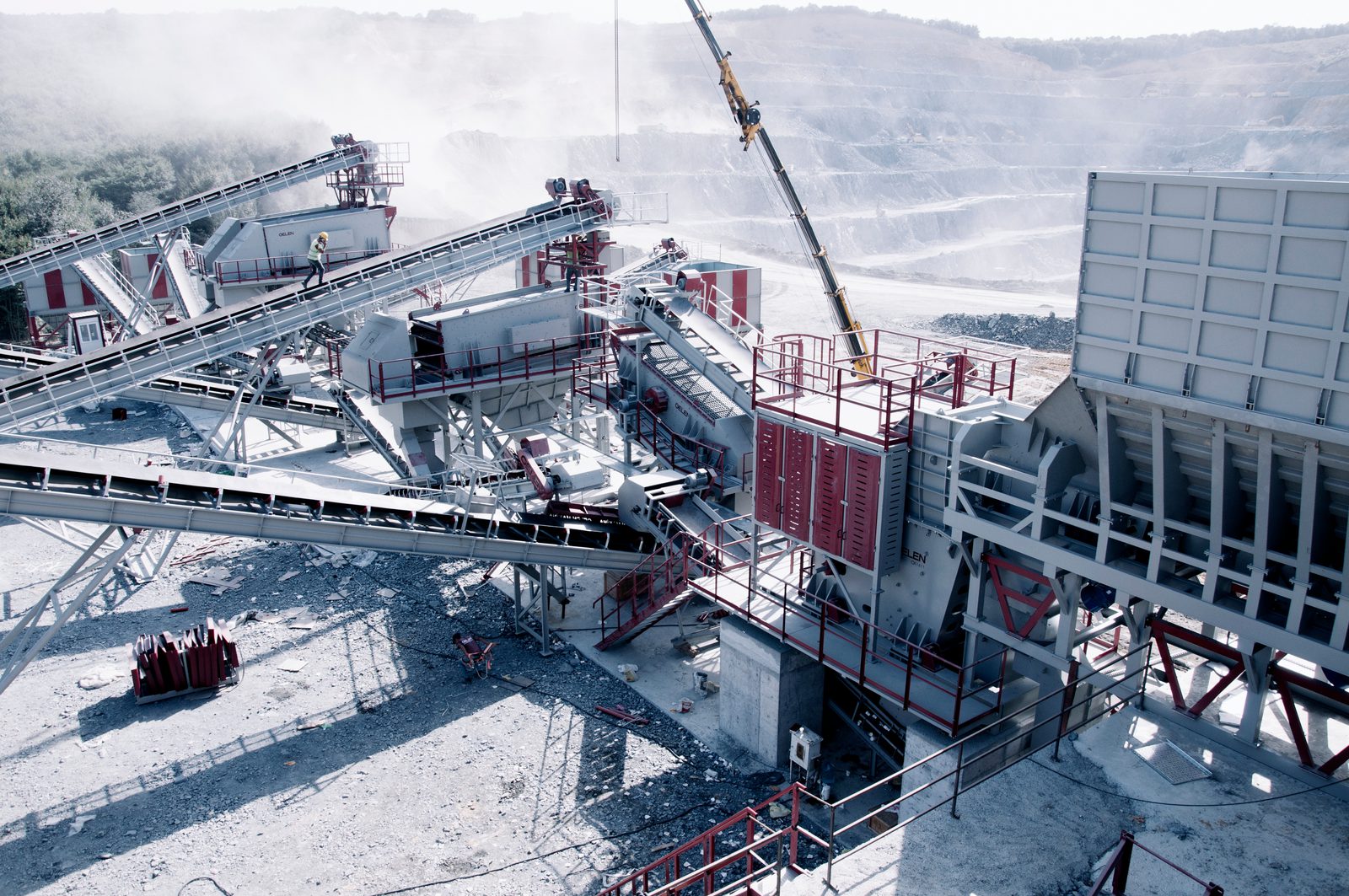
What a Feeder Does
Trucks and loaders deliver material in surges. A crusher works best with a steady, choke-fed chamber. The feeder sits between the two: it takes the impact of the dumped load, holds back the material in the hopper and delivers it to the crusher at a controlled rate. Some feeders also scalp, letting fines fall through before the crusher so they do not use its capacity.
The Five Main Types
Vibrating feeder
A steel pan driven by two unbalanced vibrator motors moves a bed of material forward in a linear motion. Speed and stroke set the feed rate. Suited to hard, free-flowing rock under hoppers at primary and secondary stations.
Vibrating grizzly feeder
A vibrating feeder with a section of grizzly bars at the discharge end. Fines fall through the gaps and bypass the crusher; only the oversize enters the chamber. It raises plant capacity and reduces crusher wear when the feed carries a lot of fines.
Apron feeder
Overlapping cast steel pans on heavy chains form a moving floor under the hopper. Apron feeders take direct truck dumping of large, heavy, sharp run-of-mine material and handle the highest impact loads.
Wobbler feeder
Elliptical bars mounted 90° apart turn at the same speed, rolling the material forward while fines, mud and clay fall through the constant gaps between them. The rolling action keeps the gaps clear, which suits wet and sticky feed that would blind a static grizzly.
Reciprocating feeder
A plate moves back and forth under a hopper or bunker, pushing a set amount of material over its edge on each stroke. It suits controlled discharge from bunkers, surge bins and reclaim tunnels.
Side by Side
| Feeder | Best material | Impact loading | Scalping | Typical position | GELEN theoretical capacity |
|---|---|---|---|---|---|
| Vibrating (TB) | Hard, free-flowing rock | High with a material bed | No | Under primary and secondary hoppers | 90–820 t/h |
| Grizzly feed screen (BE) | Free-flowing rock with fines | High with a material bed | Yes, through grizzly bars | Primary crusher feed | 380–770 t/h |
| Apron (AF) | Heavy, sharp run-of-mine rock and ore | Very high, direct truck dumping | No | Heavy-duty primary stations | 350–1,840 t/h |
| Wobbler (WB) | Wet, sticky, clay-rich material | Medium | Yes, through rotating bars | Primary feed of difficult material | 290–520 t/h |
| Reciprocating (RB) | Bulky or uneven material from storage | Medium | No | Bunkers, surge bins, reclaim tunnels | 330–710 t/h |
Theoretical capacities are calculated for free-flowing material at a bulk density of 1.6 t/m³ with the standard volumetric method; actual capacity depends on the material, lump size, moisture and hopper design.
How to Size a Feeder for the Primary Crusher
Feeders are sized with the same volumetric method most manufacturers use:
Q (t/h) = 3600 × B × h × v × ρ × φ, where B is the pan width (m), h the bed depth (m), v the material speed (m/s), ρ the loose bulk density (t/m³) and φ a fill factor.
- Width first: the pan must take the largest lump the trucks deliver without bridging, and match the crusher inlet.
- Length for duty: a longer pan holds more material under the hopper, protects the drive from impact and allows a grizzly section.
- Capacity with margin: choose a feeder whose range covers the crusher capacity at the setting you will run, not only its maximum.
- Hopper design: keep the feeder choke-fed, so a bed of material on the pan absorbs the impact of dumped loads.
Worked example
A vibrating feeder 1.3 m wide with a bed 0.35 m deep moving at 0.25 m/s, loose density 1.6 t/m³ and a fill factor of 0.85: 3600 × 1.3 × 0.35 × 0.25 × 1.6 × 0.85 ≈ 560 t/h. That sits inside the 410–740 t/h range of a GELEN TB1335 or TB1355.
Quick Selection Guide
- Hard, free-flowing rock under a hopper: vibrating feeder
- Rock with a lot of fines ahead of the primary crusher: grizzly feed screen or vibrating grizzly feeder
- Very large, heavy ore dumped straight from haul trucks: apron feeder
- Wet, sticky or clay-rich pit material: wobbler feeder
- Controlled discharge from a bunker or reclaim tunnel: reciprocating feeder
For the grizzly section itself, the grizzly bar spacing guide explains how to set the gap to the crusher setting.