
Who this is for: quarry and mine operators, plant designers and contractors specifying a new stone crusher plant or adding a crusher to an existing circuit.
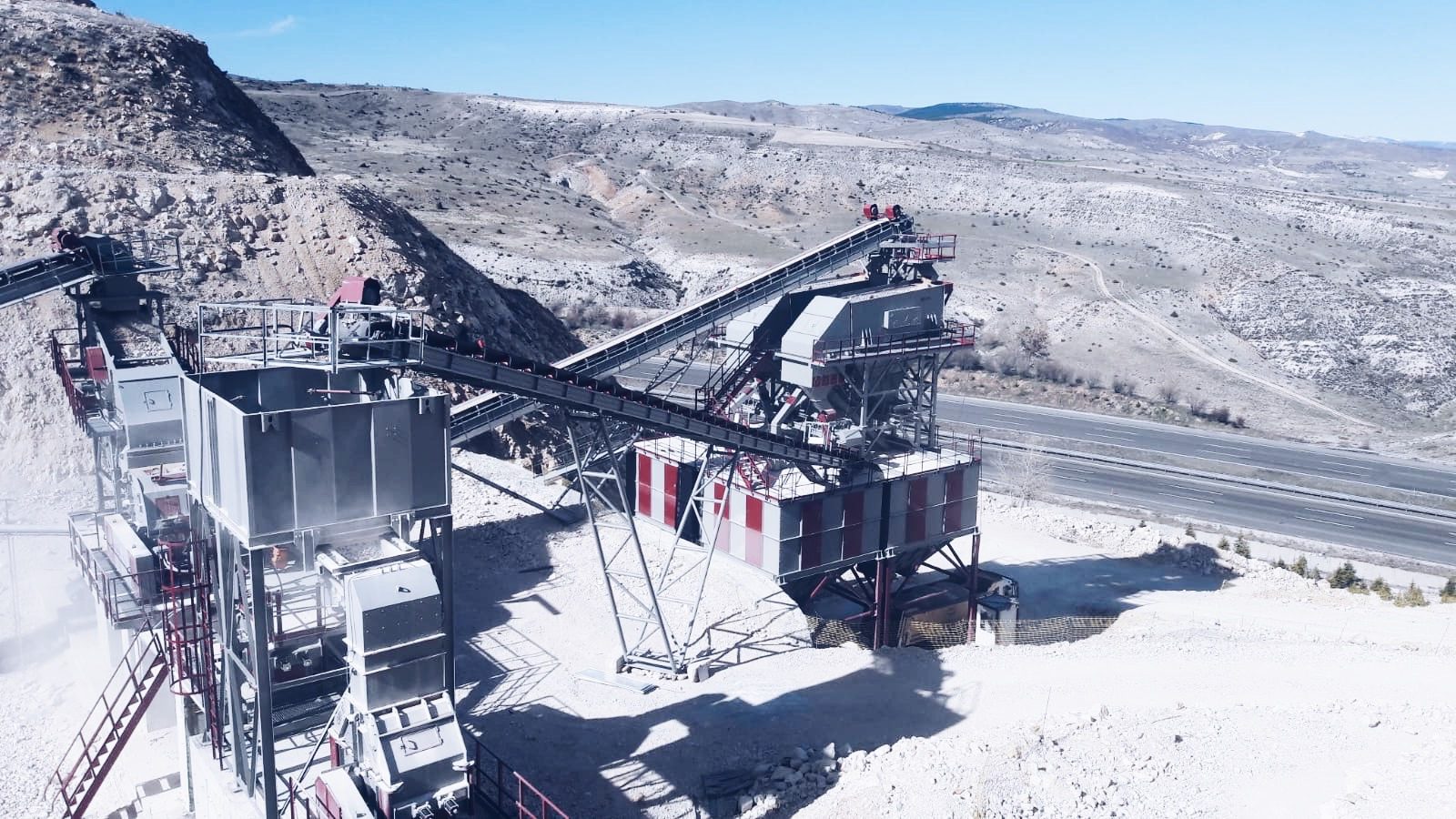
What a Crusher Does in the Plant
A crusher reduces blasted rock, gravel, ore or demolition material to smaller, usable sizes, and it is the core machine of the crushing circuit in aggregate, mining and recycling plants. No single machine does the whole job: a stone crusher plant reduces rock in stages and screens between them, so each crusher only handles the material it needs to reduce.
- Primary crushing takes the largest feed — blasted rock straight from the face — and reduces it to a size the next stage can handle. Jaw crushers and primary impact crushers are the machines for this stage.
- Secondary crushing brings the primary product close to saleable sizes. Cone and impact crushers are common here.
- Tertiary and quaternary crushing produce the final sizes and shape: cone crushers, tertiary impact crushers, or a VSI for manufactured sand.
What limits a stage is the reduction ratio. A jaw crusher gives roughly 4:1 to 6:1, a cone crusher 6:1 to 8:1, a horizontal shaft impact crusher 6:1 to 10:1 and a VSI 2:1 to 5:1. That arithmetic is why nobody goes from a 700 mm feed to 0–5 mm sand in one machine, and why most plants combine two or three crusher types.
The Four Crusher Types
Jaw crusher (CK series)
A jaw crusher breaks rock by compression between a fixed and a moving plate. An eccentric shaft swings the pitman, the wedge-shaped chamber closes and the rock is squeezed until it breaks; everything else on the machine is there to keep that motion going under load. Because the wear is spread over two plates, it has the lowest wear cost per tonne in abrasive material — granite, basalt, hard ore.
The CK series covers nine primary and three secondary models. Primary feed openings run from 600 × 380 mm to 1,600 × 1,200 mm and accept lumps up to 1,080 mm; the closed side setting, 40 to 300 mm, decides how much work is left for the next stage. Capacity runs from 20 to 1,000 t/h. The trade-off is shape: jaw product is flatter than cone or impact product, and is usually corrected downstream.
Cone crusher (GHC series)
A cone crusher squeezes rock between a gyrating mantle and a fixed concave. The gap closes and opens once per revolution at every point around the chamber, so a piece is compressed several times on its way down rather than once. Fed choke-full, the rock also breaks against rock and not only against manganese — that is what makes the product cubical and the liners last.
The GHC series has four models covering 25 to 600 t/h, with a closed side setting of 6 to 50 mm and a maximum feed of 35 to 300 mm depending on the model. Fine (F), medium (M) and extra coarse (EC) concave profiles tune the same machine to a secondary or a tertiary duty. Hydraulic adjustment changes the closed side under load and, when tramp iron arrives, releases and lets it pass instead of stopping the plant.
Horizontal shaft impact crusher
A horizontal shaft impact crusher does not squeeze the rock, it hits it. Blow bars on the rotor strike the feed and throw it against the aprons, where it breaks again on the rebound. One pass gives a reduction ratio of 6:1 to 10:1 — the work compression needs two stages for — and because the fracture follows the natural planes in the stone, the product comes out cubical.
The limit is abrasion. Blow bars are consumable and they wear fast in high-silica rock, which is why the impact crusher is at home in limestone, dolomite, gypsum and demolition waste — materials up to about 200 MPa — and a jaw is the better primary in granite or basalt. The GELEN horizontal shaft range covers 15 current models across primary, secondary and tertiary duty, with rotor diameters from 1,000 to 1,600 mm, capacities from 40 to 900 t/h and feed up to 1,300 mm on the primary models.
Vertical shaft impact crusher (VSI)
A vertical shaft impact crusher is the only machine in the plant that shapes as well as reduces. The rotor throws the feed out at 40 to 70 m/s and the stone breaks against a bed of its own kind that forms around the chamber, not against a steel face. Grains fracture along their natural planes, so the flat and elongated particles go first and what leaves the chamber is close to cubical. The working surface is renewed by the feed itself, which keeps wear costs low for such an abrasive duty.
The price is feed size. A VSI wants material a jaw, cone or impact crusher has already reduced: 40 to 50 mm on the closed rotor (CR) models, up to 120 mm on the open rotor VSI900-OR. It has no tolerance for tramp metal at all. Four models cover 700, 800 and 900 mm rotor diameters and 50 to 350 t/h, and the product curve is tuned with rotor speed and cascade ratio without changing a single wear part.
Crusher Types Compared
| Crusher | Crushing stage | How it crushes | Max feed size | Reduction ratio | Best material | Product shape |
|---|---|---|---|---|---|---|
| Jaw crusher (CK) | Primary and secondary | Compression between a fixed and a moving jaw | Up to 1,080 mm | 4:1 to 6:1 | Hard and abrasive rock, ore | Good; some flaky particles |
| Cone crusher (GHC) | Secondary and tertiary | Compression between mantle and concave | Up to 300 mm | 6:1 to 8:1 | Hard and abrasive rock | Cubical |
| Horizontal shaft impact crusher | Primary, secondary and tertiary | Impact from blow bars against aprons | Up to 1,300 mm | 6:1 to 10:1 | Medium-hard rock, limestone, recycling | Very cubical |
| Vertical shaft impact crusher (VSI) | Tertiary and quaternary | Rock-on-rock impact from a high-speed rotor | Up to 120 mm | 2:1 to 5:1 | Abrasive, brittle and moist material | Best shape; manufactured sand |
Reduction ratios and feed sizes are the values published on the GELEN product pages; the result on site depends on the material, the gradation and the setting.
GELEN Crusher Series and Capacities
| Series | Stage | Models | Capacity | Feed and setting |
|---|---|---|---|---|
| CK jaw crushers | Primary and secondary | 12 models | 20–1,000 t/h | Feed up to 1,080 mm, closed side setting 30–300 mm |
| GHC cone crushers | Secondary and tertiary | 4 models | 25–600 t/h | Feed 35–300 mm, closed side setting 6–50 mm |
| Horizontal shaft impact crushers | Primary, secondary and tertiary | 15 models | 40–900 t/h | Feed up to 1,300 mm on the primary models |
| VSI vertical shaft impact crushers | Tertiary and quaternary | 4 models | 50–350 t/h | Feed 40–50 mm on the closed rotor, up to 120 mm on the open rotor |
Figures are taken from the specification tables on the GELEN product pages and are nominal; actual capacity depends on the material, gradation, moisture and operating conditions.
Four Questions That Decide the Crusher
- How hard and how abrasive is the rock? Abrasiveness usually decides more than hardness. As the silica content rises, blow bar wear accelerates and compression crushing — a jaw, then a cone — becomes the cheaper circuit.
- What is the largest lump? Start at the feed opening: it should be at least 20% larger than the biggest stone you expect. That number alone eliminates most of the range.
- What product are you selling, and in what shape? Asphalt and concrete specifications reward cubical particles. A jaw crusher on its own will not get you there; a cone crusher, an impact crusher or a VSI will.
- How many tonnes per hour? Read the capacity at the setting you will actually run, not the maximum in the table. A smaller setting gives a finer product at a lower output.
The practical threshold: from roughly 8% silica upwards, blow bars become the dominant operating cost. Below it, impact crushing wins on reduction ratio and product shape; above it, the circuit turns to jaw and cone.
Which Crusher for Which Material
- Granite, basalt, gabbro and hard ore: a primary jaw crusher, then secondary and tertiary cone crushers
- Limestone, dolomite and gypsum: impact crushers from primary to tertiary, cubical product in one pass
- Reinforced concrete, asphalt and demolition waste: a primary impact crusher, then an impact or a hydraulically protected cone crusher as secondary
- River gravel and pit material: a jaw or impact primary, then a cone crusher
- Manufactured sand and final shaping: a vertical shaft impact crusher, with washing downstream
Still deciding between two machines? The jaw crusher vs impact crusher, jaw crusher vs cone crusher and HSI vs VSI guides take each pair in detail.
Three Typical Stone Crusher Plant Circuits
Hard rock quarry
Grizzly feeder → jaw crusher → screen → cone crusher → screen → tertiary cone or VSI. The jaw takes the abrasion at the primary stage, where the feed is largest and dirtiest; the cones do both the reduction and the shaping. A VSI is added at the end when the plant sells manufactured sand or has to meet a tight shape index.
Limestone quarry
Feeder with scalping → primary impact crusher → screen → secondary impact crusher → tertiary impact crusher → final screens. In rock below about 200 MPa and low in silica, impact crushing gives a higher reduction ratio and a better shape than compression, so a whole plant can be built from one crusher family.
Recycling and manufactured sand
Feeder → primary impact crusher → metal detector and screen → secondary impact or cone crusher → VSI → washing. Demolition concrete and asphalt break easily but carry rebar, so hydraulic apron adjustment and hydraulic overload release matter more than raw capacity. Where the plant makes sand, the VSI does the shaping and washing takes out the fines.