

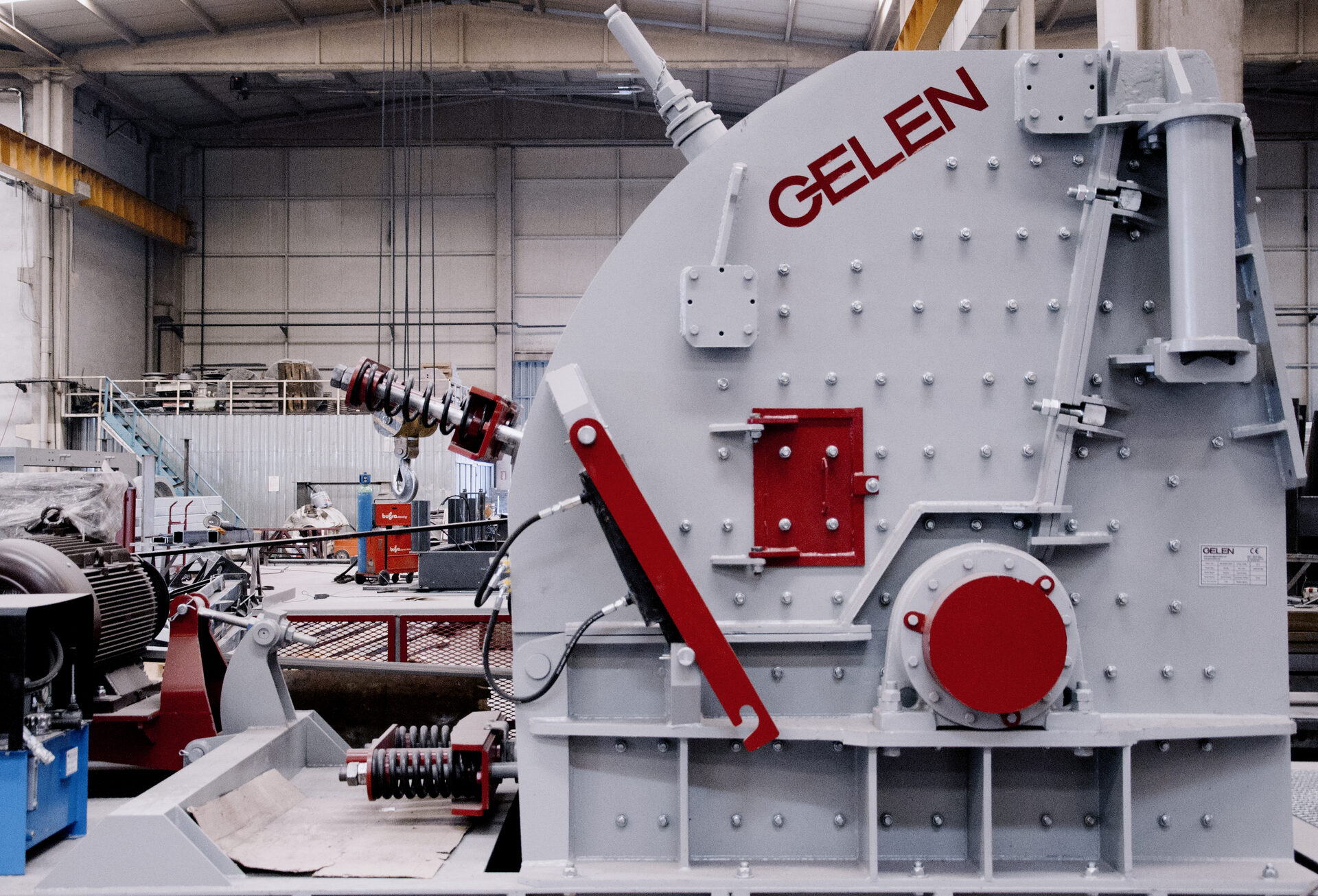
HSI vs VSI Impact Crusher: Which Do You Need?
Introduction: Both HSI (horizontal shaft impact) and VSI (vertical shaft impact) crushers belong to the impact crusher family, but they share very little beyond the use of impact force. They differ in rotor orientation, crushing stage, maximum feed size, output size range, and typical application. Choosing the wrong one for your circuit results in oversized product, excessive wear, or missed production targets. This guide gives you the full comparison.
How HSI Crushers Work
A horizontal shaft impact (HSI) crusher uses a heavy horizontal rotor fitted with replaceable blow bars. Material is fed from above and enters the crushing chamber, where it is struck by the blow bars rotating at 25–45 m/s. The shattered material is then thrown against two or three adjustable impact aprons (curtains) inside the housing, where secondary and tertiary impacts further reduce particle size.
The gap between the rotor and the aprons controls the maximum output size. Closing the gap produces finer product; opening it increases throughput at a coarser gradation. The aprons can also swing open hydraulically as an overload protection mechanism when tramp metal or uncrushable material enters.
- Feed size: Up to 700–1,300 mm depending on series (PDK primary series accepts up to 1,300 mm)
- Output range: Typically 0–150 mm depending on apron setting
- Best for: Limestone quarry, concrete recycling, asphalt RAP processing, demolition waste, soft to medium-hard rock primary and secondary crushing
- Crushing stages: Primary, secondary, or tertiary depending on rotor size and series
How VSI Crushers Work
A vertical shaft impact (VSI) crusher uses a completely different principle. Material is fed through the top of the machine into a high-speed vertical rotor. The rotor accelerates the material outward through centrifugal force and launches it at very high velocity against either a stationary anvil ring (rock-on-metal) or a rock shelf (rock-on-rock, or autogenous crushing).
In rock-on-rock mode, incoming material builds up on the rock shelf and incoming material breaks against this rock bed — greatly reducing wear part consumption. In rock-on-metal mode, the anvils provide consistent gradation but wear faster.
- Feed size: Strictly limited to 60–80 mm maximum — larger material damages the rotor
- Output range: Primarily 0–20 mm; excellent for manufactured sand (0–5 mm) and shaped decorative aggregate
- Best for: Manufactured sand production, final shaping of pre-crushed aggregate, high-cubicity premium aggregate, specialty products
- Crushing stage: Tertiary only — material must already be pre-crushed to feed size limits
HSI vs VSI — Side-by-Side Comparison
| Factor | HSI Crusher | VSI Crusher |
|---|---|---|
| Shaft orientation | Horizontal | Vertical |
| Crushing stage | Primary, secondary, or tertiary | Tertiary only |
| Maximum feed size | Up to 1,300 mm (PDK series) | Up to 80 mm maximum |
| Output range | 0–150 mm (apron-controlled) | 0–20 mm (sand and shaped aggregate) |
| Reduction ratio | 6:1 to 10:1 | 2:1 to 5:1 |
| Product shape | Good cubic | Excellent cubic / near-spherical |
| Handles rebar / tramp metal | Yes — with manganese blow bars; aprons swing open | No — damages rotor immediately |
| Best material | Limestone, concrete, asphalt, gypsum, demolition waste | Pre-crushed aggregate, river gravel, clean hard rock |
| Fines generation | 15–25% | 30–45% (higher fines by design) |
| Wear mechanism | Blow bar impact + apron abrasion | Centrifugal abrasion on anvils or rock shelf |
| Maintenance interval | Every 400–1,500 h (blow bars) | Every 500–2,000 h (anvils or shelf material) |
| GELEN series | PDK, SDK, DST, TDK, HTK | VSI Series |
When to Choose an HSI Crusher
Choose an HSI crusher when one or more of the following conditions apply:
- Material compressive strength is at or below 200 MPa (limestone, dolomite, concrete, asphalt, gypsum)
- Your feed size exceeds 80 mm — making VSI impossible
- You need primary or secondary crushing as well as size reduction
- Your feed may contain recycled concrete with rebar, tramp metal, or mixed demolition material
- You want a single machine capable of a broad application range across different projects or materials
- You need a high reduction ratio in one pass to minimize the number of crushing stages
Important: If your feed contains rebar, tramp metal, or uncrushable oversized rock — always choose HSI over VSI. Feeding these materials into a VSI rotor will cause immediate and severe damage to the rotor tip inserts and casting.
When to Choose a VSI Crusher
Choose a VSI crusher when your application matches the following criteria:
- You need manufactured sand (0–5 mm) with high particle index and low flakiness
- You require highly spherical or cubical aggregate shape for premium concrete or specialty applications
- Your feed has already been crushed to below 80 mm in a previous stage — the VSI is purely a finishing machine
- You are producing high-value decorative aggregate, specialty industrial minerals, or premium concrete aggregate
- The feed is clean — no rebar, no tramp metal, consistent particle size
View the GELEN VSI crusher product page for capacity data and technical specifications.
Using Both in a Crushing Circuit
In premium aggregate plants and manufactured sand operations, HSI and VSI crushers are often used in sequence — with each doing what it does best.
Typical three-stage circuit for manufactured sand:
- Jaw crusher (primary): Reduces ROM feed from 600–800 mm down to 80–150 mm. Handles all hardness levels and tramp metal. Low wear cost on the first break.
- HSI crusher (secondary): Reduces jaw output to 0–50 mm. Produces cubical aggregate and pre-sizes material for the VSI. Handles variable feed with minor contamination.
- VSI crusher (tertiary): Takes the +5 mm fraction and converts it to manufactured sand (0–5 mm) and high-quality shaped aggregate (5–20 mm). Feed is now clean, pre-sized, and at consistent hardness — ideal VSI conditions.
This three-stage configuration is common in premium aggregate plants in Europe and the Middle East where specification-grade manufactured sand commands a significant price premium over natural river sand.
GELEN HSI and VSI Series Summary
| Series | Type | Stage | Capacity Range | Product Page |
|---|---|---|---|---|
| PDK, SDK, DST, TDK, HTK | HSI | Primary to Tertiary | 40–900 TPH | HSI Crushers |
| VSI Series | VSI | Tertiary | Varies by model | VSI Crushers |
Related Articles
- Complete HSI Crusher Guide — working principle, sizing, blow bars, maintenance, and cost analysis.
- Blow Bar Selection Guide — match alloy to rock type and operating conditions.
- Jaw Crusher vs Impact Crusher — compression vs impact: which is right for your material?
Conclusion
The HSI and VSI crusher are complementary machines, not competitors. The HSI is a versatile workhorse that handles large, dirty feed and produces a broad range of aggregate sizes in primary and secondary roles. The VSI is a precision finishing machine that converts pre-crushed, clean material into premium manufactured sand and highly cubical aggregate.
Match the machine to the stage and the material. If you are unsure which configuration is right for your plant, view the GELEN HSI range, the GELEN vertical shaft crusher range, or contact our engineering team for a circuit design recommendation.