
Who this is for: contractors, quarry operators and highway engineers who produce or specify wet mix macadam (WMM) and want one reference for the material requirements, the mixing process and the plant. Figures are from the Indian MoRTH specification, where the term WMM comes from; the table of regional equivalents shows the matching materials elsewhere.
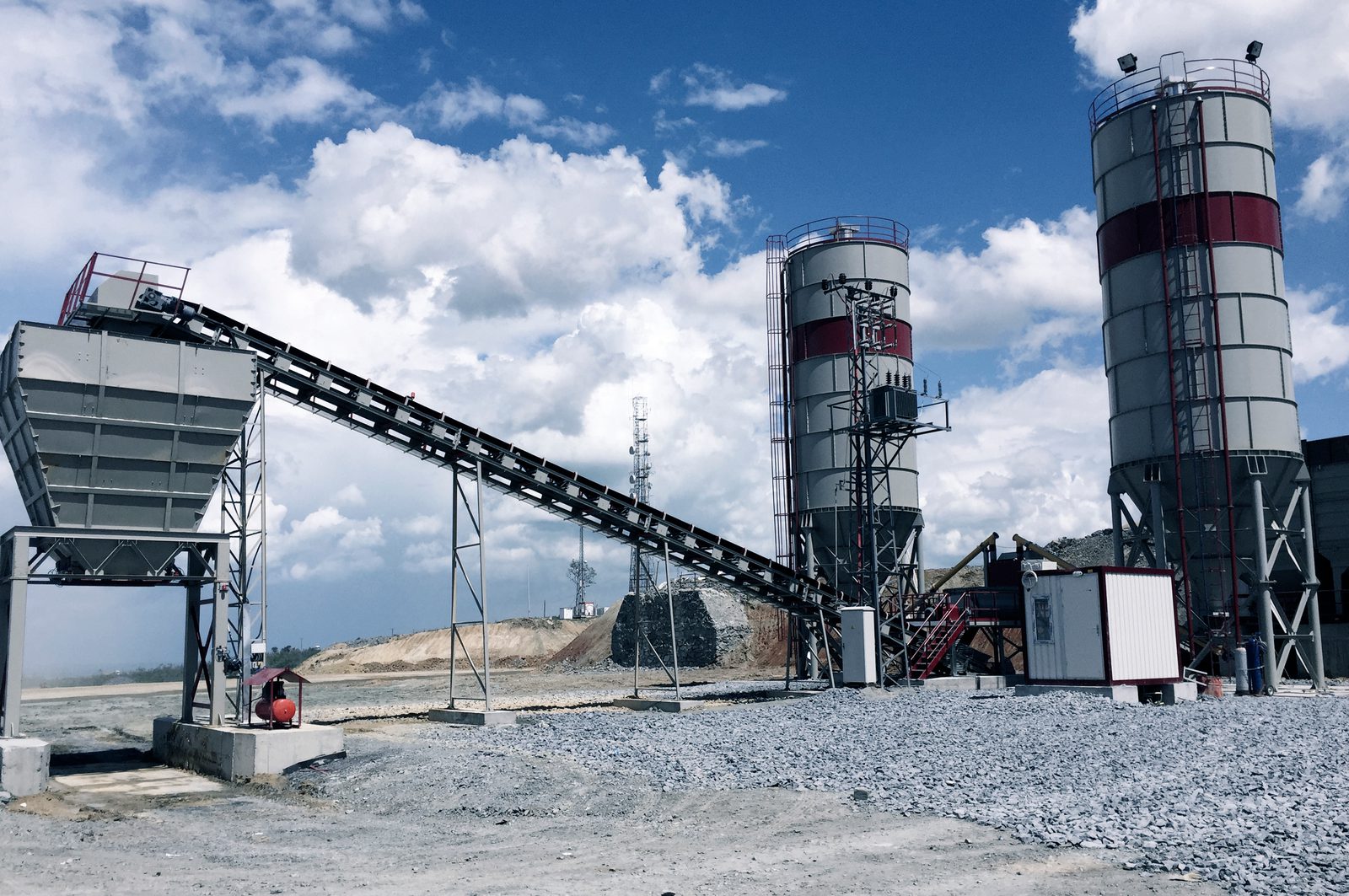
What Is Wet Mix Macadam?
Wet mix macadam is a base or sub-base course made of well-graded crushed aggregate and stone dust, mixed with water in a plant to the optimum moisture content, then laid in layers and compacted. Because every tonne leaves the plant already blended and wetted, the layer is far more uniform than water bound macadam (WBM), where coarse aggregate is spread first and screenings and water are worked in on the road.
WMM sits under bituminous or concrete surfacing on highways, expressways, airport runways, ports and heavy-duty yards. It spreads traffic loads onto the layers below and gives the pavement a dense, stable platform that does not rut or crack when it is built to specification.
The same material under other names
| Region | Material | Typical specification |
|---|---|---|
| India | Wet mix macadam (WMM) | MoRTH Section 400, Clause 406 |
| United Kingdom | Type 1 unbound mixture | Specification for Highway Works, Series 800 |
| United States | Graded aggregate base (GAB) | ASTM D2940 and state DOT specifications |
| European Union | Unbound mixture for base and sub-base | EN 13285 |
| Spain | Zahorra artificial | PG-3, Article 510 |
| France | Grave non traitée (GNT) | NF EN 13285 |
| Russia and CIS | Crushed stone–sand mixture (ЩПС) | GOST 25607 |
Grading limits and test methods differ between these specifications; always work to the one in your contract.
Material Requirements
MoRTH Clause 406 asks for crushed aggregate that is hard, durable and clean, with limits on strength, shape and plasticity. The main requirements are:
| Property | Requirement | Test |
|---|---|---|
| Aggregate impact value | 30% maximum | IS 2386 Part 4 |
| Los Angeles abrasion value | 40% maximum | IS 2386 Part 4 |
| Combined flakiness and elongation index | 30% maximum | IS 2386 Part 1 |
| Plasticity index of the fraction passing 425 µm | 6 maximum | IS 2720 Part 5 |
Grading
WMM uses a single grading with a 53 mm maximum size. The envelope commonly published for Clause 406 is:
| IS sieve | Percent passing by weight |
|---|---|
| 53 mm | 100 |
| 45 mm | 95–100 |
| 22.4 mm | 60–80 |
| 11.2 mm | 40–60 |
| 4.75 mm | 25–40 |
| 2.36 mm | 15–30 |
| 600 µm | 8–22 |
| 75 µm | 0–5 (some editions allow up to 8) |
Confirm the limits against the MoRTH edition named in your contract before designing the blend.
Most crushing plants cannot produce this grading as one stockpile. WMM is blended from three or four separate fractions, for example 40–20 mm, 20–10 mm, 10–5 mm and 5–0 mm stone dust, which is why the mixing plant needs a feed bin and a dosing belt for each fraction.
WMM, WBM and GSB Compared
| Wet mix macadam (WMM) | Water bound macadam (WBM) | Granular sub-base (GSB) | |
|---|---|---|---|
| Layer | Base, sometimes sub-base | Base or sub-base | Sub-base, above the subgrade |
| How it is made | Blended and wetted in a mixing plant | Stone, screenings and water worked in on site | Graded material, mixed in a plant or on site |
| Main role | Dense, stable base under the surfacing | Base on lower-volume roads | Load spreading and drainage |
| Specification (India) | MoRTH Clause 406 | MoRTH Clause 404 | MoRTH Clause 401 |
| Quality control | Consistent: fixed blend and moisture | Depends on work on site | Depends on the source and mixing |
Contractors move from WBM to WMM because a plant-mixed layer can be laid by paver, compacts in fewer passes and passes density tests more reliably. The same mixing plant usually produces the GSB for the layer below, only with a different blend.
Moisture, Mix Design and Compaction
The laboratory first establishes the maximum dry density (MDD) and the optimum moisture content (OMC) of the blended aggregate with the heavy compaction test (IS 2720 Part 8). The plant then adds water to reach the OMC, plus a small allowance for evaporation during transport and laying on hot, windy days.
- Too dry: the layer will not reach density, the fines separate from the stone and the surface ravels.
- Too wet: the mix pumps under the roller, loses strength and takes longer to accept the next layer.
- Compaction target: 98% of the laboratory MDD, checked on site by density tests.
- Layer thickness: 75 mm minimum and up to 200 mm compacted when vibratory rollers are used.
How a WMM Plant Works
A WMM plant, also called a pugmill mixing plant or subbase mixing plant, is a continuous mixer. MoRTH asks for forced mixing in a pugmill or pan mixer; high-output plants use a twin-shaft pugmill because it mixes continuously without stopping between batches.
- Feed and dose: each aggregate fraction sits in its own bin, and a dosing belt under the bin draws it in the recipe proportion onto a gathering conveyor.
- Add binder when needed: for cement-treated base, a screw feeder under a cement silo adds cement to the aggregate flow. Plain WMM needs no binder.
- Add water: a pump feeds a spray bar inside the mixer and the water flow is set to the OMC.
- Mix: two counter-rotating paddle shafts knead the material into a uniform, wetted mix as it moves through the trough.
- Store and load: the mix discharges to a surge hopper or silo that loads trucks without stopping the mixer, and the control cabin shows the feed rates, water flow and motor loads.
GELEN MP pugmill mixing plants are built this way, with at least three feed bins with dosing belts, an internal spray bar, optional binder feeding and real-time monitoring, in 300–400 t/h and 450–550 t/h sizes.
How Much Capacity Do You Need?
Size the plant from the paving rate, not the other way round. A worked example:
- Carriageway width 7 m, compacted layer 0.20 m, target 1 km of layer per shift: 7 × 0.20 × 1,000 = 1,400 m³ compacted.
- At a compacted density of about 2.25 t/m³ that is roughly 3,150 t.
- Over an 8-hour shift with about 7 productive hours: 3,150 ÷ 7 ≈ 450 t/h.
Add margin for waiting trucks, water adjustment and wider sections, and match the paver and roller fleet to the same rate. A plant that runs well below its rating wastes energy; a plant at its limit leaves the paver waiting.
- Enough feed bins for every fraction in the blend, plus one spare for adjustments
- Dosing belts calibrated for each material before production
- Water dosing sized for the driest aggregate and the hottest weather on the project
- Surge hopper or silo so trucks can be loaded while the mixer keeps running
- Fixed plant for a quarry that supplies many projects; mobile plant to move along a long highway
Common WMM Problems and Their Causes
| Problem | Likely cause | What to do |
|---|---|---|
| Density tests fail | Moisture off the OMC, poor grading or too thick a layer | Recheck OMC, blend and layer thickness; add roller passes |
| Segregated stone and fines | Dry mix, long free fall into trucks, poor stockpiles | Keep moisture at OMC, use the surge hopper, build stockpiles in layers |
| Blend drifts during the day | Dosing belts out of calibration or a bin running low | Calibrate belts, keep bins topped up, watch the feed rates |
| Surface ravels after rolling | Mix dried out in transport | Cover trucks, shorten haul times, allow for evaporation |
| Soft spots under the roller | Too much water or plastic fines | Reduce water; check the plasticity index of the stone dust |