
Who this is for: operators of sand and gravel pits, quarries and recycling plants whose product fails on clay content, clay balls or deleterious material, and engineers deciding whether a rinsing screen is enough or a scrubber is needed.
Why Clay Is Hard to Remove
Loose silt and fine dirt wash off on a vibrating screen with spray bars. Clay is different: plastic, sticky clay binds to the stone, forms balls that roll through the screen intact and cements gravel into conglomerates. Sprays wet it but do not break it down.
Clay left in the product raises the fines content, forms weak spots in concrete and asphalt, and makes aggregate fail specifications for clay lumps and friable particles. Removing it takes scrubbing: time and mechanical energy in water until the clay softens, breaks up and becomes a slurry that the screen can wash away.
The Options, from Lightest to Heaviest Scrubbing
| Machine | How it scrubs | Best for |
|---|---|---|
| Rinsing screen with spray bars | Water sprays on a vibrating deck | Loose dirt and silt on the stone |
| Coarse material washer | Spiral flights tumble material up an inclined tub; water overflows | Gravel with light clay coatings and floating debris such as wood and roots |
| Blade mill | Blades cut and mix feed with water in a nearly flat trough | Dry, sticky or cohesive feed that must be turned into slurry before screening |
| Log washer | Two heavy paddle shafts grind material against material | Heavy, plastic clay, clay balls and conglomerates |
How a Log Washer Works
A log washer is an inclined trough with two long shafts fitted with heavy paddles. Material and water enter at the lower end. The shafts turn slowly towards each other, so the paddles lift, tumble and rub stone against stone while pushing the material up the trough. Clay and lightweight debris float away with the water, and the scrubbed stone discharges at the upper end.
The long retention time and the stone-on-stone action are what break down plastic clay. The clean stone leaves at the top onto a rinsing screen, which washes off the loosened slurry and sizes the product.
GELEN GLW log washers handle 25–175 t/h with maximum material sizes of 50 to 100 mm and drives from 30 kW to 160 kW.
Blade Mills and Coarse Material Washers
Blade mill
A blade mill looks like a coarse material washer but works differently. It runs almost flat, at 0–5°, with no overflow weir, so all the material and water leave at the discharge end. The blades cut and mix the feed into a uniform slurry, which improves screening efficiency and passes more tonnage than a coarse material washer of the same diameter. GELEN GBM blade mills handle 120–600 t/h.
Coarse material washer
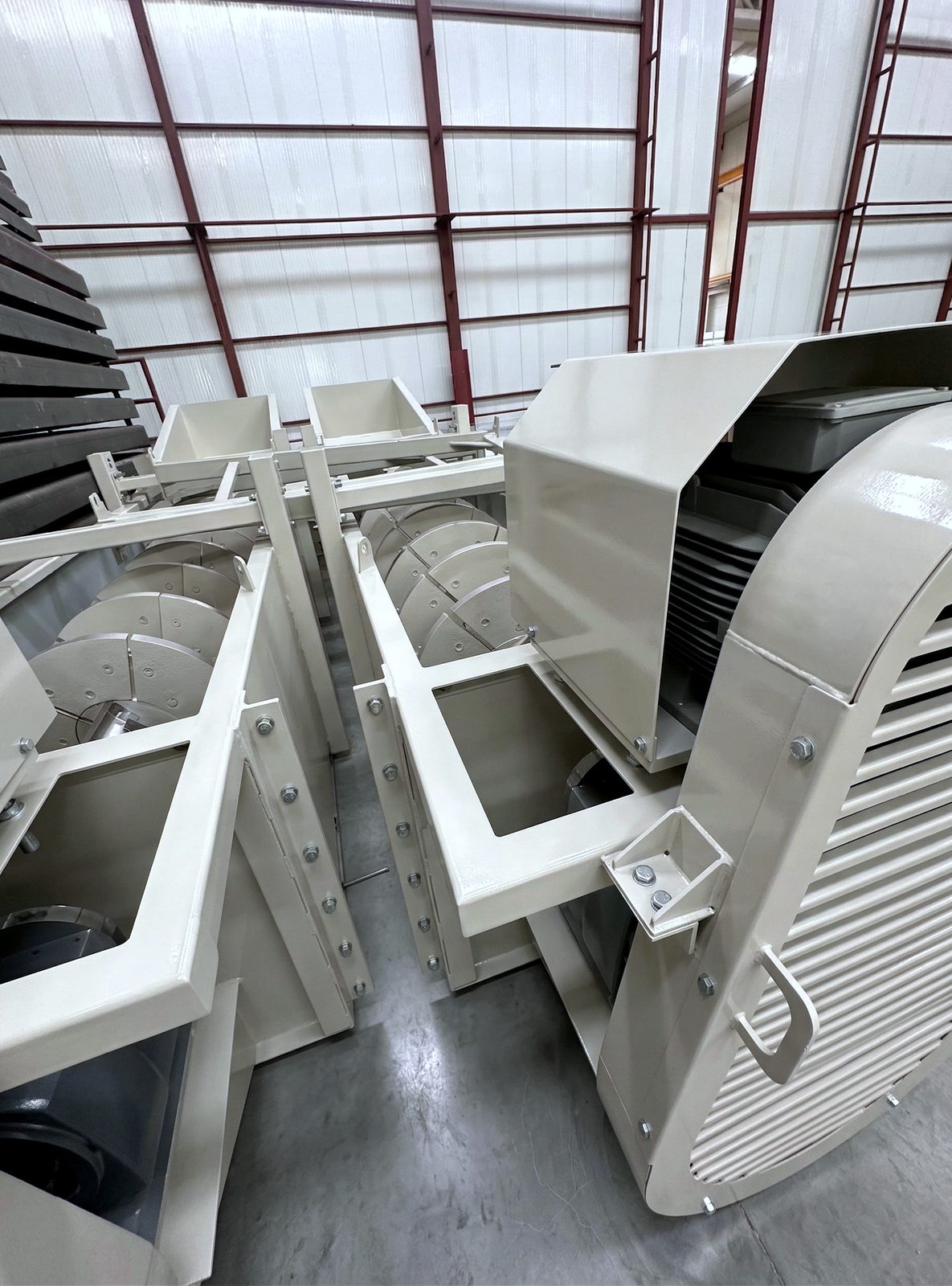
A coarse material washer is a heavy spiral washer in an inclined tub. The spiral tumbles and scrubs gravel and crushed stone while lifting it out of the water; clay, silt, wood and roots float away over the overflow. GELEN GCW coarse material washers handle 135–450 t/h with feed up to 65–75 mm.
How to Choose
- Test the clay: if a sample breaks down after a few minutes in a bucket of water, sprays or a coarse material washer may do; if the lumps stay whole, you need a log washer.
- Largest stone size: log washers take the largest material (up to 100 mm on GELEN GLW); blade mills and coarse material washers take 65–75 mm.
- Tonnage: twin machines double the throughput of a single blade mill or coarse material washer.
- Light debris: wood and roots in recycled or pit material favour a coarse material washer, whose overflow floats them away.
- Water: plan the water supply and recycling with the machine; the tables on the product pages give the estimated water per model.
Where clay content changes from one part of the deposit to another, size for the worst material you will feed, not the average.
Where the Scrubber Sits in the Plant
- Feeder or hopper
- Log washer, blade mill or coarse material washer
- Rinsing screen with spray bars, which washes the loosened clay off and sizes the stone
- Sand line: the screen underflow goes to a screw classifier or a sand washing plant
- Water treatment: ponds or a thickener recover the water and the silt
Placing the scrubber first means the screen and the sand line receive material that is already free of clay balls, so they work at their rated capacity instead of blinding.
Wear Parts and Maintenance
- Paddles and blades wear fastest; they are bolted on and replaced in sets.
- Check shaft alignment and bearings on a schedule, especially on long twin-shaft machines.
- Keep the water supply steady: too little water turns the trough into a mud mill and overloads the drive.
- Watch the drive motor load; a steady rise usually means the feed or the clay content has changed.