
Who this is for: Plant managers, process engineers, and maintenance teams choosing between inclined, horizontal, and banana screens — and looking for practical guidance on sizing, setup, and troubleshooting an inclined vibrating screen.
What Is an Inclined Vibrating Screen?
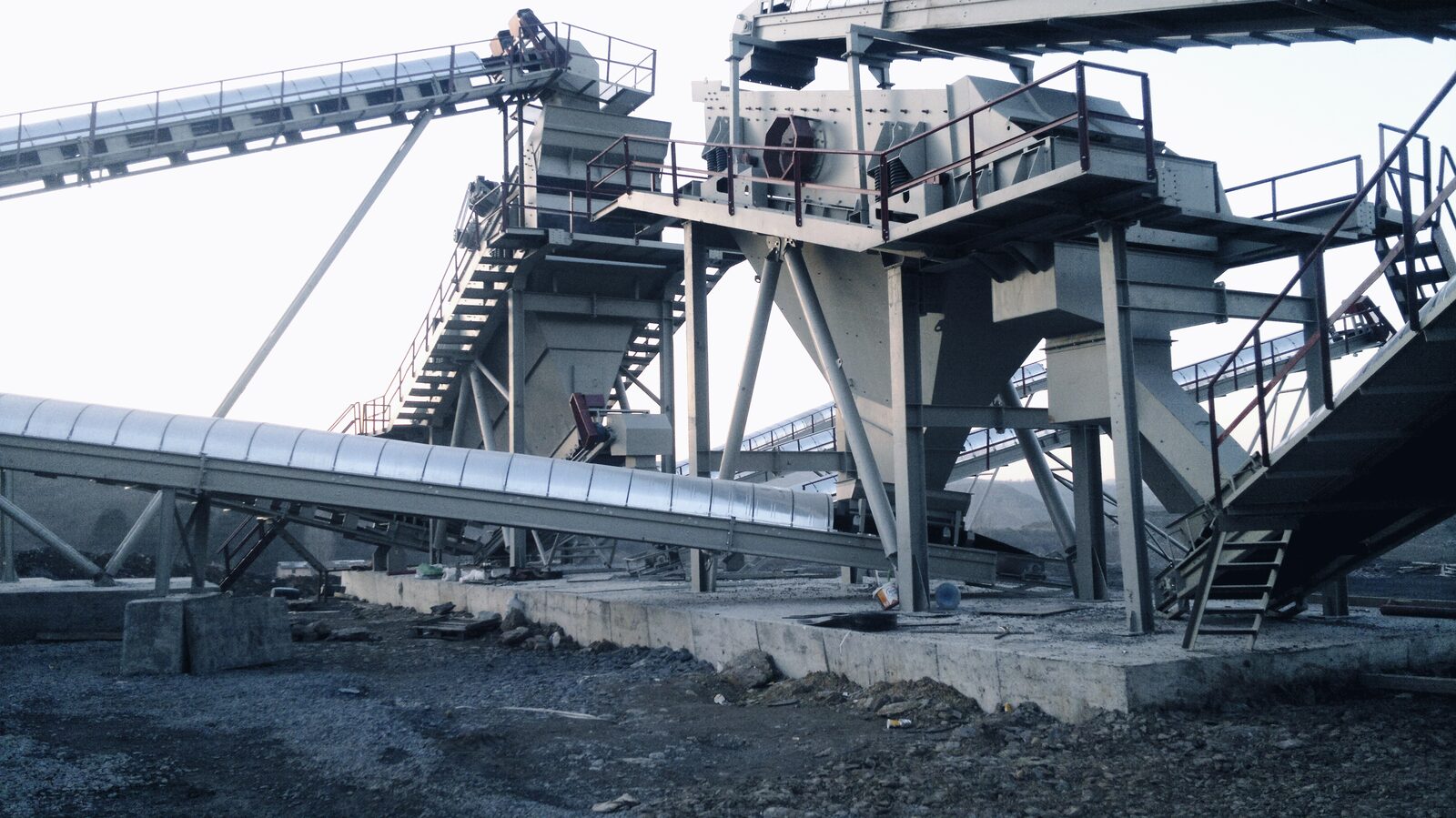
An inclined vibrating screen is a gravity-assisted screening machine mounted at 15° to 25° that uses circular vibration to separate bulk material by particle size. The combination of circular throw and the deck inclination lifts material, creates stratification, and moves the bed toward the discharge end while undersize particles fall through the screen apertures.
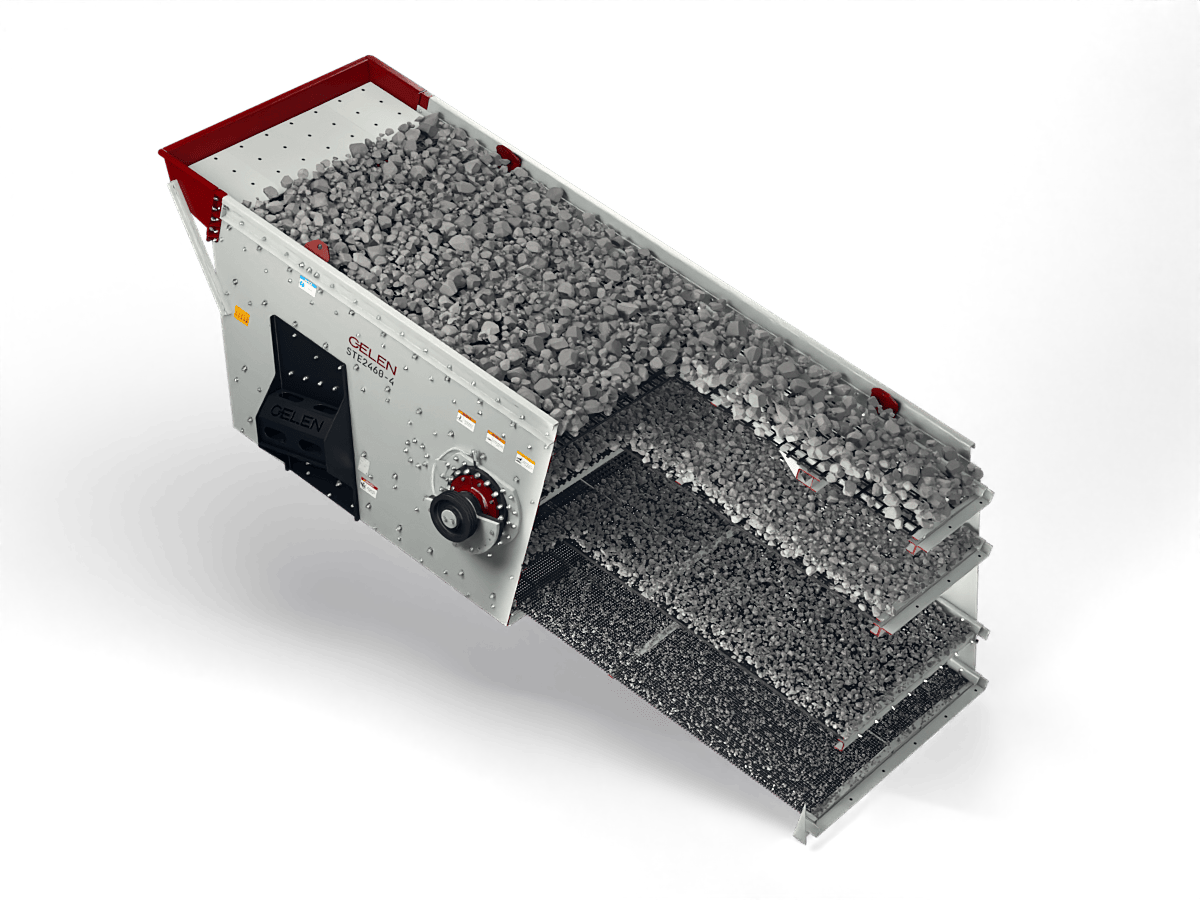
It is the most widely used screen type in aggregate production, mining, and recycling thanks to its simplicity, high throughput, and low operating cost. The GELEN STE Series is a two-bearing, circular-motion inclined screen with the exciter shaft positioned at the screen body's center of gravity, producing uniform vibration amplitude across the entire deck surface.
How circular motion works on an inclined screen
The exciter shaft carries eccentric counterweights. As the shaft rotates — typically 800 to 950 RPM — the counterweights generate a centrifugal force that moves the screen body in a circular path. This circular throw lifts the material bed in three repeating phases:
- Lift phase: Material lifts off the deck, creating voids between particles. This is where stratification happens — the heavier coarse particles rise and the fines settle through the bed.
- Forward phase: Gravity and the deck angle combine to move material toward the discharge end. The forward velocity is what controls retention time and therefore screening efficiency.
- Settle phase: Finer particles fall through the voids and pass through the screen openings. Particles that don't pass are carried forward by the next lift phase.
The combination of vibration amplitude (stroke), shaft speed (RPM), and deck inclination angle determines the G-force applied to the material. For most aggregate applications, the target operating range is 3 to 4 G-force.
G-force formula: G = (2π × RPM / 60)² × (Stroke / 2) / 9.81 — for example, at 900 RPM with a 9 mm stroke: G ≈ 4.1 G.
Key components of an inclined vibrating screen
- Side plates: Structural walls in high-tensile steel. On the STE Series, these are weld-free and assembled with high-strength bolted connections to resist fatigue cracking that plagues welded designs after 5,000–10,000 hours.
- Deck frames (cross members): Internal bracing that supports the screen media panels.
- Screen media: The screening surface — woven wire mesh, polyurethane, or rubber panels. See the screen media selection guide for the trade-offs.
- Exciter mechanism: The shaft with counterweights that generates the circular vibration. On center-mounted designs like the STE, the shaft sits at the body's center of gravity for uniform motion.
- Drive assembly: Electric motor with V-belt transmission to the exciter shaft. Typical installed power runs 5.5 kW (STE1030) up to 37 kW (STE2470 3-deck).
- Spring suspension: Coil springs that isolate vibration from the support structure and let the screen body bounce freely.
Typical inclination angles and what they mean
| Angle range | Effect | Best for |
|---|---|---|
| 15°–18° | Slower travel, higher screening accuracy | Fine separations, precision sizing |
| 18°–22° | Balanced throughput and accuracy | General-purpose material screening |
| 22°–25° | Faster travel, higher capacity, less precision | Coarse scalping, high-tonnage operations |
Practical tip: Start at 20° for most crushed stone and gravel applications. If undersize contamination in the oversize product is too high, reduce the angle by 2°. If throughput is too low, increase the angle by 2°. On the STE Series, the inclination angle is adjustable in the field without structural modification.
Inclined vs. Horizontal vs. Banana — Decision Guide
The right screen type depends on your feed material, the precision you need, and the headroom available in your plant. Here is the practical comparison.
| Criterion | Inclined (STE) | Horizontal (ETE) | Banana |
|---|---|---|---|
| Throughput capacity | |||
| Sizing accuracy | |||
| Wet/sticky material | |||
| CAPEX (initial cost) | (lowest) | ||
| Maintenance simplicity | |||
| Headroom required | High | Low | High |
| Fine screening (<10 mm) |
Decision flowchart
- Wet, sticky, or clay-contaminated feed? → Horizontal (ETE).
- Need precision sizing below 10 mm? → Horizontal.
- Headroom severely limited? → Horizontal.
- Need maximum throughput on coarse material (>500 t/h)? → Inclined (STE) or banana.
- Budget is the primary constraint? → Inclined (lowest CAPEX and OPEX).
Bottom line: For 80% of standard aggregate and mining screening applications, an inclined screen is the right choice. For the full decision framework including banana screens, read Inclined vs Horizontal vs Banana Screen — which do you need?
How to Size an Inclined Screen — Step by Step
The 5 inputs you need
- Feed rate (t/h)
- Particle size distribution (PSD) — sieve analysis of the feed
- Bulk density and moisture content
- Number of product fractions needed (determines deck count)
- Open area % of selected screen media
Worked example — 300 t/h limestone, 3 products
Given: 0–100 mm crushed limestone, 4% moisture, 1.6 t/m³ density. Need three products: 0–16 mm, 16–32 mm, and 32+ mm (oversize). Two cuts → 2-deck screen.
- Step 1: Calculate required screen area: A = Q / (B × K × E × D × F × S), where the factors correct for material density, screening efficiency, deck position, feed conditions, and bed depth.
- Step 2: For the top deck (32 mm cut), basic capacity ≈ 12 t/h/m². After correction factors of 0.7–0.9, you need approximately 5 to 6 m² of effective area.
- Step 3: Match to STE model. An STE 1860 (1.8 m × 6.0 m = 10.8 m² per deck) provides adequate area with margin for variation in feed gradation.
- Step 4: Verify installed power (30–37 kW for that size class) and bed depth — bed depth must not exceed three times the top-deck aperture.
For the full sizing methodology including all the K-factor corrections and how to handle tricky cases, see the dedicated inclined screen sizing calculator and step-by-step guide.
Common sizing mistakes
- Ignoring near-size material: If more than 25% of the feed is within ±25% of the cut size, you need significantly more area than the basic capacity formula suggests.
- Underestimating moisture: Even 5–8% moisture reduces screening capacity by 20–30% on standard wire mesh.
- Wrong open area: Polyurethane panels (~35%) have very different open area than woven wire (~60%) — using the wrong figure can over- or under-size the screen by 30%.
Screen Media Selection for Inclined Screens
The STE Series accepts three types of screening surfaces, and operators can mix media types across decks to optimize each separation stage.
| Factor | Woven wire | Polyurethane | Rubber |
|---|---|---|---|
| Open area | 50–65% | 25–45% | 30–40% |
| Wear life | 4–12 weeks | 12–24 months | 6–18 months |
| Cost per panel | Lowest | 3–5× wire | 2–4× wire |
| Cost per ton screened | Medium | Lowest (long-term) | Low–medium |
| Best for | Dry, non-abrasive | Abrasive, wet | Wet, sticky, high-impact |
Mix media types across decks — rubber on the top deck for impact protection, fine wire on the bottom decks for sharp cuts. Read the full screen media selection guide for recommendations by industry and material.
Installation and Commissioning
Foundation and structural requirements
- Design the support structure for dynamic load (3–5× static load).
- Allow 600 mm clearance on all sides for media changes and bearing maintenance.
- Feed chute must distribute material evenly across the full deck width — uneven loading kills screening efficiency.
Step-by-step commissioning checklist
- Torque all structural bolts to spec.
- Verify spring compression equal on all four corners (±2 mm).
- Check exciter shaft alignment and hand-rotate to verify free movement.
- Verify V-belt tension and pulley alignment.
- Install and tension all screen media.
- Start empty. Run 15–30 minutes and check amplitude symmetry at all four corners.
- Check bearing temperature after 1 hour of running (<70°C is normal).
- Feed at 50% capacity and observe distribution across the deck.
- Increase to 100% feed and check bed depth (≤3× top-deck aperture).
- Fine-tune inclination angle and feed rate based on the products coming off.
Setting up for wet screening
- Install spray bars at the feed end, oriented at 45° to the deck surface.
- Set water pressure to 2–4 bar.
- Ensure adequate drainage under the screen — clogged drains drown the spray.
- Start sequence: screen first, then water, then feed.
- Monitor underflow clarity. Cloudy underflow means clay is breaking through.
- For heavy clay feeds, add a second spray bar row mid-deck.
Maintenance Schedule and Troubleshooting
Preventive maintenance schedule
| Interval | Tasks |
|---|---|
| Daily | Visual bolt check; listen for bearing noise; check amplitude; inspect springs for cracks. |
| Weekly | Grease bearings; check belt tension; inspect screen media for wear; clean discharge chutes. |
| Monthly | Measure amplitude/frequency with analyzer; check motor current; retorque structural bolts; check spring free-height. |
| Quarterly | Full bearing inspection; shaft alignment; counterweight bolts; gearbox oil analysis. |
| Annually | Replace V-belts as a set; full structural inspection; vibration baseline comparison. |
For the detailed checklist with visual inspection points, see the vibrating screen maintenance schedule.
Solving blinding and pegging — 7 fixes in order
- Increase G-force within spec (more stroke or more RPM).
- Switch to anti-blinding mesh or a different aperture geometry.
- Add anti-blinding balls beneath the mesh.
- Switch to polyurethane or rubber panels.
- Add or increase spray water for wet blinding.
- Reduce bed depth by lowering the feed rate.
- Steepen the inclination angle.
Read more in the dedicated prevent screen blinding guide. Replace media when apertures are elongated, undersize yield is dropping, wires are visibly broken, or PU wear exceeds 30% of original thickness.
Bearing failure warning signs
- Temperature above 90°C is a warning; above 100°C is a shutdown — immediately.
- Grinding or metallic noise replacing the normal rumble.
- Vibration asymmetry between left and right sides of the screen.
- Metal flakes in expelled grease.
- Expected bearing life: 6,000 to 12,000 operating hours with proper lubrication.
Where an Inclined Screen Fits in Your Plant
- Primary scalping: Hopper → vibrating feeder → jaw crusher → scalping screen (often a grizzly, see the ITE Series).
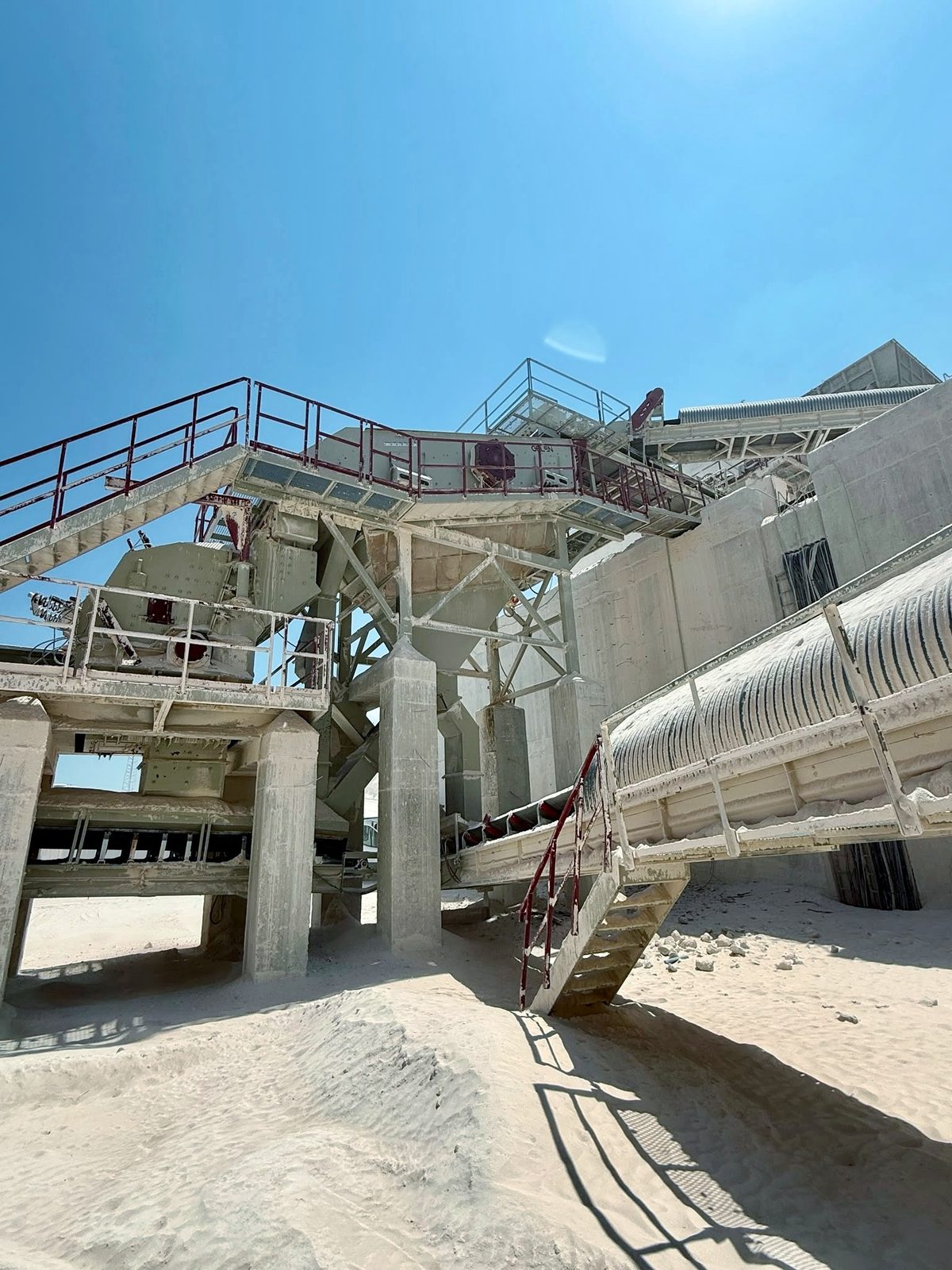
- Secondary sizing: Cone crusher → STE inclined screen (2–3 deck for sizing).
- Closed-circuit: Oversize from the inclined screen returns to the cone crusher. This is the standard configuration for spec-compliant aggregate.
- Pre-screening: A grizzly ITE screen sits ahead of the jaw crusher, with the STE downstream for product sizing.
Applications and Real-World Examples
- Aggregates: 250 t/h crushed limestone, STE 2060 3-deck, wire mesh with cuts at 32, 16, and 4 mm. Products: 0/4, 4/16, 16/32 mm and 32+ recirculated. Result: less than 5% oversize contamination.
- Mining: 400 t/h iron ore, STE 2460 2-deck, polyurethane panels. Products: −25 mm fines and 25–80 mm to tertiary crushing. PU panel life: 14 months vs. 6 weeks on woven wire.
- Recycling and C&D: 120 t/h C&D waste, STE 1560 2-deck, rubber panels. Products: 0–40 mm recycled aggregate and 40+ oversize. The rubber panels handle rebar and mixed contaminants without tearing.
- Sand & gravel: 200 t/h river gravel, 8–12% moisture, STE 1860 3-deck with spray bars and PU panels. Products: 0/2, 2/8, 8/16, 16+ mm.
For more sizing examples and industry-specific tuning advice, see inclined screen applications by industry.