

Screen Media Selection Guide for Inclined Vibrating Screens
Who this is for: Plant managers, maintenance superintendents, and procurement specialists who order screen media for inclined vibrating screens and want to stop guessing about which type to spec.
The 3 Screen Media Types in Plain English
Woven wire mesh
Steel or stainless wire woven into a square or rectangular pattern, then tensioned across the deck with hook strips. The most common screening surface in the world, especially for dry, non-abrasive aggregate. Highest open area (50–65%), sharpest cut points, lowest panel cost, but the shortest wear life on abrasive feeds.
Variants: square aperture (most common), slotted (for elongated particles), Harp wire (for fine separations and blinding-prone material), and tension wire (longer life on coarse duty).
Polyurethane (PU) panels
Cast polyurethane panels with the apertures moulded directly into the panel body. Mounted with bolt-on or clip-on systems on a steel sub-frame. Open area is lower than wire (25–45%), but the elastic PU material delivers 12 to 24 months of wear life on abrasive feeds — three to five times longer than woven wire on the same duty. The standard choice for hard, abrasive minerals, wet screening, and any application where media replacement downtime drives the economics.
Rubber panels
Vulcanized natural rubber panels with apertures moulded in. Soft and flexible, with similar open area to PU (30–40%). Rubber excels at impact resistance and self-cleaning — the elastic deformation under impact actually helps eject pegged particles. Best for wet, sticky, and contaminated feeds like recycled concrete with rebar and tire chips. Wear life of 6 to 18 months depending on feed.
Side-by-Side Comparison Table
| Factor | Woven wire | Polyurethane | Rubber |
|---|---|---|---|
| Open area | 50–65% | 25–45% | 30–40% |
| Wear life | 4–12 weeks | 12–24 months | 6–18 months |
| Cost per panel (relative) | 1× | 3–5× | 2–4× |
| Cost per screened ton | Medium | Lowest (long-term) | Low–medium |
| Cut accuracy | Sharpest | Slightly lower | Slightly lower |
| Blinding resistance | Lowest | High (elastic flex) | Highest (impact deflection) |
| Pegging resistance | Low | High | Highest |
| Best for | Dry, non-abrasive | Abrasive, wet | Wet, sticky, high-impact |
| Worst for | Abrasive, wet, sticky | Very fine cuts <3 mm | Sharp dry cuts |
| Typical use | Limestone, granite, clean dry feed | Iron ore, copper, sand wash | C&D recycling, coal, asphalt |
Cost-Life Economics — Why Wear Life Beats Sticker Price
The single biggest mistake in screen media selection is buying on panel price instead of cost per ton screened. Here is the math.
Worked example — 200 t/h granite, top deck
Wire mesh option: Panel cost $300, replaced every 6 weeks (1,000 hours). At 200 t/h, that is 200,000 tons per panel. Cost per ton = $0.0015. Plus the cost of downtime: each replacement takes 4 hours of crew time = ~$800 in labor and lost production. Per ton, that is another $0.004. Total: $0.0055/ton.
Polyurethane option: Panel cost $1,200 (4× wire), replaced every 18 months (~12,000 hours). At 200 t/h, that is 2.4 million tons per panel. Cost per ton = $0.0005. Downtime: one replacement every 18 months instead of every 6 weeks = 12× less labor cost. Effective downtime cost ~$0.0003/ton. Total: $0.0008/ton.
The PU panel is ~7× cheaper per screened ton despite being 4× more expensive at purchase. On a 200 t/h plant running 5,000 hours per year, that saves around $4,700 per year per top-deck panel — a 4× ROI on the higher panel investment, every year.
Decision rule: If your feed is hard or abrasive (Mohs >5) and you are running more than 3,000 hours per year, polyurethane almost always wins on cost per ton. The only exception is when you need very sharp cuts on small apertures (<5 mm), where wire mesh's higher open area offsets the wear cost.
Recommendations by Material
Limestone & soft sedimentary
Wire mesh on all decks. Limestone is soft (Mohs 3) and not abrasive, so wire lasts 8–12 weeks even on the top deck. The high open area maximizes throughput per square metre, and panel cost is the lowest of any media. PU only makes sense if the plant runs more than 6,000 hours per year and downtime is critical.
Granite, basalt & hard igneous
Polyurethane on top and middle decks; wire on the bottom deck. Granite (Mohs 6–7) destroys wire mesh in 3–6 weeks. PU panels last 12–18 months on the same duty. The bottom deck cuts smaller apertures where wire's open area advantage matters more, so wire often wins there.
Iron ore & metallic ore
Polyurethane throughout. Iron ore is highly abrasive and the high tonnages mean media life dominates the cost per ton. PU panels reach 18–24 months on iron ore classification screens. For very fine cuts below 3 mm, switch to high-tension wire mesh on the bottom deck to maintain cut sharpness.
Coal & lignite
Rubber panels (impact deck) + polyurethane (sizing decks). Coal is soft but often wet and clay-contaminated. Rubber on the top impact deck handles the wet, sticky feed and resists pegging by softer materials. PU on the lower decks handles the abrasive ash content.
Sand & gravel washing
Polyurethane (high-durometer) throughout. Wet screening with high water flow demands media that won't blind under wet fines or peg with clay. PU panels with anti-peg geometry are the standard. Wire mesh is only used on the very top scalping deck if there is one.
Recycled concrete & C&D waste
Rubber on the top deck; PU on the lower decks. Rebar and embedded metal will tear wire mesh apart and gouge rigid PU panels. Rubber's elastic deformation absorbs the impact and self-clears trapped objects. PU on the lower decks handles the abrasive recycled aggregate.
Sticky clays, topsoil, compost
Rubber panels — and consider a horizontal screen instead. Sticky materials peg every screen design eventually. Rubber buys you the most run time before cleaning, but if pegging is your dominant problem, an inclined screen may not be the right choice — switch to a horizontal screen with elliptical motion for sticky duties.
Mixing Media Across Decks
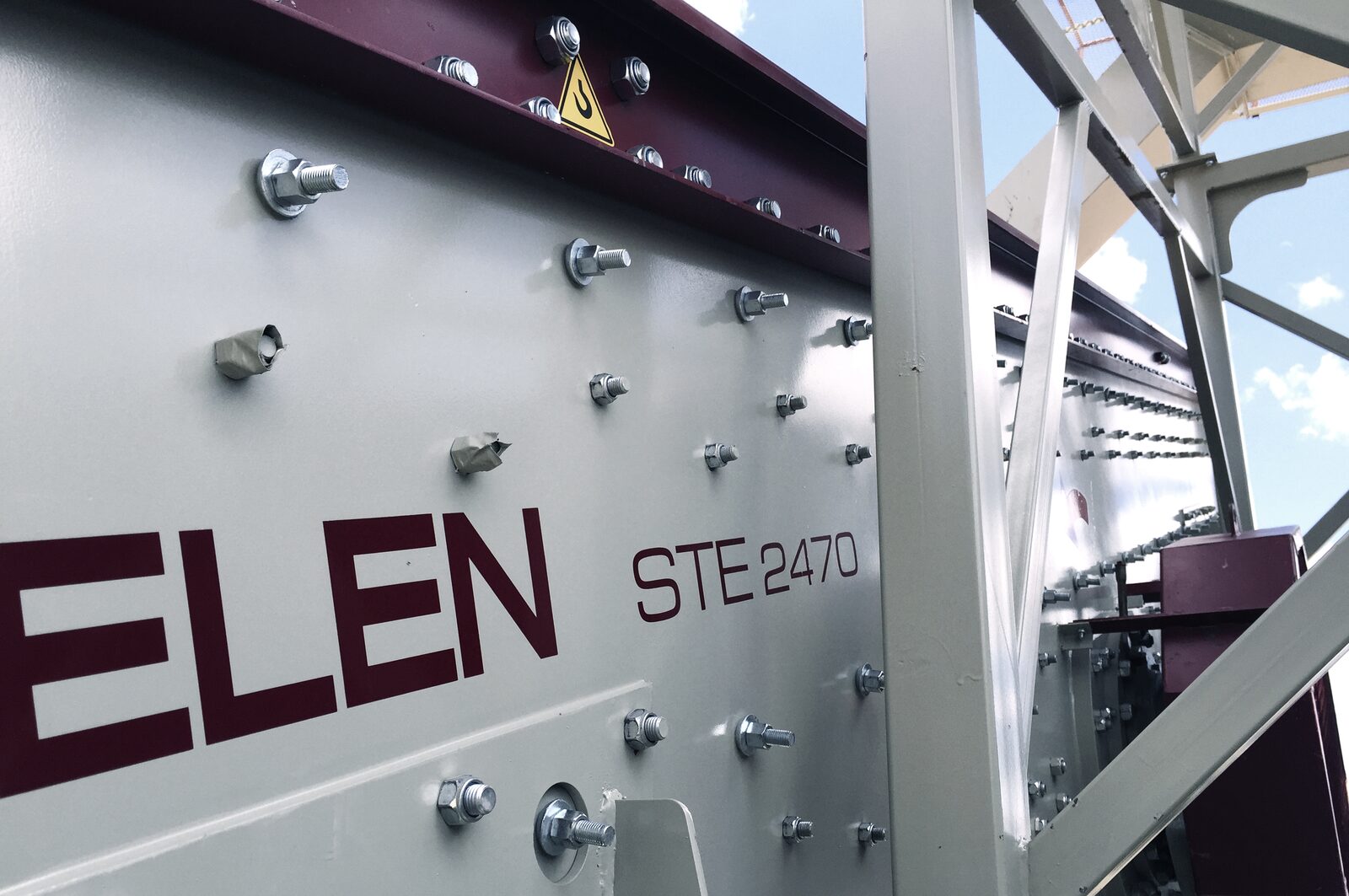
One of the underused advantages of the GELEN STE Series is that the same frame accepts wire, PU, and rubber on different decks. Mixing media is often the optimal solution.
Common winning combinations
- Granite plant: PU top deck (wear life), wire middle deck (open area + cut sharpness), wire bottom deck (fine cuts).
- Iron ore: PU top + middle decks (wear life), high-tension wire bottom deck (sharp fines <3 mm).
- Recycling plant: Rubber top deck (impact + rebar), PU middle deck (wear life), PU bottom deck (wet contaminants).
- Limestone aggregate: Wire on all decks (lowest cost; soft material).
- Sand & gravel wash: PU on all decks with anti-peg geometry.
When to Replace — Wear Indicators
Don't run media to failure. Replace when one of these triggers:
- Apertures elongated by more than 20%. Pegging accelerates as apertures stretch.
- Visible broken wires or slack wires that can be lifted by hand.
- PU wear depth >30% of original thickness. Below this point the apertures rapidly enlarge and you start losing fines into the wrong product.
- Undersize yield dropping by >10% at constant feed rate. The screen is letting through less than it should.
- Oversize contamination rising in the undersize product. Apertures are letting big particles through that should not pass.
- Visible patches of pegged or blinded mesh during inspection.
Track media changes in a maintenance log — see the vibrating screen maintenance schedule for the full inspection routine.
FAQ
- Can I mix wire and PU on the same deck? Yes — split the deck into zones. Top zone (impact area) often uses tougher material, sizing zone uses higher open area. The STE frame supports zoned panels.
- Are stainless steel meshes worth the price? Only for corrosive feed (chlorides, acidic process water). Standard high-carbon spring steel is fine for normal aggregate and most mining ores.
- What is "self-cleaning" wire mesh? It is a wire pattern with vibrating cross wires that knock pegged particles loose. Helps blinding-prone material but reduces open area by 5–10%.
- Polyurethane vs rubber for wet sand? Polyurethane wins for dewatering (faster water release) and longer life on abrasive sand. Rubber wins when there is also high impact or contamination.
- How thick should PU panels be? Standard is 25–35 mm for inclined screens. Thicker panels last longer but reduce open area slightly and add weight to the deck.
- Can I retrofit PU panels to a wire-mesh screen? Yes — most modern screens including the STE Series accept either media on the same frame. You will need a sub-frame conversion kit on older designs.
Get a Custom Media Recommendation
Send us your feed material, target product fractions, current media life, and operating hours — we will recommend the right wire / PU / rubber combination for each deck of your STE Series inclined screen. We can also supply replacement panels and conversion kits.
Request a RecommendationRelated guides: