

The Complete Guide to Cone Crushers: How They Work, Types, and How to Choose
What Is a Cone Crusher?
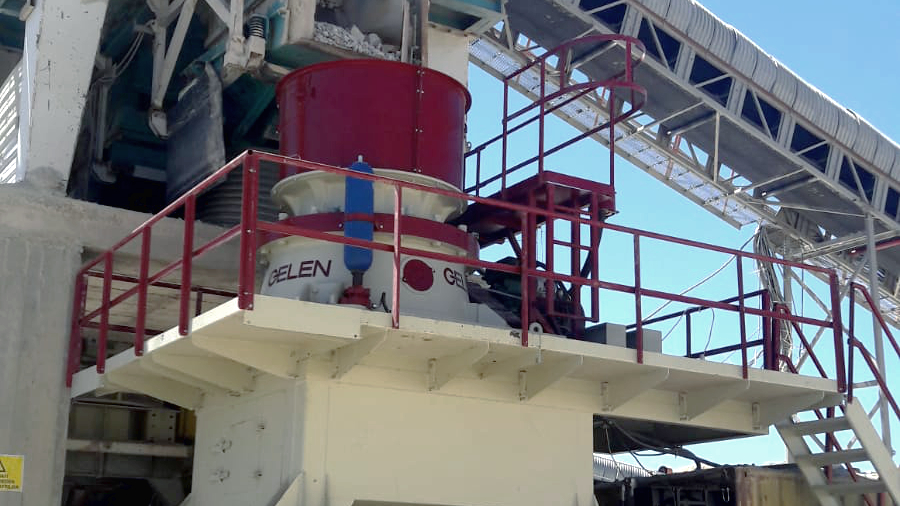
A cone crusher is a compression-type crushing machine used primarily in secondary and tertiary stages of a crushing plant. While a jaw crusher handles the initial size reduction of blasted rock, the cone crusher takes over to reduce material further into finer, more uniform sizes suitable for downstream processing or final use as aggregate.
At its core, a cone crusher works by squeezing material between two hard surfaces: a rotating piece of steel called the mantle and a stationary outer shell called the concave (or bowl liner). The mantle gyrates eccentrically inside the concave, continuously compressing and releasing material as it travels downward through the crushing chamber. This compression principle produces a well-shaped, cubical product — one of the key reasons cone crushers are favoured in aggregate and mining operations around the world.
Cone crushers sit between the primary crusher and final screening in most crushing and screening plants. In a typical three-stage layout, the jaw crusher performs primary crushing, the cone crusher handles secondary reduction, and a vertical shaft impact (VSI) crusher or a short-head cone crusher carries out the tertiary or shaping stage. Because of their ability to handle hard, abrasive materials at high throughput, cone crushers have become indispensable in granite, basalt, and hard-rock mining operations.
How Does a Cone Crusher Work? (Step-by-Step)
Understanding the internal mechanics of a cone crusher helps operators choose the right model, set it correctly, and keep it running efficiently. Here is the step-by-step process:
Step 1: Material Enters the Feed Opening
Crushed material from a primary jaw crusher or a vibrating feeder is fed into the top of the cone crusher through the feed opening (also called the feed hopper). The opening size limits the maximum feed dimension the crusher can accept. It is critical that the feed is properly sized and evenly distributed around the full circumference of the crushing chamber; a choke-fed condition — where the chamber is kept consistently full — produces the best particle shape and the highest reduction ratio.
Step 2: Eccentric Rotation Begins
At the heart of the machine is a main shaft seated in an eccentric bushing (or bearing assembly). When the motor drives the countershaft and gear assembly, the eccentric bushing causes the main shaft — and with it the mantle — to gyrate in a circular motion inside the concave. Importantly, the mantle does not spin; it oscillates, swinging toward one side of the concave and then away. This action creates a continuously changing gap between the mantle and the concave.
Step 3: Compression Between the Mantle and the Concave
As the mantle gyrates toward the concave on one side, material trapped between the two surfaces is subjected to intense compressive force. The rock fractures along its natural planes of weakness. On the opposite side of the chamber, the gap widens and partially crushed material drops further down toward the narrower end of the cavity. With each revolution of the eccentric, the material is compressed multiple times, progressively becoming smaller.
Step 4: Product Exits Through the CSS Gap
The closed side setting (CSS) is the narrowest point between the mantle and the concave at the bottom of the crushing chamber. It is the single most important parameter in determining the final product size. Once particles are small enough to pass through this gap, they fall out of the crusher and onto a discharge conveyor or into a screening circuit. Adjusting the CSS — typically by raising or lowering the mantle assembly — allows the operator to fine-tune the output gradation without stopping the machine. Hydraulic cone crushers make this adjustment especially straightforward, often offering automated CSS control for consistent output.
Main Types of Cone Crushers
Not all cone crushers are built for the same job. Several distinct types have evolved over more than a century of crushing technology, each optimised for a particular stage of size reduction or a particular operational requirement.
1. Standard Cone Crushers (Secondary Crushing)
The standard cone crusher is the workhorse of secondary crushing. It features a wider feed opening and a larger throw (eccentric stroke) compared to fine-crushing variants. This design allows it to accept larger feed sizes — typically 150 mm to 350 mm — and produce a product in the 20 mm to 50 mm range. Standard cone crushers are used directly after the primary jaw crusher to prepare material for either final screening or a tertiary reduction stage.
2. Short-Head Cone Crushers (Tertiary / Fine Crushing)
A short-head cone crusher is designed for fine and tertiary crushing. It has a steeper mantle angle, a narrower feed opening, and a longer parallel zone at the bottom of the crushing chamber. These geometric differences mean the material spends more time being compressed in the tight zone, resulting in a finer, more uniform product — often below 15 mm. Short-head models are widely used in the production of manufactured sand, fine aggregate, and pre-ground mill feed.
3. Hydraulic Cone Crushers
Modern hydraulic cone crushers use hydraulic cylinders for CSS adjustment and overload protection. If an uncrushable object — a piece of tramp iron, for example — enters the chamber, the hydraulic system automatically relieves pressure by lowering the main shaft assembly, allowing the obstruction to pass through. This protects the mantle, concave, and frame from catastrophic damage. Hydraulic systems also enable remote and automated CSS control, which improves consistency and reduces downtime. Most modern cone crushers, including the GELEN GHC Series, are hydraulic designs.
4. Spring Cone Crushers
Older cone crusher designs rely on spring assemblies for overload protection instead of hydraulics. When uncrushable material enters the chamber, heavy coil springs around the top shell compress and allow the bowl to lift momentarily, releasing the obstruction. While spring cone crushers are mechanically simpler and have a lower initial cost, they lack the precise CSS adjustment and automated clearing capabilities of hydraulic models. They are still found in smaller operations and in regions where simplicity of maintenance is a priority.
5. Gyratory Crushers (Primary Stage — Different Category)
Although gyratory crushers share the same basic gyrating principle as cone crushers, they belong to a different operational category. Gyratory crushers are massive machines designed for primary crushing of run-of-mine ore directly from the blast face. They feature a much larger feed opening (often over 1,500 mm), higher capacities, and heavier construction. In high-volume mining operations, gyratory crushers replace or complement jaw crushers at the primary stage, feeding material to secondary cone crushers downstream.
Standard vs. Short Head: What Is the Difference?
Choosing between a standard and a short-head cone crusher depends on where the machine sits in your circuit and what product size you need. The following comparison highlights the key differences:
| Parameter | Standard Cone Crusher | Short-Head Cone Crusher |
|---|---|---|
| Crushing Stage | Secondary | Tertiary / Fine |
| Feed Opening | Wider (150–350 mm typical) | Narrower (60–175 mm typical) |
| CSS Range | 15–50 mm | 5–15 mm |
| Mantle Angle | Flatter | Steeper |
| Parallel Zone | Shorter | Longer |
| Typical Output Size | 20–50 mm | 5–20 mm |
| Best Application | Secondary reduction after jaw crusher | Fine aggregate, manufactured sand, pre-grinding |
In many modern plants, a single hydraulic cone crusher with interchangeable liner profiles can serve either role by swapping between a standard chamber and a short-head chamber, reducing the number of spare machines needed on site.
How to Choose the Right Cone Crusher
Selecting the correct cone crusher is a multi-step process that depends on material characteristics, desired output, throughput requirements, and site constraints. Following a structured approach prevents costly mistakes.
Step 1: Assess Your Material
Start with the rock itself. Three material properties matter most for cone crusher selection:
- Hardness — Measured on the Mohs scale or via uniaxial compressive strength (UCS). Hard materials such as granite, basalt, and gabbro (UCS above 150 MPa) demand a robust crusher with thick liners and a powerful drive. Softer limestones and sandstones are more forgiving.
- Abrasiveness — Quantified by the Bond Abrasion Index or silica content. Highly abrasive feeds accelerate liner wear, increasing operating cost. For abrasive materials, select a crusher designed for easy liner changes and consider manganese alloys with higher wear resistance.
- Moisture and Fines Content — Wet, sticky, or clay-rich feeds can clog the crushing chamber and reduce throughput. If moisture is a concern, look for crushers with larger CSS settings or consider pre-screening fines before the cone crusher stage.
Step 2: Determine the Required Output Size
The target product size dictates the CSS at which the crusher must operate. If you need a final product of 0–20 mm for road base, a CSS of roughly 15–20 mm is appropriate. If you are producing manufactured sand at 0–5 mm, you need a short-head configuration running at a very tight CSS. Always consult the manufacturer's gradation curves for the specific liner profile and CSS combination you plan to use.
Step 3: Match Capacity to Plant Throughput
Each cone crusher model has a nominal capacity range (in tonnes per hour) that varies with CSS, feed size, and material characteristics. Your secondary cone crusher must be able to process the full output of the primary jaw crusher without creating a bottleneck. Conversely, an oversized cone crusher running at partial load wastes energy and reduces liner life due to uneven wear. Match the cone crusher capacity closely to the expected feed rate from the preceding stage.
Step 4: Decide Between Stationary and Mobile
For permanent quarry installations, a stationary cone crusher mounted on a concrete foundation offers maximum stability and lowest vibration. For contract crushing, road construction, and projects where the plant must relocate frequently, a mobile or semi-mobile (track-mounted or wheel-mounted) cone crusher provides flexibility. GELEN offers both stationary cone crusher solutions and integrated mobile crushing plants to fit either scenario.
Cone Crusher vs. Jaw Crusher vs. Impact Crusher
Each crusher type has strengths that make it ideal for certain stages and materials. The following comparison helps clarify where a cone crusher fits relative to a jaw crusher and a horizontal shaft impact (HSI) crusher.
| Factor | Jaw Crusher | Cone Crusher | Impact Crusher (HSI) |
|---|---|---|---|
| Primary Use | Primary crushing | Secondary / Tertiary crushing | Secondary crushing / Shaping |
| Crushing Principle | Compression | Compression | Impact |
| Particle Shape | Good (slightly elongated) | Very good (cubical) | Excellent (cubical) |
| Best for Material Hardness | Soft to very hard | Medium-hard to very hard | Soft to medium-hard |
| Abrasive Material | Good | Very good | Poor (high wear cost) |
| Energy Consumption | Low | Moderate | Higher |
| Reduction Ratio | 6:1 typical | 4:1 to 8:1 typical | Up to 20:1 |
| Best Use Case | Initial size reduction of blasted rock | Hard-rock aggregate, mining secondary/tertiary | Limestone, recycled concrete, shaping |
In practice, many modern crushing plants combine all three types. A jaw crusher handles the primary stage, a cone crusher handles secondary reduction of hard material, and an impact crusher handles softer material or serves as a shaping stage when cubical particle form is paramount. The right combination depends on the material, the required product specification, and the total cost of ownership.
GELEN GHC Series — Technical Overview
The GELEN GHC Series hydraulic cone crushers are engineered for demanding secondary and tertiary crushing applications in hard-rock mining, quarrying, and aggregate production. Key features of the GHC Series include:
- Full hydraulic adjustment — CSS can be set and fine-tuned remotely without stopping the machine, ensuring consistent product gradation and maximising uptime.
- Automatic overload protection — Hydraulic tramp-iron release prevents catastrophic damage from uncrushable objects, reducing repair costs and unplanned downtime.
- Robust frame and drive — Heavy-duty cast-steel construction and high-capacity bearings handle the toughest materials, from granite to gabbro.
- Interchangeable chamber profiles — Swappable mantles and concaves let you switch between standard (secondary) and short-head (tertiary) configurations on the same machine.
- Optimised crushing chamber geometry — Designed using advanced simulation to maximise inter-particle crushing, producing a cubical product with a high percentage of on-spec material.
The GHC Series is available in multiple sizes to match throughput requirements from small aggregate plants to large-scale mining operations. Every unit is manufactured at GELEN's own production facility in Turkey under strict quality control.
Further Reading
- The Complete Guide to Jaw Crushers — understand primary crushing before selecting a secondary cone crusher.
- Jaw Crusher vs Cone Crusher — a detailed side-by-side comparison.
- GELEN Cone Crushers — Product Page — full specifications and models.
- GELEN Jaw Crushers — Product Page — primary crusher options to pair with your cone crusher.
- GELEN Horizontal Shaft Impact Crushers — for softer materials and shaping applications.
Find the Right Cone Crusher for Your Operation
GELEN cone crushers combine proven hydraulic technology with heavy-duty construction to deliver:
- Consistent, cubical product shape
- High throughput on hard, abrasive materials
- Low cost per tonne with long liner life
- Fast CSS adjustment and automatic overload protection
Whether you need a secondary cone crusher for a granite quarry or a tertiary unit for manufactured sand production, our engineering team can help you select and configure the right GHC Series model for your specific requirements.