

Cone Crushers: Mobile vs Stationary — Which Is Right for Your Project?
What Are the Main Differences?
Choosing between a mobile cone crusher and a stationary cone crusher is one of the most consequential decisions an operator can make. Both configurations use the same fundamental crushing principle, yet the way each is deployed, powered, and maintained leads to very different cost profiles and operational outcomes. A tracked cone crusher rides on its own undercarriage and can be repositioned without dismantling, while a stationary unit is bolted to a concrete foundation and fed through a fixed conveyor network.
The table below summarizes the key factors you should evaluate before committing to either option:
| Factor | Mobile Cone Crusher | Stationary Cone Crusher |
|---|---|---|
| Mobility | Self-propelled or trailer-mounted; relocates in hours | Fixed on concrete foundation; permanent installation |
| Setup Time | Hours to 1 day | Weeks to months (civil works + erection) |
| Throughput | Typically 100 – 350 mtph | 200 – 800+ mtph |
| CAPEX | 20 – 30 % lower purchase price | Higher upfront (foundation, steel structure, electrics) |
| OPEX | Higher fuel cost (diesel-driven); shorter wear-part intervals at peak load | Lower per-ton cost at scale; electric motors are more efficient |
Understanding these trade-offs early prevents costly mid-project changes. In the sections that follow, we break down the scenarios where each configuration excels.
When to Choose a Mobile Cone Crusher
A portable cone crusher is the natural choice when the work comes to you in different locations rather than staying in one place for decades. Contract crushers, road builders, and operators who serve multiple quarry faces all benefit from the rapid deployment that a tracked cone crusher provides. Here are the scenarios where mobile wins:
Multiple Quarry Faces or Pit Locations
When a single quarry has several active benches spread over a large area, hauling raw material to a centralized stationary plant drives up truck hours and fuel consumption. A mobile cone crusher can be moved directly to the active face, cutting haul distances dramatically. Some operators report a 30 – 40 % reduction in loader and truck costs after switching to mobile secondary crushing at the bench.
Contract Crushing and Short-Term Projects
Contract crushers need to move from site to site as jobs finish. A mobile plant that folds up and travels on a lowboy trailer can be producing aggregate at a new location within 24 hours. Stationary installations, by contrast, would require expensive decommissioning and reinstallation every time the contract changes. For projects lasting less than two to three years, the math almost always favors mobile.
Remote or Off-Grid Sites
Infrastructure projects in remote areas often lack grid power and paved access roads. A diesel-hydraulic mobile cone crusher is self-sufficient: it carries its own power source and does not need extensive civil foundations. This autonomy can shave months off a project timeline, letting you crush from day one rather than waiting for utility connections.
Rental and Leasing Projects
If your business model includes renting equipment to third parties, mobility is a prerequisite. Mobile cone crushers hold their resale value better than custom-built stationary plants, and they can be re-deployed to a new rental customer within days.
When to Choose a Stationary Cone Crusher
Stationary cone crushers remain the backbone of high-volume aggregate and mining operations worldwide. When the deposit is large, the permit is long-term, and throughput demands are high, a fixed plant offers unmatched efficiency. Consider stationary when the following conditions apply:
Large-Scale, Long-Term Operations
Quarries and mines with proven reserves spanning 10 years or more can amortize the higher initial investment of a stationary plant over a much longer production life. The per-ton processing cost drops steadily as cumulative tonnage rises, making stationary the most economical option for high-volume sites.
Full Plant Integration
A stationary cone crusher integrates seamlessly into a complete crushing circuit with feeders, screens, conveyors, surge bins, and automated controls. This level of integration maximizes uptime and product consistency in ways that are difficult to replicate on a mobile chassis. Centralized lubrication, automated CSS adjustment, and real-time monitoring are easier to implement on a fixed platform.
Throughput Above 300 mtph
While large tracked cone crushers can approach 350 mtph under ideal feed conditions, sustained throughput above 300 metric tons per hour is where stationary plants truly shine. Larger crushing chambers, heavier flywheels, and more powerful electric motors give stationary units the muscle to handle harder rock at higher volumes without overloading.
Access to the Power Grid
Electric-driven stationary crushers draw from the grid or on-site generators at a fraction of the per-kilowatt cost of diesel. Over a 10-year mine life, the energy savings alone can offset the higher capital expenditure of a stationary installation. Electric drives also produce fewer emissions and lower noise levels, which may be critical for permits near residential areas.
Cost Comparison: Mobile vs. Stationary
Cost is often the deciding factor, yet the comparison is more nuanced than a simple sticker price. A portable cone crusher vs stationary analysis must consider the total cost of ownership over the expected project life.
Mobile: Lower Upfront, Higher Running Cost
A mobile cone crusher typically costs 20 – 30 % less to purchase than an equivalent-capacity stationary plant once you factor in civil works, structural steel, and electrical infrastructure. There is no need for concrete foundations, no months-long erection schedule, and no separate conveyor galleries. However, the diesel engines that power most mobile units consume significantly more fuel per ton of material crushed. Wear parts may also need more frequent replacement when the machine is pushed to its rated capacity continuously, because mobile units carry less mass to absorb vibration.
Stationary: Higher Install, Lower Per-Ton Cost
The all-in installed cost of a stationary cone crusher including foundation, steel structure, electrics, and commissioning is substantially higher. Yet once running, the cost per ton is lower. Electric motors are more energy-efficient than diesel-hydraulic drives, scheduled maintenance intervals are longer, and the heavier frame absorbs operational stresses better. For operations processing more than 500,000 tons per year, the payback period on the extra capital is often less than three years.
As a rule of thumb, if your project will run for fewer than three years or process less than 300,000 tons annually, mobile is likely more economical. For anything larger or longer, stationary will usually deliver a lower lifetime cost.
Hybrid Solutions: Semi-Mobile and Modular Plants
Not every project fits neatly into the mobile or stationary category. Semi-mobile and modular crushing plants bridge the gap, offering a middle ground for operators who need more throughput than a tracked unit can provide but still require the ability to relocate periodically.
A semi-mobile cone crusher is typically skid-mounted or placed on a steel platform with bolt-down legs. It does not travel under its own power, but it can be lifted by crane and moved on a flatbed trailer. Setup takes days rather than weeks, and the unit can be powered by either diesel generator sets or grid electricity. This flexibility makes semi-mobile plants popular in large open-pit mines where the crusher follows the advancing pit face every few years.
Modular plants take the concept further by pre-assembling entire crushing and screening stations in containerized or skid-mounted modules at the factory. On-site, modules are bolted together and connected to a shared power and control system. Modular designs slash commissioning time by up to 60 % compared to conventional stick-built plants, and they can be disassembled and shipped to a new site when the deposit is exhausted.
The hybrid approach is especially attractive for mid-size operations in the 200 – 500 mtph range that expect to relocate once or twice over a 10-year horizon. It captures much of the per-ton efficiency of stationary crushing while preserving redeployment options.
GELEN GHC Series: Stationary and Mobile Options
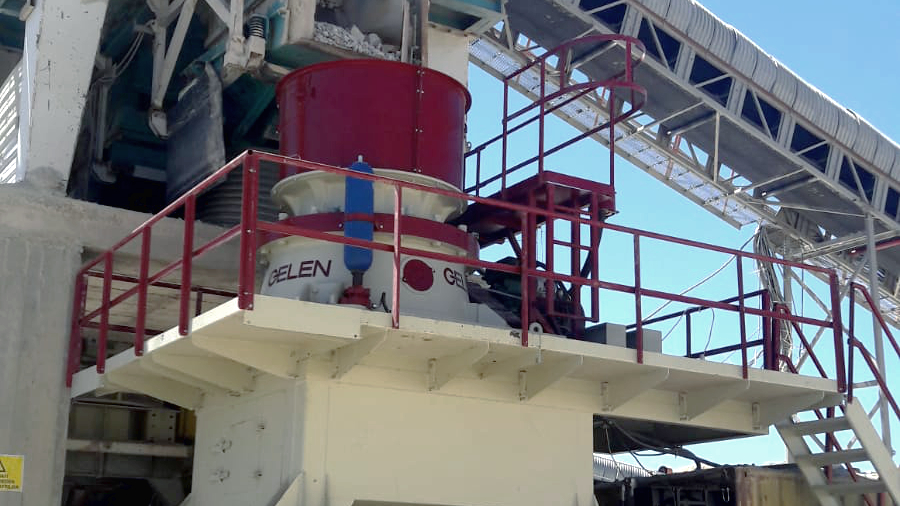
GELEN designs its GHC Series cone crushers to perform in both mobile and stationary configurations. The same robust crushing chamber, hardened manganese liners, and hydraulic CSS adjustment system are shared across the range, so you get consistent product shape and gradation regardless of how the machine is deployed.
GHC28 and GHC37: Built for Mobility
The compact GHC28 and GHC37 models are sized to fit on tracked or wheeled mobile chassis. With throughput ratings between 100 and 250 mtph, they handle secondary and tertiary crushing duties at the quarry face or on contract crushing sites. A diesel-hydraulic power pack keeps them independent of grid electricity, while the hydraulic tramp-iron release protects the chamber in unpredictable feed conditions common on mobile jobs.
GHC45 and GHC56: Stationary Powerhouses
For permanent installations demanding sustained high throughput, the GHC45 and GHC56 deliver 300 to 600+ mtph. These larger models are designed to bolt onto reinforced concrete pedestals and integrate into full crushing circuits with automated feed control, centralized lubrication, and remote monitoring. Their heavier mainframes and larger eccentric throws produce excellent reduction ratios even on hard, abrasive rock.
Common Features Across the GHC Range
- Hydraulic CSS adjustment — Change the closed-side setting without stopping the crusher, maintaining consistent product size as liners wear.
- Tramp-iron release — Hydraulic overload protection opens the chamber automatically to pass uncrushable objects, preventing catastrophic damage.
- Manganese liner system — Interchangeable mantle and concave profiles let you optimize the chamber for coarse, medium, or fine crushing.
- Heavy-duty bearings — Oversized roller bearings extend service intervals and handle shock loads from irregular feed.
Whether you are setting up a new quarry with a long-term stationary plant or expanding your mobile fleet for contract work, the GHC Series gives you a single platform that adapts to your needs. Learn more about the full lineup on our cone crushers page, or read the complete guide to cone crushers for deeper technical background.
Find the Right Cone Crusher for Your Project
Whether you need a mobile cone crusher for flexible contract work or a stationary cone crusher for a high-volume quarry, GELEN engineers can help you choose the configuration that delivers the lowest total cost of ownership.
- Side-by-side mobile vs. stationary cost analysis for your tonnage
- Custom crushing circuit design with GHC Series units
- On-site commissioning and operator training
- Genuine GELEN wear parts and aftermarket support