

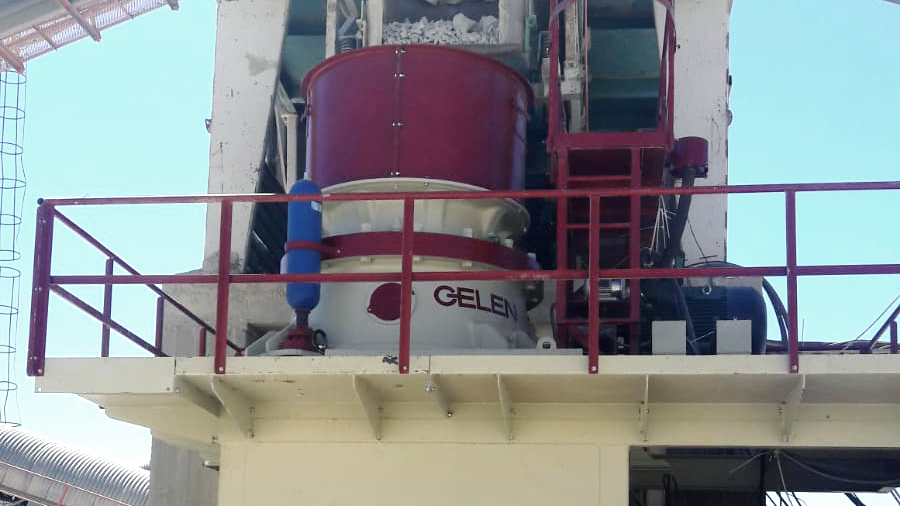
Cone Crusher in a Crushing Circuit: Design and Integration Guide
Where Does a Cone Crusher Fit?
A cone crusher occupies the secondary or tertiary stage in a multi-stage crushing circuit. In a typical aggregate or mining operation the sequence follows a well-established pattern: raw material is first reduced by a jaw crusher in the primary stage, then fed to one or more cone crushers for further size reduction, and finally screened to separate finished products from material that needs additional processing.
The standard flow in a secondary crushing plant design looks like this:
- Primary crushing - A jaw crusher reduces blasted rock from up to 1,000 mm down to roughly 150-200 mm.
- Secondary crushing - A standard-head cone crusher takes the jaw product and reduces it to approximately 25-50 mm.
- Tertiary crushing - A short-head cone crusher or VSI crusher brings the material to its final specification, typically 5-20 mm.
- Screening - Vibrating screens separate the crushed material into saleable size fractions and return oversize to the appropriate crusher.
Understanding where the cone crusher circuit sits within this flow is the first step toward a balanced, high-throughput plant. Each stage must be sized so that the downstream equipment can handle the tonnage and gradation produced upstream. Bottlenecks at any point reduce the entire plant's output.
Open Circuit vs. Closed Circuit
The choice between an open and a closed cone crusher circuit has a direct impact on product quality, throughput, and equipment wear. Both configurations have their place, and the right decision depends on the end-product specification you need to meet.
Open Circuit
In an open circuit the material passes through the cone crusher once and is not recirculated. Whatever comes out of the crusher discharge goes directly to a stockpile or the next process. This approach is simpler and costs less to build because no screen is required after the crusher. However, it produces a wider gradation with more variation in top size. Open circuits are acceptable when the product does not need to meet a tight specification, for example when producing road base or crusher run material where a broader particle size distribution is tolerable.
Closed Circuit
A closed circuit adds a cone crusher with screen arrangement where the screen deck separates on-spec material from oversize. The oversize fraction is recirculated back to the cone crusher feed for additional reduction. This loop continues until all material meets the target size. Closed circuits deliver a tighter, more consistent gradation and allow the operator to guarantee a specific top-size product. The trade-off is higher capital cost for the screen and return conveyors, as well as a higher circulating load that the crusher must handle. A typical circulating load ranges from 100% to 300% of the fresh feed tonnage, meaning the crusher actually processes significantly more material than the new feed rate alone.
For most commercial aggregate and mining operations, closed-circuit configurations are preferred because buyers demand products with guaranteed gradations. GELEN ETE Series horizontal screens and STE Series circular vibrating screens are engineered to handle the high circulating loads that closed-circuit cone crushing demands.
Sizing the Screen to Match
One of the most overlooked aspects of secondary crushing plant design is properly sizing the screen that works with the cone crusher. An undersized screen creates a bottleneck that chokes the entire circuit; an oversized screen wastes capital and plant footprint.
A practical rule of thumb is that the screen width should be 1.5 to 2 times the cone crusher discharge opening width. This ensures the screen can handle the peak instantaneous flow from the crusher, including the recirculated oversize load. Screen length is equally important: longer decks give each particle more opportunities to pass through the aperture, improving screening efficiency.
When designing a closed circuit, consider these screening factors:
- Deck area - Must be sufficient for the total feed rate including recirculated oversize, not just the fresh feed.
- Aperture size - Should match the desired product top size. Typically, the screen cut point equals the closed-side setting (CSS) of the cone crusher.
- Screen media type - Woven wire, polyurethane, or rubber panels each have different open-area percentages that affect throughput.
- Stroke and frequency - These parameters control how aggressively material is stratified and presented to the apertures.
GELEN's ETE Series horizontal screens are an excellent match for secondary and tertiary cone circuits because their linear stroke provides efficient material transport and high screening accuracy. For applications that require aggressive screening of wet or sticky material, the STE Series circular vibrating screens offer robust performance with easy media changeout.
Feed Control: Why Choke Feeding Matters
How you feed a cone crusher matters as much as how you size it. A cone crusher performs best when it is choke fed, meaning the crushing chamber is kept consistently full of material. Choke feeding delivers several measurable benefits:
- Better particle shape - When the chamber is full, inter-particle crushing occurs alongside compression against the mantle and concave. This rock-on-rock action produces more cubical particles with fewer elongated or flaky pieces.
- Reduced liner wear - A full chamber distributes crushing forces more evenly across the mantle and concave surfaces, preventing localized wear patterns that shorten liner life.
- Higher throughput - A consistently full chamber ensures the crusher operates at its rated capacity rather than cycling between loaded and unloaded conditions.
- More consistent gradation - Steady feed produces a more uniform product, reducing variation between truck loads or time intervals.
To maintain choke-fed conditions, most well-designed circuits place a surge bin (also called a feed hopper) between the primary crusher discharge and the secondary cone crusher. The surge bin acts as a buffer, absorbing the irregular feed rate from the primary stage and delivering a steady, controlled flow to the cone. A variable-speed belt feeder or vibrating feeder beneath the surge bin regulates the feed rate to match the cone crusher's capacity.
Starve feeding, the opposite of choke feeding, is one of the most common operational mistakes in a cone crusher circuit. When the crusher runs partially empty, material falls freely through the chamber without proper inter-particle compression. The result is poorer product shape, more fines than expected, uneven liner wear, and wasted energy.
Case Example: 200 tph Granite Quarry
To bring these concepts together, consider a real-world secondary crushing plant design for a granite quarry targeting 200 tonnes per hour of finished aggregate in three fractions: 0-5 mm, 5-15 mm, and 15-25 mm.
Primary Stage
A GELEN CK1075 jaw crusher receives blasted granite up to 750 mm and reduces it to a P80 of approximately 150 mm. The jaw discharge is conveyed to a surge bin with a live capacity of around 50 tonnes to buffer the intermittent truck dumping cycle.
Secondary Stage
A GELEN GHC45 cone crusher operates in closed circuit with a double-deck ETE Series screen. The cone is set to a CSS of 25 mm. The screen's top deck uses 25 mm apertures to return oversize to the cone, while the bottom deck at 15 mm separates intermediate product. Material passing both decks enters the tertiary stage.
Tertiary Stage
A GELEN GHC28 short-head cone crusher operates in closed circuit with its own single-deck screen to produce the final 0-5 mm and 5-15 mm fractions. The GHC28 runs at a tighter CSS of 8 mm, and the screen returns any +15 mm oversize back to the tertiary cone.
In this configuration the total circulating load across both closed circuits is approximately 150% of the fresh feed. The surge bin and belt feeders ensure both cones stay choke fed throughout the shift, maintaining consistent product shape and gradation. This layout reliably produces specification-grade aggregate from hard granite at the target 200 tph rate.
Common Circuit Design Mistakes
Even experienced plant designers can fall into these traps when laying out a cone crusher circuit. Avoiding them from the outset saves significant cost and downtime:
- Undersized screens - This is the single most common error. When the screen cannot keep up with the crusher, the circulating load spirals upward, the cone overloads, and product quality drops. Always size the screen for the total circuit throughput, including recirculated oversize, not just the fresh feed rate.
- Starve feeding the cone - Running the crusher at 50-60% of capacity to "go easy on it" actually increases wear, produces poor shape, and wastes energy. If the feed rate needs to be lower than the crusher's rating, consider a smaller model instead.
- Wrong chamber selection - Cone crushers are offered with different mantle and concave profiles: standard, medium, and short-head. Using a standard head where a short-head is needed, or vice versa, results in poor reduction efficiency and premature wear. Match the chamber to the feed size and the target product.
- Bypassing the screen - Some operators temporarily bypass the screen to increase "output." This converts a closed circuit into an open one, immediately widening the gradation and allowing oversize material into the product stockpile. It also removes the choke-feed effect, degrading particle shape.
- Ignoring the surge bin - Without a buffer between the primary and secondary stage, the cone crusher receives an irregular feed that alternates between surges and starvation. A properly sized surge bin is one of the cheapest and most effective investments in circuit stability.
- Neglecting conveyor transitions - Transfer points between conveyors and equipment are where spillage, dust, and blockages occur. Proper chute design, skirting, and dust suppression at each transfer point keep the circuit running reliably.
GELEN Crushing Plant Solutions
GELEN offers a complete range of equipment to build a balanced, high-performance cone crusher circuit from primary stage through final screening:
- GHC Series Cone Crushers - Available in standard and short-head configurations for secondary and tertiary applications, with capacities from 50 to 600+ tph.
- CK Series Jaw Crushers - Robust primary crushers sized to feed any downstream cone circuit.
- ETE Series Horizontal Screens - Precision screening for closed-circuit cone crushing with high capacity and accurate separation.
- STE Series Circular Vibrating Screens - Heavy-duty screening for demanding circuit applications with easy maintenance.
Whether you are designing a new secondary crushing plant from scratch or upgrading an existing circuit, our engineering team can help you select and size every component for optimal performance. Read more about cone crusher fundamentals in our Complete Guide to Cone Crushers.